HEVEFARM Group, Center for the Study of Liver and Gastrointestinal Diseases (CIBERehd), Carlos III National Institute of Health. University of Salamanca, IBSAL, 37007-Salamanca, Spain.
Cells. 2020 Feb 21;9(2):498. doi: 10.3390/cells9020498.
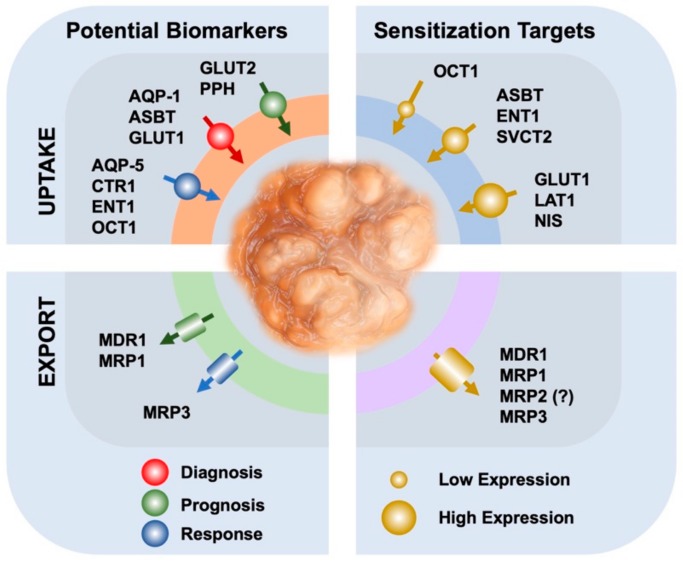
The dismal prognosis of patients with advanced cholangiocarcinoma (CCA) is due, in part, to the extreme resistance of this type of liver cancer to available chemotherapeutic agents. Among the complex mechanisms accounting for CCA chemoresistance are those involving the impairment of drug uptake, which mainly occurs through transporters of the superfamily of solute carrier (SLC) proteins, and the active export of drugs from cancer cells, mainly through members of families B, C and G of ATP-binding cassette (ABC) proteins. Both mechanisms result in decreased amounts of active drugs able to reach their intracellular targets. Therefore, the "cancer transportome", defined as the set of transporters expressed at a given moment in the tumor, is an essential element for defining the multidrug resistance (MDR) phenotype of cancer cells. For this reason, during the last two decades, plasma membrane transporters have been envisaged as targets for the development of strategies aimed at sensitizing cancer cells to chemotherapy, either by increasing the uptake or reducing the export of antitumor agents by modulating the expression/function of SLC and ABC proteins, respectively. Moreover, since some elements of the transportome are differentially expressed in CCA, their usefulness as biomarkers with diagnostic and prognostic purposes in CCA patients has been evaluated.
晚期胆管癌(CCA)患者的预后不佳,部分原因是这种类型的肝癌对现有化疗药物具有极强的耐药性。在导致 CCA 化疗耐药的复杂机制中,涉及药物摄取受损的机制,主要通过溶质载体(SLC)蛋白超家族的转运体发生,以及癌细胞主动将药物排出,主要通过 ABC 蛋白家族 B、C 和 G 的成员发生。这两种机制都会导致能够到达其细胞内靶点的有效药物数量减少。因此,“癌症转运组”(定义为肿瘤中特定时刻表达的转运体集合)是定义癌细胞多药耐药(MDR)表型的重要因素。出于这个原因,在过去的二十年中,人们一直设想将质膜转运体作为开发旨在通过调节 SLC 和 ABC 蛋白的表达/功能分别增加摄取或减少抗肿瘤药物的外排来使癌细胞对化疗敏感的策略的靶点。此外,由于转运组的一些元素在 CCA 中差异表达,因此评估了它们作为 CCA 患者诊断和预后目的的生物标志物的有用性。