Three Gorges Research Center for Geo-hazard, Ministry of Education, China University of Geosciences, Wuhan 430074, China.
School of Earth Sciences, China University of Geosciences, Wuhan 430074, China.
Sensors (Basel). 2020 Feb 21;20(4):1197. doi: 10.3390/s20041197.
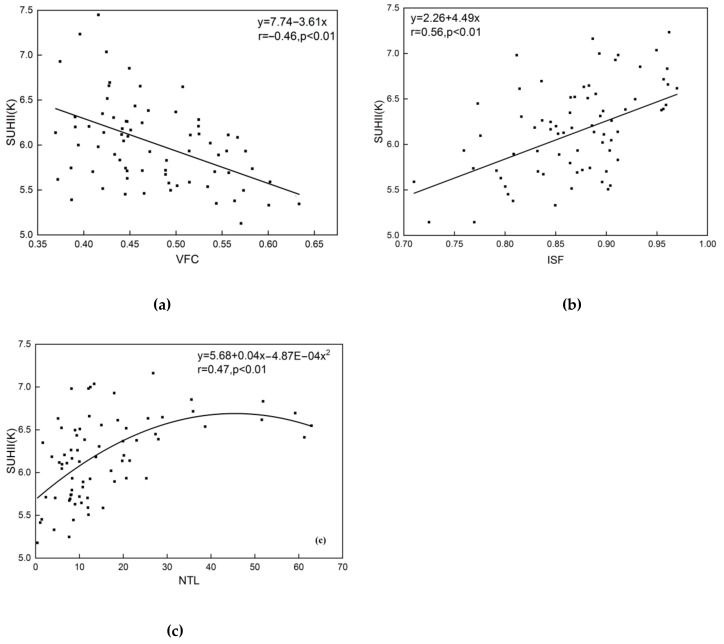
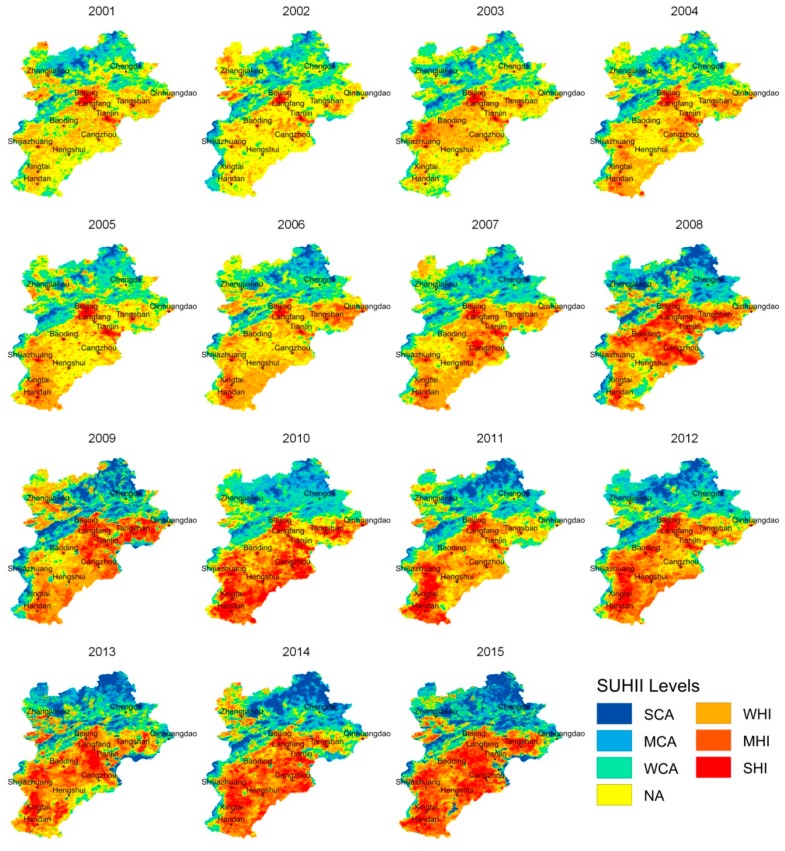
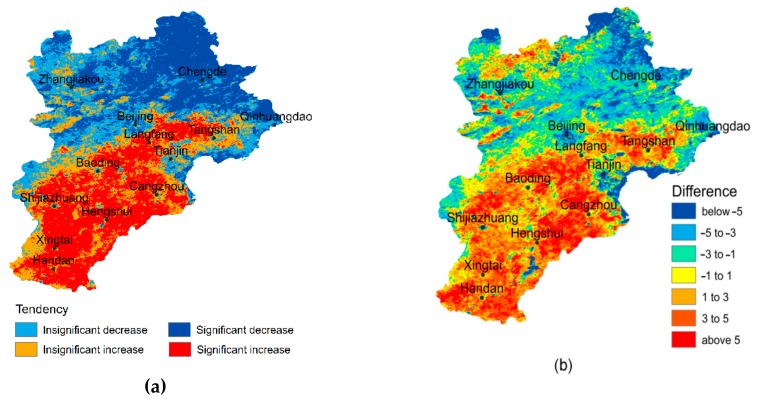
Many studies have revealed the characteristics and spatial-temporal dynamics of the thermal environment in specific cities or urban agglomerations (UA), as well as the associated determining factors. However, few studies focus on the changing relationships (the difference, distance, interaction, etc.) among inner cities' heat islands in a UA, which represent not only the detailed dynamics of regional thermal environment (RTE), but also the changing competition and cooperation among cities in a developing UA. In this study, we used Moderate Resolution Imaging Spectroradiometer (MODIS) land surface temperature (LST) products to map and analyze the detailed dynamics of the Beijing-Tianjin-Hebei (BTH) UA thermal environment. From 2001 to 2015, the mean surface urban heat island intensity (SUHII) of the BTH increased significantly, and the surface urban heat islands (SUHIs) in the southern BTH have rapidly increased, expanded and connected, eventually forming a large heat islands agglomeration. According to correlation analysis, urban sprawl probably led to the expansion and enhance of SUHIs in the south plain, while the forest has significantly alleviated urban heat island effect in northern mountains. The results expose the detailed evolution process of BTH thermal environment, and the changing relationships among the inner cities. In a developing UA, mitigation solutions (e.g., ecological corridors or controlling energy consumption) are in demand to stop the formation of a great heat region.
许多研究揭示了特定城市或城市群(UA)热环境的特征和时空动态,以及相关的决定因素。然而,很少有研究关注 UA 内城市热岛之间不断变化的关系(差异、距离、相互作用等),这些关系不仅代表了区域热环境(RTE)的详细动态,还代表了发展中的 UA 中城市之间竞争与合作的变化。在这项研究中,我们使用中分辨率成像光谱仪(MODIS)陆地表面温度(LST)产品来绘制和分析京津冀(BTH)UA 热环境的详细动态。从 2001 年到 2015 年,BTH 的平均地表城市热岛强度(SUHII)显著增加,BTH 南部的地表城市热岛(SUHIs)迅速增加、扩大和连接,最终形成了一个大的热岛聚集区。根据相关分析,城市扩张可能导致南部平原的 SUHIs 扩张和增强,而森林则显著缓解了北部山区的城市热岛效应。研究结果揭示了 BTH 热环境的详细演变过程以及城市内部的变化关系。在一个发展中的 UA 中,需要采取缓解措施(例如,生态走廊或控制能源消耗)来阻止一个大的热区的形成。