Perez Barbara A, Shutterly Alison, Chan Ying Kai, Byrne Barry J, Corti Manuela
Department of Pediatrics and Powell Gene Therapy Center, University of Florida, Gainesville, FL 32610, USA.
Molecular Genetics and Microbiology, University of Florida, Gainesville, FL 32610, USA.
Brain Sci. 2020 Feb 22;10(2):119. doi: 10.3390/brainsci10020119.
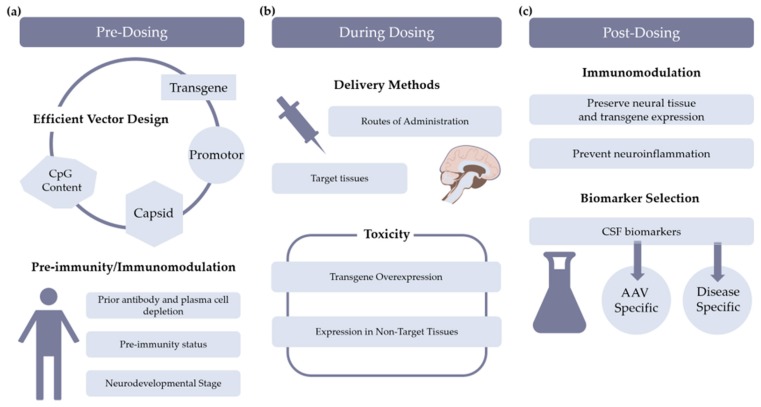
Recently, adeno-associated virus (AAV)-mediated gene therapies have attracted clinical interest for treating neurodegenerative diseases including spinal muscular atrophy (SMA), Canavan disease (CD), Parkinson's disease (PD), and Friedreich's ataxia (FA). The influx of clinical findings led to the first approved gene therapy for neurodegenerative disorders in 2019 and highlighted new safety concerns for patients. Large doses of systemically administered AAV stimulate host immune responses, resulting in anti-capsid and anti-transgene immunity with implications for transgene expression, treatment longevity, and patient safety. Delivering lower doses directly to the central nervous system (CNS) is a promising alternative, resulting in higher transgene expression with decreased immune responses. However, neuroinflammatory responses after CNS-targeted delivery of AAV are a critical concern. Reported signs of AAV-associated neuroinflammation in preclinical studies include dorsal root ganglion (DRG) and spinal cord pathology with mononuclear cell infiltration. In this review, we discuss ways to manage neuroinflammation, including choice of AAV capsid serotypes, CNS-targeting routes of delivery, genetic modifications to the vector and/or transgene, and adding immunosuppressive strategies to clinical protocols. As additional gene therapies for neurodegenerative diseases enter clinics, tracking biomarkers of neuroinflammation will be important for understanding the impact immune reactions can have on treatment safety and efficacy.
最近,腺相关病毒(AAV)介导的基因疗法已引起临床关注,用于治疗包括脊髓性肌萎缩症(SMA)、卡纳万病(CD)、帕金森病(PD)和弗里德赖希共济失调(FA)在内的神经退行性疾病。临床研究结果的大量涌现促成了2019年首个获批的神经退行性疾病基因疗法,并凸显了患者面临的新安全问题。大剂量全身给药的AAV会刺激宿主免疫反应,导致抗衣壳和抗转基因免疫,这对转基因表达、治疗持久性和患者安全都有影响。直接向中枢神经系统(CNS)递送较低剂量是一种有前景的替代方法,可实现更高的转基因表达且免疫反应降低。然而,CNS靶向递送AAV后的神经炎症反应是一个关键问题。临床前研究中报道的与AAV相关的神经炎症迹象包括背根神经节(DRG)和脊髓病理改变以及单核细胞浸润。在本综述中,我们讨论了管理神经炎症的方法,包括AAV衣壳血清型的选择、CNS靶向递送途径、载体和/或转基因的基因改造,以及在临床方案中添加免疫抑制策略。随着更多用于神经退行性疾病的基因疗法进入临床,追踪神经炎症的生物标志物对于了解免疫反应对治疗安全性和疗效的影响将至关重要。