Yin Ling, He Hongliang, Zhang Hongliang, Shang Yuhua, Fu Chengbo, Wu Songquan, Jin Tengchuan
Center of Disease Immunity and Intervention, College of Medicine, Lishui University, Lishui, China.
College of Medicine, University of Florida, Gainesville, Florida, USA.
J Med Virol. 2025 Jun;97(6):e70447. doi: 10.1002/jmv.70447.
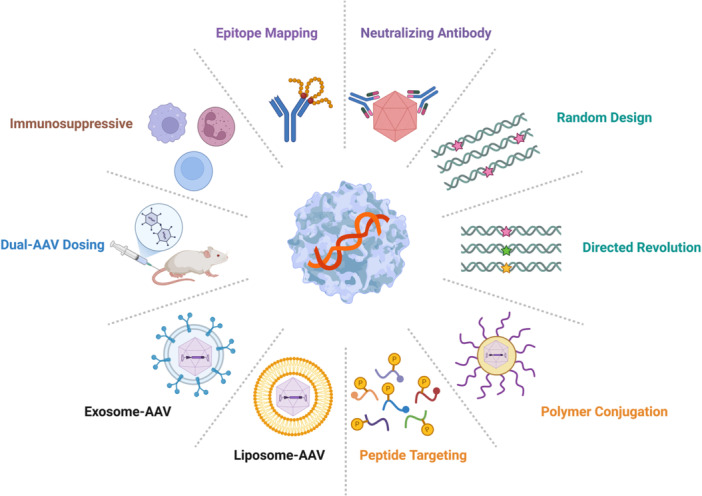
Adeno-associated virus (AAV) is a non-enveloped DNA virus infecting a wide variety of species, tissues, and cell types, which is recognized as a safe and effective method for delivering therapeutic transgenes. AAV vector is the most popular viral gene delivery system in clinical delivery systems with unique and multiple advantages, such as tissue tropism, transduction specificity, long-lasting gene expression, low immune responses, and without host chromosome incorporation. Till now, four AAV-based gene therapy drugs have already been approved by the US Food and Drug Administration (FDA) or European Medicines Agency (EMA). Despite the success of AAV vectors, there are still some remaining challenges that limit further usage, such as poor packaging capacity, low organ specificity, pre-existing humoral immunity, and vector dose-dependent toxicity. In the present review, we address the different approaches to optimize AAV vector delivery system with a focus on capsid engineering, packaging capacity, and immune response at the clinical level. The review further investigates the potential of manipulating AAV vectors in preclinical applications and clinical translation, which emphasizes the challenges and prospects in viral vector selection, drug delivery strategies, immune reactions in cancer, neurodegenerative disease, retinal disease, SARS-CoV-2, and monkeypox. Finally, it forecasts future directions and potential challenges of artificial intelligence (AI), vaccines, and nanobodies, which emphasizes the need for ethical and secure approaches in AAV application.
腺相关病毒(AAV)是一种无包膜的DNA病毒,可感染多种物种、组织和细胞类型,被认为是一种安全有效的治疗性转基因递送方法。AAV载体是临床递送系统中最受欢迎的病毒基因递送系统,具有独特的多重优势,如组织嗜性、转导特异性、持久的基因表达、低免疫反应以及不整合到宿主染色体中。到目前为止,已有四种基于AAV的基因治疗药物获得美国食品药品监督管理局(FDA)或欧洲药品管理局(EMA)的批准。尽管AAV载体取得了成功,但仍存在一些限制其进一步应用的挑战,如包装能力差、器官特异性低、预先存在的体液免疫以及载体剂量依赖性毒性。在本综述中,我们探讨了优化AAV载体递送系统的不同方法,重点关注衣壳工程、包装能力以及临床层面的免疫反应。该综述进一步研究了在临床前应用和临床转化中操纵AAV载体的潜力,强调了在病毒载体选择、药物递送策略、癌症、神经退行性疾病、视网膜疾病、SARS-CoV-2和猴痘中的免疫反应方面的挑战和前景。最后,它预测了人工智能(AI)、疫苗和纳米抗体的未来方向和潜在挑战,强调了在AAV应用中采用符合伦理和安全的方法的必要性。