Kim Bokun, Kim Seungyeol
Faculty of Sports Health Care, Inje University, Gimhae, Gyeongsangnamdo, Republic of Korea.
College of Arts and Sports, Dong-A University, Busan, Republic of Korea.
Diabetes Metab Syndr Obes. 2020 Feb 4;13:267-276. doi: 10.2147/DMSO.S231981. eCollection 2020.
The purpose of this study was to comparatively investigate changes in physiological and physical fitness in previously inactive men with obesity in response to aerobic exercise (AE) or resistance exercise (RE).
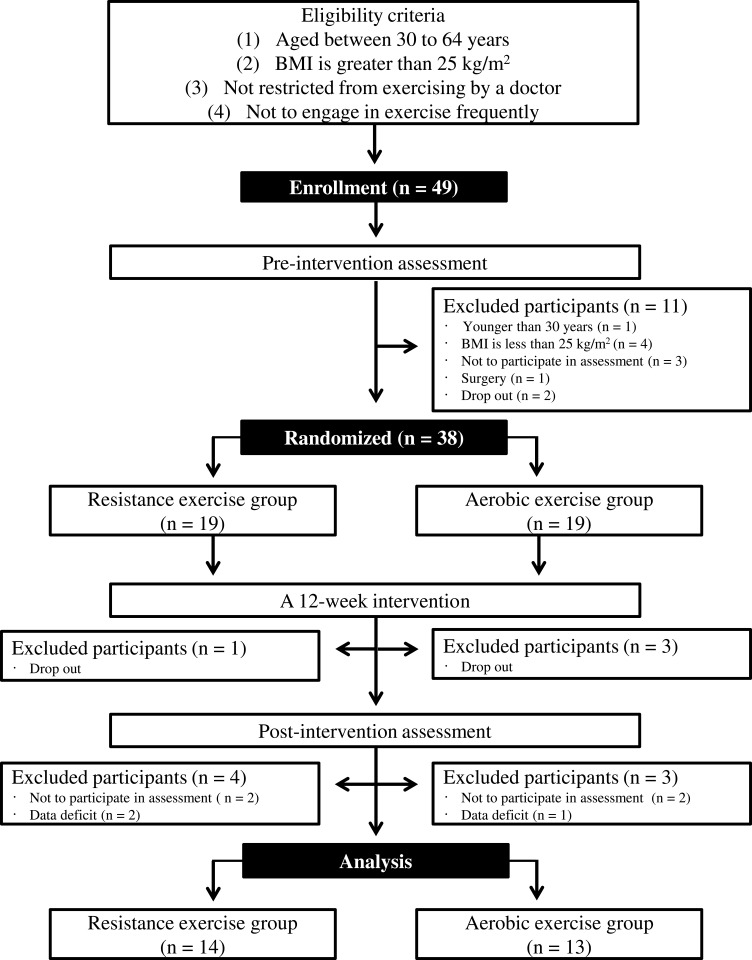
A total of 27 inactive men with obesity, aged 34-60 years, attended a 90-min AE or RE program 3 days/week for 12 weeks. The subjects underwent assessments of energy intake (by a 3-day weighted dietary record), body weight (by a digital scale), body composition (by whole-body dual-energy X-ray absorptiometry), VO (by a cycling ergometer), muscle strength (by a Biodex System 3 dynamometer) and blood analysis.
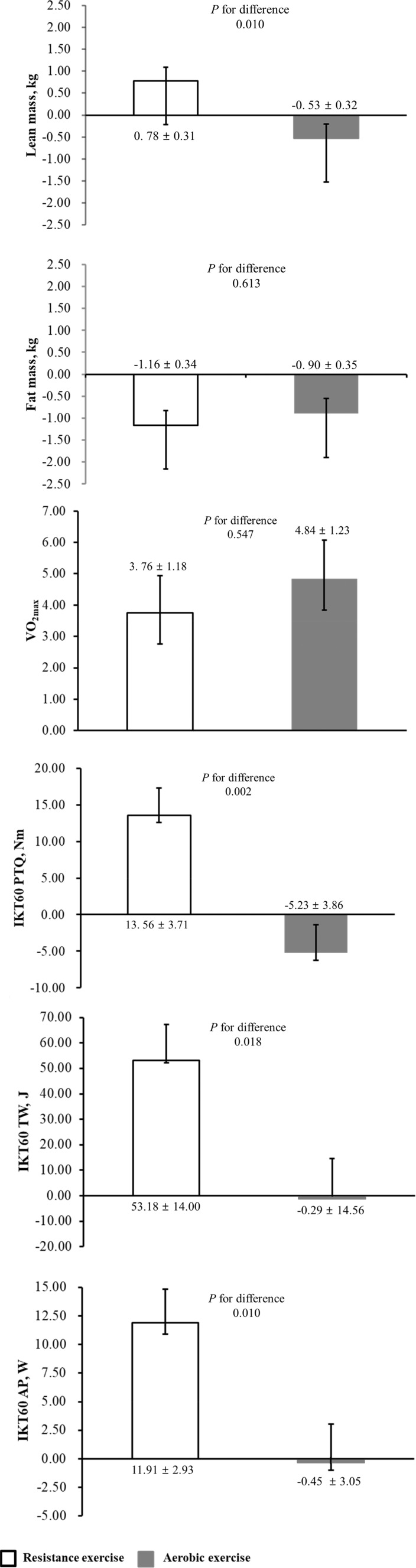
There were no significant interactions ( = 0.1000.730) among energy intake variables. RE led to decreased fat mass (-4.39%, < 0.05) and improved cardiorespiratory capacity (+11.66%, < 0.05), as well as increases in lean mass (+2.12%, < 0.01) and muscle strength variables (+8.41+11.00%, < 0.01 for all), without significant weight change. Although AE induced decreases in fat mass (-5.91%, < 0.05) and weight (-2.28%, < 0.05) and improved cardiorespiratory capacity (+19.07%, < 0.01), lean mass and muscle strength variables remained unchanged. RE showed a stronger positive influence than AE on lean mass ( = 0.003) and muscle strength variables ( = 0.001~0.015), and RE and AE had similar influences on weight, fat mass, cardiorespiratory capacity and blood markers.
It may be an efficient exercise regimen to perform RE first and then utilize AE to maintain the changes that occur in response to RE.
本研究旨在比较调查先前不运动的肥胖男性在进行有氧运动(AE)或抗阻运动(RE)后生理和体能的变化。
共有27名年龄在34至60岁之间的不运动肥胖男性,每周3天参加为期12周、每次90分钟的AE或RE项目。受试者接受了能量摄入(通过3天加权饮食记录)、体重(通过数字秤)、身体成分(通过全身双能X线吸收法)、摄氧量(通过自行车测力计)、肌肉力量(通过Biodex System 3测力计)和血液分析评估。
能量摄入变量之间无显著交互作用(P = 0.1000.730)。RE导致脂肪量减少(-4.39%,P < 0.05),心肺功能改善(+11.66%,P < 0.05),瘦体重增加(+2.12%,P < 0.01),肌肉力量变量增加(+8.41+11.00%,均P < 0.01),体重无显著变化。虽然AE导致脂肪量减少(-5.91%,P < 0.05)和体重减轻(-2.28%,P < 0.05),心肺功能改善(+19.07%,P < 0.01),但瘦体重和肌肉力量变量保持不变。RE对瘦体重(P = 0.003)和肌肉力量变量(P = 0.001~0.015)的积极影响比AE更强,RE和AE对体重、脂肪量、心肺功能和血液指标的影响相似。
先进行RE然后利用AE来维持因RE而发生的变化可能是一种有效的运动方案。