Kim Bokun, Tsujimoto Takehiko, So Rina, Zhao Xiaoguang, Oh Sechang, Tanaka Kiyoji
Faculty of Sports Health Care, Inje University, Gyeongsangnamdo, Republic of Korea.
Faculty of Health and Sport Sciences, University of Tsukuba, Ibaraki.
Diabetes Metab Syndr Obes. 2017 May 9;10:187-194. doi: 10.2147/DMSO.S132707. eCollection 2017.
The benefits of weight reduction for musculoskeletal disorders are well understood. Steep declines in muscle mass following considerable weight reduction can decrease muscle strength and, consequently, physical performance. However, only a limited number of studies have examined the changes in muscle mass and strength in the context of interventional weight reduction programs. Thus, we investigated the influence of muscle mass decrease caused by diet-induced weight reduction on muscle strength in obese men.
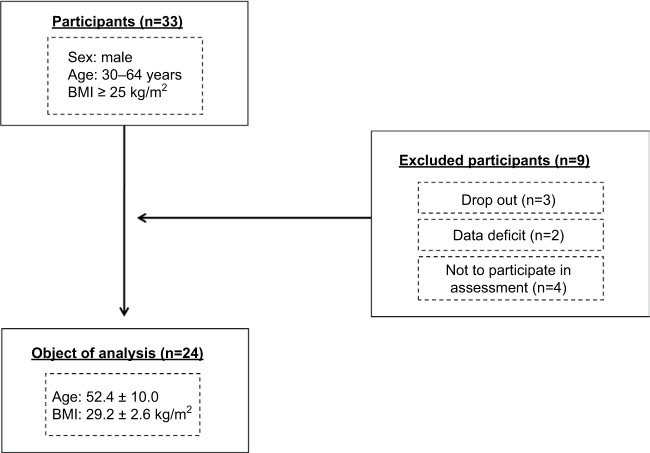
A total of 24 men with obesity (body mass index [BMI]: 29.2 ± 2.6 kg/m; age: 52.4 ± 10.0 years) attended a 12-week weight reduction program that implemented dietary restrictions. Each participant underwent assessments of body weight (by a digital scale), body composition (by whole-body dual-energy X-ray absorptiometry [DEXA]), and upper and lower extremity muscle strength (by a hand-held dynamometer and a Biodex System 3 dynamometer, respectively) before and after the program.
The program led to significant reductions of 10.5% of weight and 6.1% of lower extremity muscle mass. Similarly, lower extremity muscle strength (measured using a Biodex System 3 dynamometer) was significantly decreased (isometric 60° peak torque decreased by 10% and isokinetic 60°/s peak torque decreased by 9.4%); however, the level of body weight-normalized lower extremity muscle strength did not significantly change (increased by +1.2% and +1.4%). The decrease in muscle strength was related to but did not entirely depend on decrease in muscle mass. Although handgrip strength did not significantly differ (-2.2%), the weight-normalized level of this parameter significantly improved (+9.1%). In addition, decrease in the percentage of whole-body fat mass and increase in the percentage of muscle mass index were observed.
We recommend performing exercise after diet-induced weight reduction to regain muscle mass and strength and improve body weight-normalized lower extremity muscle strength.
减轻体重对肌肉骨骼疾病的益处已广为人知。大幅减重后肌肉量急剧下降会降低肌肉力量,进而影响身体机能。然而,仅有少数研究在干预性减重计划的背景下考察了肌肉量和力量的变化。因此,我们研究了饮食诱导减重导致的肌肉量减少对肥胖男性肌肉力量的影响。
共有24名肥胖男性(体重指数[BMI]:29.2±2.6kg/m²;年龄:52.4±10.0岁)参加了一项为期12周的实施饮食限制的减重计划。每位参与者在计划前后均接受了体重(使用数字秤)、身体成分(使用全身双能X线吸收法[DEXA])以及上肢和下肢肌肉力量(分别使用手持测力计和Biodex System 3测力计)的评估。
该计划导致体重显著下降10.5%,下肢肌肉量下降6.1%。同样,下肢肌肉力量(使用Biodex System 3测力计测量)显著降低(等长60°峰值扭矩下降10%,等速60°/秒峰值扭矩下降9.4%);然而,体重标准化的下肢肌肉力量水平并未显著变化(分别增加1.2%和1.4%)。肌肉力量的下降与肌肉量的减少有关,但并不完全取决于肌肉量的减少。尽管握力没有显著差异(下降2.2%),但该参数的体重标准化水平显著提高(增加9.1%)。此外,还观察到全身脂肪量百分比下降,肌肉量指数百分比增加。
我们建议在饮食诱导减重后进行运动,以恢复肌肉量和力量,并改善体重标准化的下肢肌肉力量。