Yin Dongmei, Ji Changmian, Song Qingxin, Zhang Wanke, Zhang Xingguo, Zhao Kunkun, Chen Charles Y, Wang Chuantang, He Guohao, Liang Zhe, Ma Xingli, Li Zhongfeng, Tang Yueyi, Wang Yuejun, Li Ke, Ning Longlong, Zhang Hui, Zhao Kai, Li Xuming, Yu Haiyan, Lei Yan, Wang Mingcheng, Ma Liming, Zheng Hongkun, Zhang Yijing, Zhang Jinsong, Hu Wei, Chen Z Jeffrey
College of Agronomy Henan Agricultural University Zhengzhou 450002 China.
Biomarker Technologies Corporation Beijing 101300 China.
Adv Sci (Weinh). 2019 Nov 28;7(4):1901672. doi: 10.1002/advs.201901672. eCollection 2020 Feb.
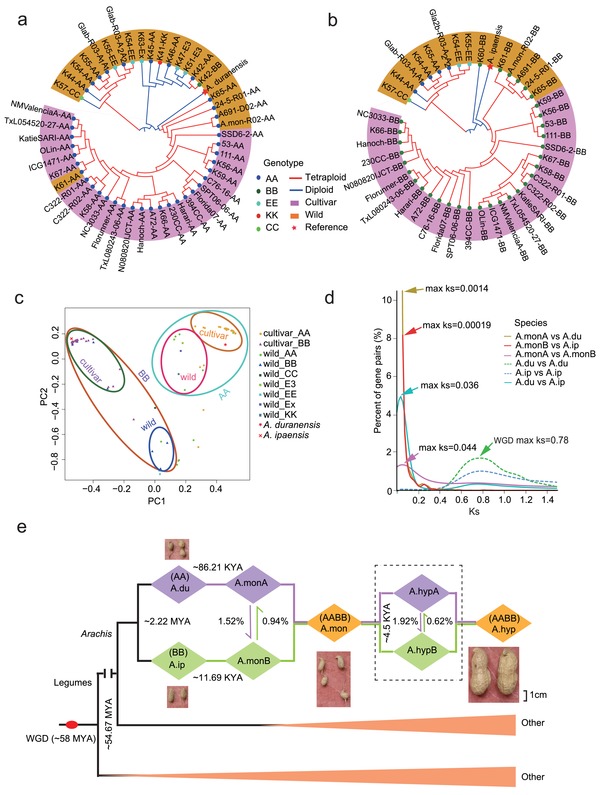
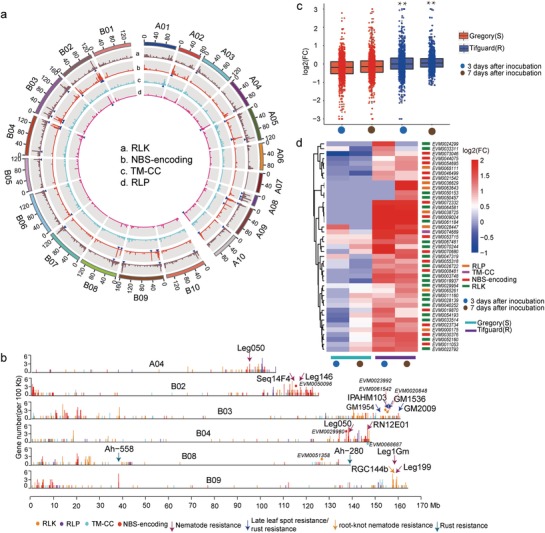
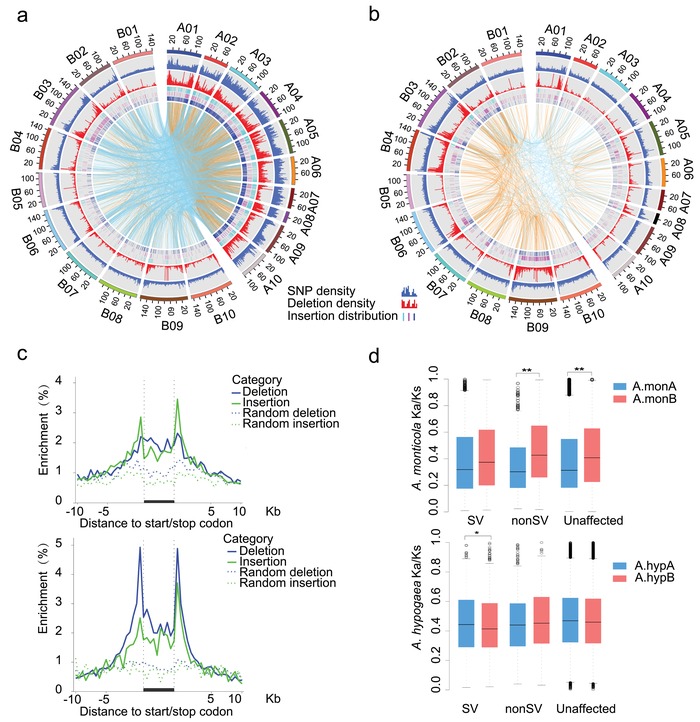
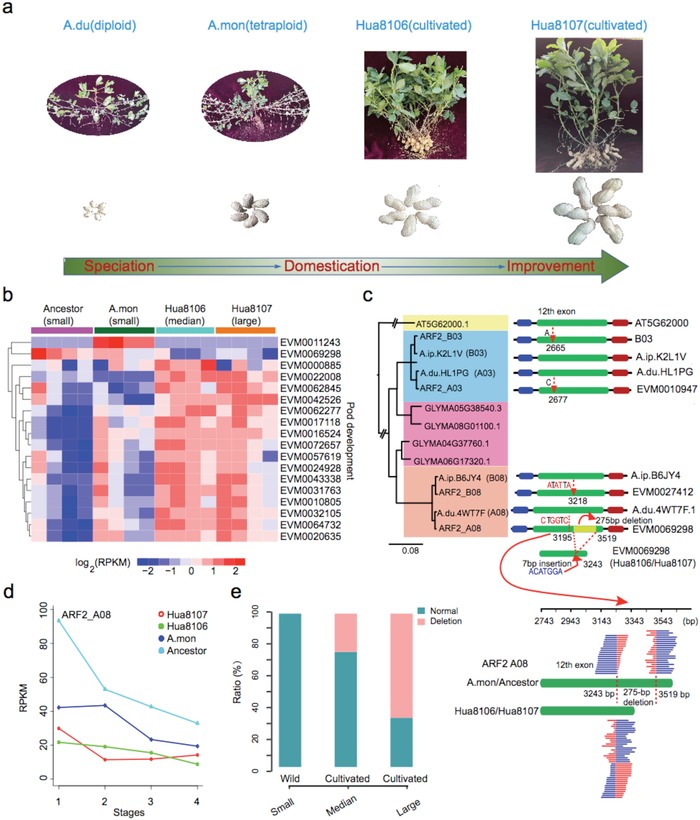
Like many important crops, peanut is a polyploid that underwent polyploidization, evolution, and domestication. The wild allotetraploid peanut species () is an important and unique link from the wild diploid species to cultivated tetraploid species in the lineage. However, little is known about and its role in the evolution and domestication of this important crop. A fully annotated sequence of ≈2.6 Gb genome and comparative genomics of the species is reported. Genomic reconstruction of 17 wild diploids from AA, BB, EE, KK, and CC groups and 30 tetraploids demonstrates a monophyletic origin of A and B subgenomes in allotetraploid peanuts. The wild and cultivated tetraploids undergo asymmetric subgenome evolution, including homoeologous exchanges, homoeolog expression bias, and structural variation (SV), leading to subgenome functional divergence during peanut domestication. Significantly, SV-associated homoeologs tend to show expression bias and correlation with pod size increase from diploids to wild and cultivated tetraploids. Moreover, genomic analysis of disease resistance genes shows the unique alleles present in the wild peanut can be introduced into breeding programs to improve some resistance traits in the cultivated peanuts. These genomic resources are valuable for studying polyploid genome evolution, domestication, and improvement of peanut production and resistance.
与许多重要作物一样,花生是一种经历了多倍体化、进化和驯化的多倍体。野生异源四倍体花生物种()是野生二倍体物种与该谱系中栽培四倍体物种之间重要且独特的联系。然而,关于及其在这种重要作物的进化和驯化中的作用却知之甚少。本文报道了约2.6 Gb基因组的完整注释序列以及该物种的比较基因组学。对来自AA、BB、EE、KK和CC组的17个野生二倍体和30个四倍体进行基因组重建,结果表明异源四倍体花生中A和B亚基因组具有单系起源。野生和栽培四倍体经历了不对称的亚基因组进化,包括同源交换、同源基因表达偏向和结构变异(SV),导致花生驯化过程中亚基因组功能分化。值得注意的是,与SV相关的同源基因往往表现出表达偏向,并且与从二倍体到野生和栽培四倍体的荚果大小增加相关。此外,抗病基因的基因组分析表明,野生花生中存在的独特等位基因可引入育种计划,以改善栽培花生的一些抗性性状。这些基因组资源对于研究多倍体基因组进化、驯化以及提高花生产量和抗性具有重要价值。