Campbell Rebecca K, Tamayo-Ortiz Marcela, Cantoral Alejandra, Schnaas Lourdes, Osorio-Valencia Erika, Wright Rosalind J, Téllez-Rojo Martha M, Wright Robert O
Department of Pediatrics, Kravis Children's Hospital, Icahn School of Medicine at Mount Sinai, New York, NY, USA.
Department of Environmental Medicine and Public Health, Icahn School of Medicine at Mount Sinai, New York, NY, USA.
Curr Dev Nutr. 2020 Feb 6;4(2):nzaa018. doi: 10.1093/cdn/nzaa018. eCollection 2020 Feb.
Iron accrued in utero is critical for fetal and infant neurocognitive development. Psychosocial stress and obesity can each suppress fetal iron accrual. Their combined effects and differences by fetal sex are not known. In an observational pregnancy cohort study in Mexico City, we investigated associations of maternal prenatal life stressors, psychological dysfunction, and prepregnancy BMI with fetal iron status at delivery.
We hypothesized that greater maternal prenatal psychosocial stress and prepregnancy overweight and obesity are associated with lower cord blood ferritin and hemoglobin (Hb), with stronger associations in boys than girls.
Psychosocial stress in multiple domains of life stress (negative life events, perceived stress, exposure to violence) and psychological dysfunction symptoms (depression, generalized anxiety, and pregnancy-specific anxiety) were assessed with validated questionnaires during pregnancy. Prepregnancy BMI was predicted with a validated equation and categorized as normal/overweight/obese. Cord blood ferritin and Hb associations with prenatal psychosocial stress and BMI were modeled in multivariable linear regressions adjusted for maternal age, socioeconomic status, child sex, and prenatal iron supplementation. Interactions with child sex and 3-way stress-overweight/obesity-sex interactions were tested with product terms and likelihood ratio tests.
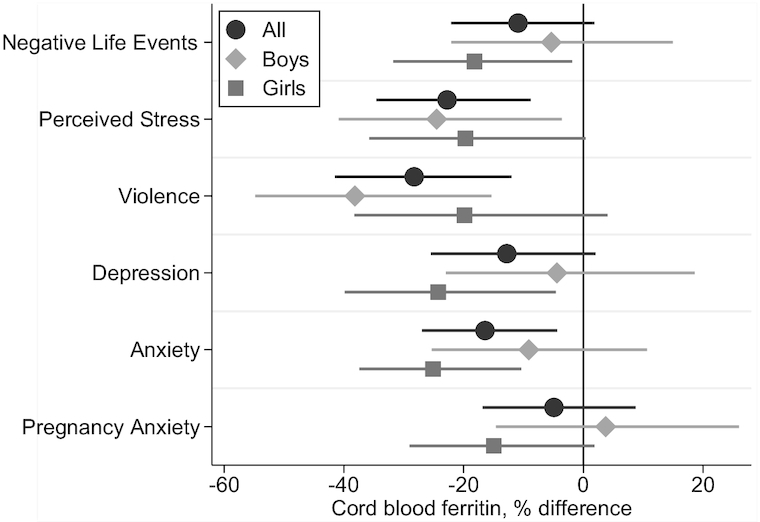
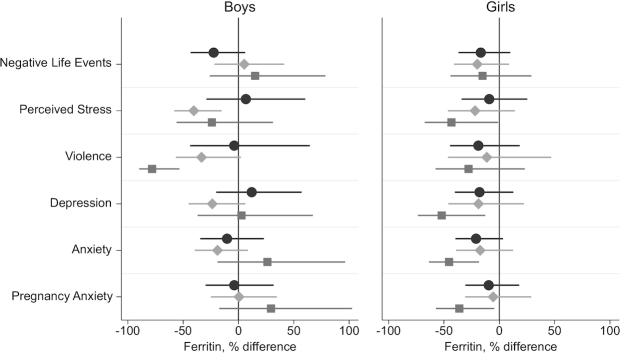
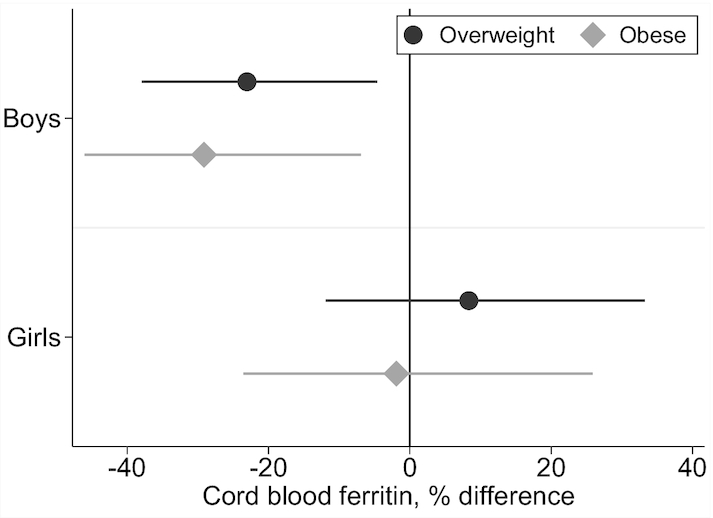
In 493 dyads, median (IQR) cord blood ferritin and Hb concentrations were 185 µg/L (126-263 g/dL) and 16 g/dL (14.7-17.1 g/dL), respectively. Ferritin was lower in infants of mothers with higher prenatal perceived stress (-23%; 95% CI: -35%, -9%), violence exposure (-28%; 95% CI: -42%, -12%), anxiety symptoms (-16%; 95% CI: -27%, -4%), and obesity (-17%; 95% CI: -31%, 0.2%). Interaction models suggested sex differences and synergism between maternal stress and overweight/obesity. No associations were observed between stress or BMI and Hb.
Multiple prenatal psychosocial stressors and excess prepregnancy BMI were each inversely associated with fetal iron status at birth. Pregnancies and infants at elevated risk of impaired fetal iron accrual may be identifiable according to observed synergism between maternal stress and obesity and differential associations with fetal iron status by infant sex.
子宫内积累的铁对胎儿和婴儿的神经认知发育至关重要。心理社会压力和肥胖均可抑制胎儿铁的积累。它们的联合作用以及胎儿性别的差异尚不清楚。在墨西哥城的一项观察性妊娠队列研究中,我们调查了母亲产前生活应激源、心理功能障碍和孕前体重指数与分娩时胎儿铁状态之间的关联。
我们假设母亲产前心理社会压力越大以及孕前超重和肥胖与脐血铁蛋白和血红蛋白(Hb)水平越低相关,且男孩的关联比女孩更强。
在孕期使用经过验证的问卷评估生活压力多个领域的心理社会压力(负面生活事件、感知压力、暴力暴露)和心理功能障碍症状(抑郁、广泛性焦虑和孕期特异性焦虑)。使用经过验证的方程预测孕前体重指数,并将其分类为正常/超重/肥胖。在对母亲年龄、社会经济地位、孩子性别和产前铁补充进行调整的多变量线性回归中,对脐血铁蛋白和Hb与产前心理社会压力和体重指数的关联进行建模。通过乘积项和似然比检验测试与孩子性别的相互作用以及压力 - 超重/肥胖 - 性别三元相互作用。
在493对母婴中,脐血铁蛋白和Hb浓度的中位数(IQR)分别为185μg/L(126 - 263g/dL)和16g/dL(14.7 - 17.1g/dL)。母亲产前感知压力较高(-23%;95%CI:-35%,-9%)、暴力暴露(-28%;95%CI:-42%,-12%)、焦虑症状(-16%;95%CI:-27%,-4%)和肥胖(-17%;95%CI:-31%,0.2%)的婴儿铁蛋白水平较低。相互作用模型表明母亲压力与超重/肥胖之间存在性别差异和协同作用。未观察到压力或体重指数与Hb之间的关联。
多种产前心理社会压力源和孕前超重均与出生时胎儿铁状态呈负相关。根据母亲压力与肥胖之间观察到的协同作用以及婴儿性别与胎儿铁状态的不同关联,可能识别出胎儿铁积累受损风险较高的妊娠和婴儿。