School of Electrical and Computer Engineering, Ben-Gurion University of the Negev, Beer-Sheva 8410501, Israel.
Sensors (Basel). 2020 Feb 24;20(4):1229. doi: 10.3390/s20041229.
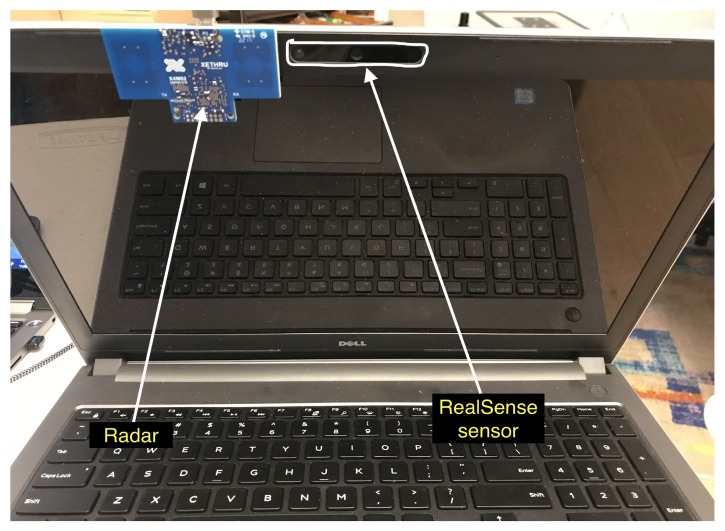
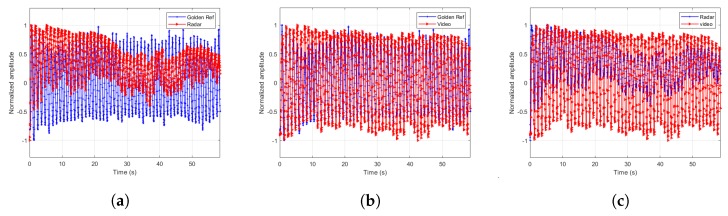
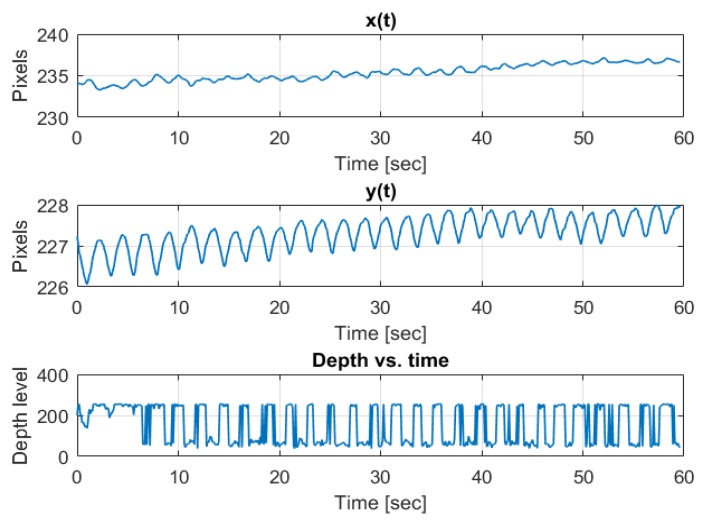
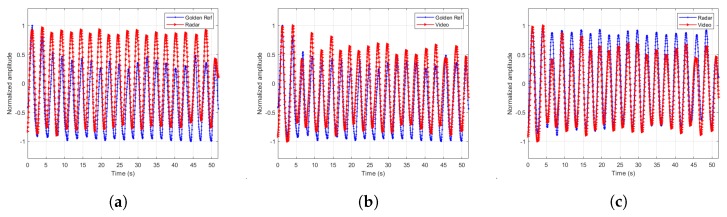
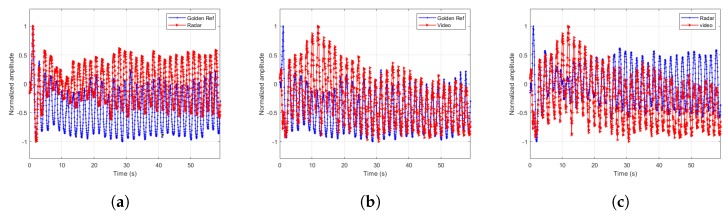
Monitoring breathing is important for a plethora of applications including, but not limited to, baby monitoring, sleep monitoring, and elderly care. This paper presents a way to fuse both vision-based and RF-based modalities for the task of estimating the breathing rate of a human. The modalities used are the F200 Intel RealSense RGB and depth (RGBD) sensor, and an ultra-wideband (UWB) radar. RGB image-based features and their corresponding image coordinates are detected on the human body and are tracked using the famous optical flow algorithm of Lucas and Kanade. The depth at these coordinates is also tracked. The synced-radar received signal is processed to extract the breathing pattern. All of these signals are then passed to a harmonic signal detector which is based on a generalized likelihood ratio test. Finally, a spectral estimation algorithm based on the reformed Pisarenko algorithm tracks the breathing fundamental frequencies in real-time, which are then fused into a one optimal breathing rate in a maximum likelihood fashion. We tested this multimodal set-up on 14 human subjects and we report a maximum error of 0.5 BPM compared to the true breathing rate.
监测呼吸对于许多应用都很重要,包括但不限于婴儿监护、睡眠监测和老年人护理。本文提出了一种融合基于视觉和基于射频两种模态的方法,用于估计人体的呼吸率。所使用的模态是 F200 Intel RealSense RGBD 传感器和超宽带 (UWB) 雷达。在人体上检测基于 RGB 图像的特征及其对应的图像坐标,并使用著名的 Lucas 和 Kanade 光流算法进行跟踪。还跟踪这些坐标处的深度。同步雷达接收信号被处理以提取呼吸模式。然后将所有这些信号传递到基于广义似然比检验的谐波信号检测器。最后,基于重构的 Pisarenko 算法的频谱估计算法实时跟踪呼吸基频,然后以最大似然的方式融合为一个最优呼吸率。我们在 14 名人类受试者上测试了这种多模态设置,与真实呼吸率相比,报告的最大误差为 0.5 BPM。