Song Jiuqiang, Huang Zhixiong, Qin Yan, Wang Honghua, Shi Minxian
School of Materials Science and Engineering, Wuhan University of Technology, Wuhan 430070, China.
Polymers (Basel). 2020 Feb 24;12(2):496. doi: 10.3390/polym12020496.
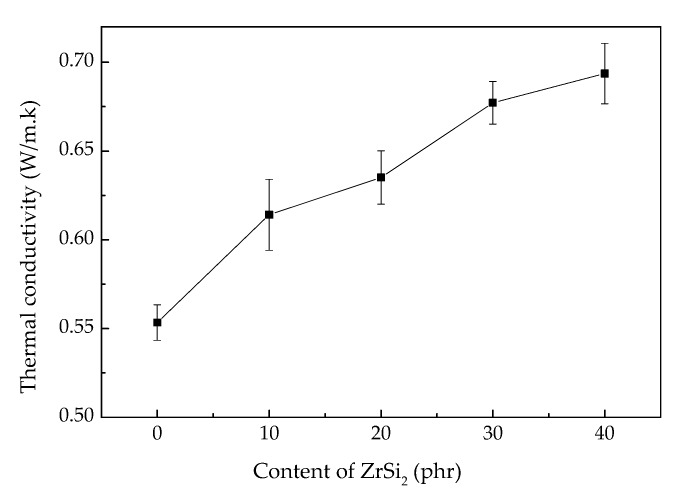
Ceramifiable silicone rubber composites play important roles in the field of thermal protection systems (TPS) for rocket motor cases due to their advantages. Ceramifiable silicone rubber composites filled with different contents of ZrSi were prepared in this paper. The fffects of ZrSi on the vulcanization, mechanical and ablation resistance properties of the composites were also investigated. The results showed that the introduction of ZrSi decreased the vulcanization time of silicone rubber. FTIR spectra showed that ZrSi did not participate in reactions of the functional groups of silicone rubber. With the increasing content of ZrSi, the tensile strength increased first and then decreased. The elongation at break decreased and the permanent deformation increased gradually. The thermal conductivity of the composite increased from 0.553 W/(m·K) to 0.694 W/(m·K) as the content of the ZrSi increased from 0 to 40 phr. In addition, the thermal conductivity of the composite decreased with the increase of temperature. Moreover, thermal analysis showed that the addition of ZrSi increased the initial decomposition temperature of the composite, but had little effect on the peak decomposition temperature in nitrogen. However, the thermal decomposition temperature of the composite in air was lower than that in nitrogen. The addition of ZrSi decreased the linear and mass ablation rate, which improved the ablative resistance of the composite. With the ZrSi content of 30 phr, the linear and mass ablation rate were 0.041 mm/s and 0.029 g/s, decreasing by 57.5% and 46.3% compared with the composite without ZrSi, respectively. Consequently, the ceramifiable silicone rubber composite filled with ZrSi is very promising for TPS.
可陶瓷化硅橡胶复合材料因其优点在火箭发动机壳体热防护系统(TPS)领域发挥着重要作用。本文制备了填充不同含量ZrSi的可陶瓷化硅橡胶复合材料。研究了ZrSi对复合材料硫化、力学和耐烧蚀性能的影响。结果表明,ZrSi的引入缩短了硅橡胶的硫化时间。傅里叶变换红外光谱表明ZrSi未参与硅橡胶官能团的反应。随着ZrSi含量的增加,拉伸强度先增加后降低。断裂伸长率降低,永久变形逐渐增加。当ZrSi含量从0 phr增加到40 phr时,复合材料的热导率从0.553 W/(m·K)增加到0.694 W/(m·K)。此外,复合材料的热导率随温度升高而降低。热分析表明,ZrSi的加入提高了复合材料的初始分解温度,但对氮气气氛下的峰值分解温度影响不大。然而,复合材料在空气中的热分解温度低于在氮气中的热分解温度。ZrSi的加入降低了线烧蚀率和质量烧蚀率,提高了复合材料的耐烧蚀性。当ZrSi含量为30 phr时,线烧蚀率和质量烧蚀率分别为0.041 mm/s和0.029 g/s,与未添加ZrSi的复合材料相比分别降低了57.5%和46.3%。因此,填充ZrSi的可陶瓷化硅橡胶复合材料在热防护系统方面具有很大的应用前景。