Department of Anesthesiology and Pain Medicine, Korea University Anam Hospital, College of Medicine, Korea University, Goryodae-ro 73, Seongbuk-gu, 02841, Seoul, Republic of Korea.
Department of Anesthesiology and Pain Medicine, Ewha University Magok Hospital, College of Medicine, Ewha University, Seoul, Republic of Korea.
BMC Anesthesiol. 2020 Feb 26;20(1):49. doi: 10.1186/s12871-020-00964-5.
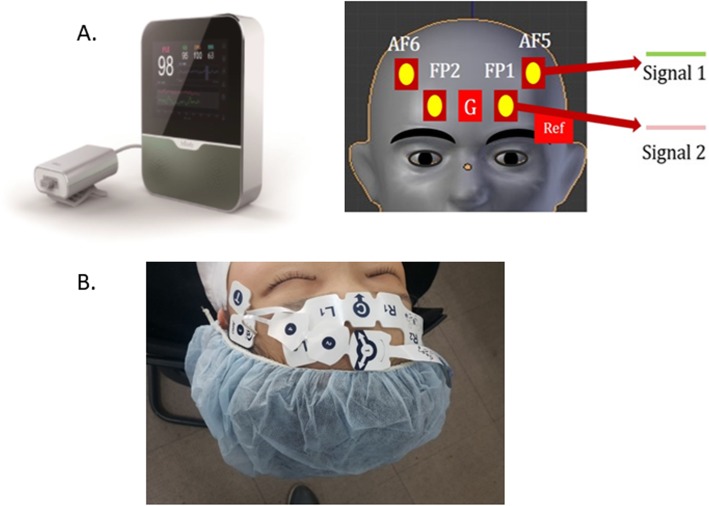
Phase lag entropy (PLE) is a novel anesthetic depth indicator that uses four-channel electroencephalography (EEG) to measure the temporal pattern diversity in the phase relationship of frequency signals in the brain. The purpose of the study was to evaluate the anesthetic depth monitoring using PLE and to evaluate the correlation between PLE and bispectral index (BIS) values during propofol anesthesia.
In thirty-five adult patients undergoing elective surgery, anesthesia was induced with propofol using target-controlled infusion (the Schneider model). We recorded the PLE value, raw EEG, BIS value, and hemodynamic data when the target effect-site concentration (Ce) of propofol reached 2, 3, 4, 5, and 6 μg/ml before intubation and 6, 5, 4, 3, 2 μg/ml after intubation and injection of muscle relaxant. We analyzed whether PLE and raw EEG data from the PLE monitor reflected the anesthetic depth as the Ce of propofol changed, and whether PLE values were comparable to BIS values.
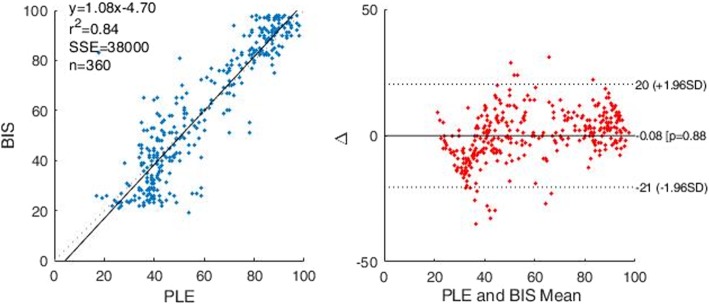
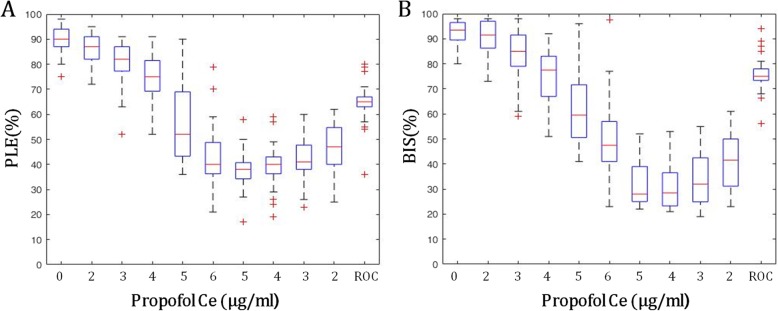
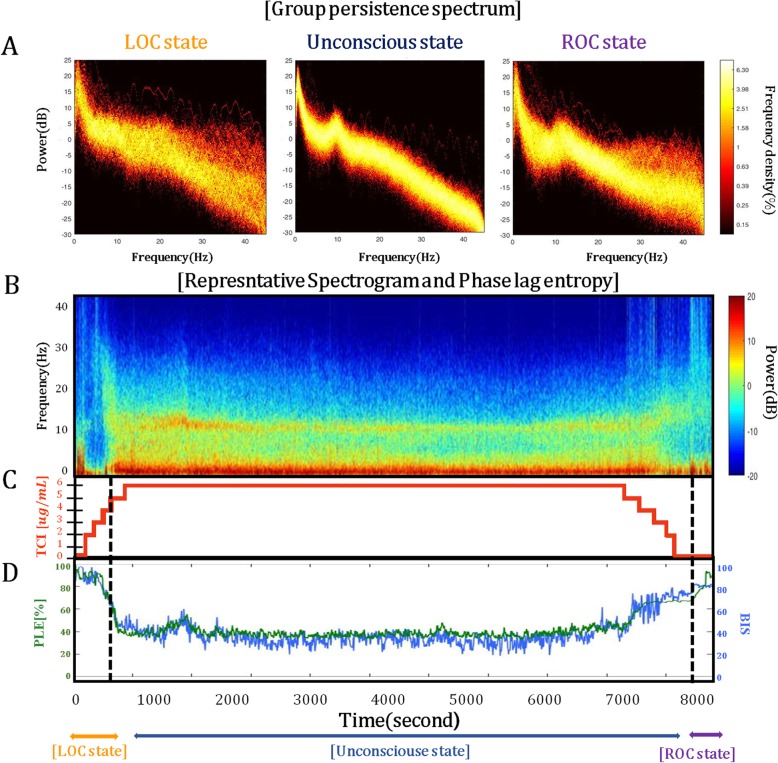
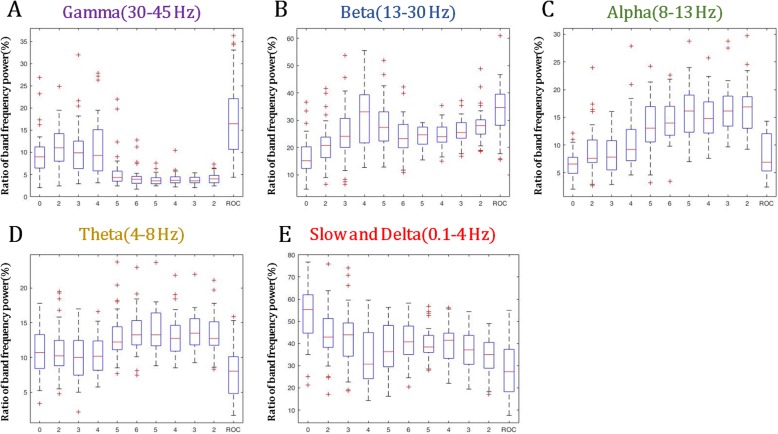
PLE values were inversely correlated to changes in propofol Ce (propofol Ce from 0 to 6.0 μg/ml, r = - 0.83; propofol Ce from 6.0 to 2.0 μg/ml, r = - 0.46). In the spectral analysis of EEG acquired from the PLE monitor, the persistence spectrogram revealed a wide distribution of power at loss of consciousness (LOC) and recovery of consciousness (ROC), with a narrow distribution during unconsciousness. The power spectrogram showed the typical pattern seen in propofol anesthesia with slow alpha frequency band oscillation. The PLE value demonstrated a strong correlation with the BIS value during the change in propofol Ce from 0 to 6.0 μg/ml (r = 0.84). PLE and BIS values were similar at LOC (62.3 vs. 61.8) (P > 0.05), but PLE values were smaller than BIS values at ROC (64.4 vs 75.7) (P < 0.05).
The PLE value is a useful anesthetic depth indicator, similar to the BIS value, during propofol anesthesia. Spectral analysis of EEG acquired from the PLE monitor demonstrated the typical patterns seen in propofol anesthesia.
This clinical trial was retrospectively registered at ClinicalTrials.gov at October 2017 (NCT03299621).
相位滞后熵(PLE)是一种新的麻醉深度指标,它使用四通道脑电图(EEG)来测量大脑中频率信号相位关系的时间模式多样性。本研究旨在评估使用 PLE 进行麻醉深度监测的效果,并评估丙泊酚麻醉期间 PLE 与双频谱指数(BIS)值之间的相关性。
在 35 名接受择期手术的成年患者中,使用丙泊酚靶控输注(施耐德模型)诱导麻醉。我们记录了 PLE 值、原始 EEG、BIS 值和血流动力学数据,当丙泊酚的目标效应部位浓度(Ce)达到插管前 2、3、4、5 和 6μg/ml 以及插管后和注射肌松剂后 6、5、4、3、2μg/ml 时。我们分析了 PLE 和来自 PLE 监视器的原始 EEG 数据是否反映了随着丙泊酚 Ce 的变化而变化的麻醉深度,以及 PLE 值是否与 BIS 值相当。
PLE 值与丙泊酚 Ce 的变化呈负相关(丙泊酚 Ce 从 0 到 6.0μg/ml,r=-0.83;丙泊酚 Ce 从 6.0 到 2.0μg/ml,r=-0.46)。在来自 PLE 监视器的 EEG 频谱分析中,失意识(LOC)和意识恢复(ROC)时的持久谱图显示出广泛的功率分布,而无意识时的功率分布较窄。功率谱图显示了丙泊酚麻醉中典型的慢阿尔法频带振荡模式。在丙泊酚 Ce 从 0 到 6.0μg/ml 变化期间,PLE 值与 BIS 值具有很强的相关性(r=0.84)。LOC 时 PLE 和 BIS 值相似(62.3 与 61.8)(P>0.05),但 ROC 时 PLE 值小于 BIS 值(64.4 与 75.7)(P<0.05)。
在丙泊酚麻醉期间,PLE 值是一种有用的麻醉深度指标,与 BIS 值相似。来自 PLE 监视器的 EEG 频谱分析显示了丙泊酚麻醉中典型的模式。
这项临床试验于 2017 年 10 月在 ClinicalTrials.gov 进行了回顾性注册(NCT03299621)。