Dalla Lana School of Public Health, University of Toronto, Toronto, Ontario, Canada.
Institute of Health Policy, Management and Evaluation, University of Toronto, Toronto, Ontario, Canada.
BMJ Open. 2020 Feb 25;10(2):e032837. doi: 10.1136/bmjopen-2019-032837.
To examine if low life satisfaction is associated with an increased risk of being hospitalised for an ambulatory care sensitive condition (ACSC), in comparison to high life satisfaction DESIGN AND SETTING: Population-based cohort study of adults from Ontario, Canada. Baseline data were captured through the Canadian Community Health Survey (CCHS) and linked to health administrative data for follow-up information.
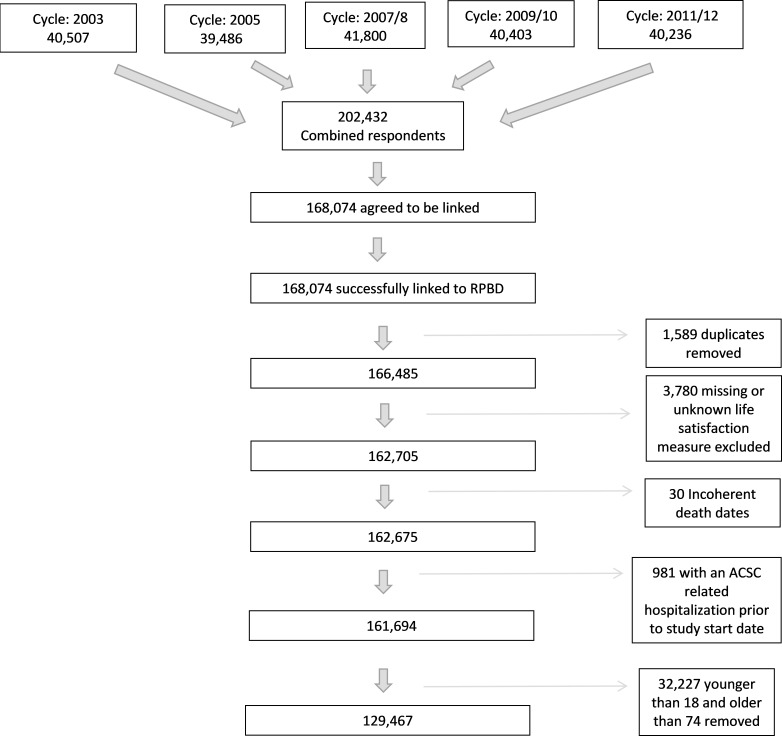
129 467 men and women between the ages 18 and 74.
Time to avoidable hospitalisations defined by ACSCs.
Life satisfaction was measured at baseline through the CCHS and follow-up information on ACSC hospitalisations were captured by linking participant respondents to hospitalisation records covered under a single payer health system. Within the study time frame (maximum of 14 years), 3037 individuals were hospitalised. Older men in the lowest household income quintile were more likely to be hospitalised with an ACSC. After controlling for age, sex, socioeconomic status (SES) and other behavioural factors, low life satisfaction at baseline had a strong relationship with future hospitalisations for ACSCs (HR 2.71; 95% CI 1.87 to 3.93). The hazards were highest for those who jointly had the lowest levels of life satisfaction and low household income (HR 3.80; 95% CI 2.13 to 6.73). Results did not meaningful change after running a competing risk survival analysis.
This study demonstrates that poor life satisfaction is associated with hospitalisations for ACSCs after adjustment for several confounders. Furthermore, the magnitude of this relationship was greater for those who were more socioeconomically disadvantaged. This study adds to the existing literature on the impact of life satisfaction on health system outcomes by documenting its impact on avoidable hospitalisations in a universal health system.
与生活满意度高相比,比较生活满意度低与因可避免的门诊治疗敏感条件(ACSC)住院的风险增加是否相关。
这是一项基于人群的加拿大安大略省成年人队列研究。基线数据通过加拿大社区健康调查(CCHS)收集,并与健康管理数据链接以获取随访信息。
年龄在 18 至 74 岁之间的 129467 名男性和女性。
避免可避免的 ACSC 住院的时间。
生活满意度在基线时通过 CCHS 进行测量,通过将参与者受访者与单一支付者健康系统涵盖的住院记录链接,获得 ACSC 住院的随访信息。在研究时间范围内(最长 14 年),有 3037 人住院。收入最低的五分之一家庭的老年男性更有可能因 ACSC 住院。在控制年龄、性别、社会经济地位(SES)和其他行为因素后,基线时生活满意度低与未来 ACSC 住院有很强的关系(HR 2.71;95%CI 1.87 至 3.93)。对于那些同时生活满意度和低家庭收入最低的人,风险最高(HR 3.80;95%CI 2.13 至 6.73)。在进行竞争风险生存分析后,结果没有明显变化。
这项研究表明,在调整了几个混杂因素后,较差的生活满意度与 ACSC 住院有关。此外,对于那些社会经济地位较低的人来说,这种关系的程度更大。这项研究通过记录生活满意度对全民健康系统中可避免住院的影响,为生活满意度对卫生系统结果的影响的现有文献做出了贡献。