Dalla Lana School of Public Health, University of Toronto, Toronto, Ontario, Canada.
Populations and Public Health, ICES, Toronto, Ontario, Canada.
BMJ Open. 2022 Apr 29;12(4):e050057. doi: 10.1136/bmjopen-2021-050057.
To investigate the prospective association between life satisfaction and future mental health service use in: (1) hospital/emergency department, and (2) outpatient settings.
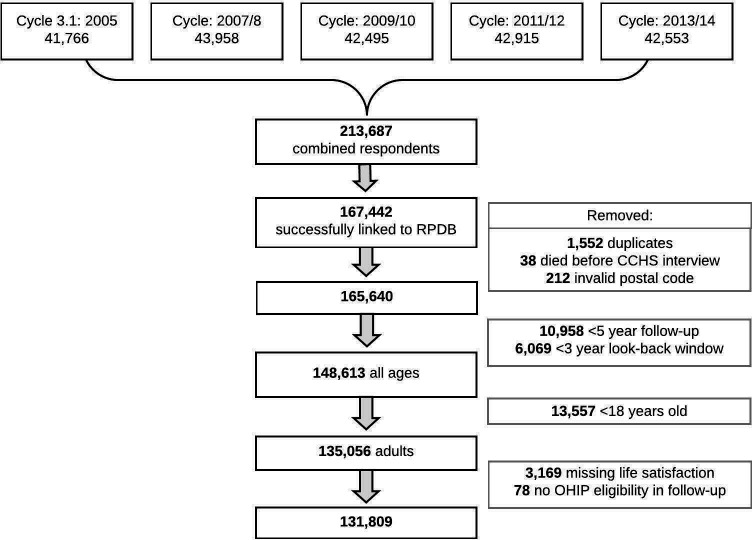
Population-based cohort study of adults from Ontario, Canada. Baseline data were captured through pooled cycles of the Canadian Community Health Survey (CCHS 2005-2014) and linked to health administrative data for up to 5 years of follow-up.
131 809 Ontarians aged 18 years and older.
The number of mental health-related visits in (1) hospitals/emergency department and (2) outpatient settings within 5 years of follow-up.
Poisson regression models were used to estimate rate ratios in each setting, adjusting for sociodemographic measures, history of mental health-related visits, and health behaviours. In the hospital/emergency setting, compared to those most satisfied with life, those with the poorest satisfaction exhibited a rate ratio of 3.71 (95% CI 2.14 to 6.45) for future visits. In the outpatient setting, this same comparison group exhibited a rate ratio of 1.83 (95% CI 1.42 to 2.37). When the joint effects of household income were considered, compared with the highest income and most satisfied individuals, the least satisfied and lowest income individuals exhibited the highest rate ratio in the hospital/emergency setting at 11.25 (95% CI 5.32 to 23.80) whereas in the outpatient setting, the least satisfied and highest income individuals exhibited the highest rate ratio at 3.33 (95% CI 1.65 to 6.70).
The findings suggest that life satisfaction is a risk factor for future mental health visits. This study contributes to an evidence base connecting positive well-being with health system outcomes.
调查生活满意度与未来精神卫生服务使用之间的前瞻性关联:(1)在医院/急诊室,以及(2)在门诊环境中。
这是一项基于人群的加拿大安大略省成年人队列研究。通过加拿大社区健康调查(CCHS 2005-2014 年)的综合周期收集基线数据,并与健康管理数据进行链接,以进行长达 5 年的随访。
131809 名 18 岁及以上的安大略人。
在 5 年的随访期内,(1)医院/急诊室和(2)门诊环境中与精神健康相关的就诊次数。
使用泊松回归模型,在每个环境中根据社会人口学指标、精神健康相关就诊史和健康行为调整率比值。在医院/急诊环境中,与对生活最满意的人相比,满意度最差的人未来就诊的比率比为 3.71(95%CI 2.14 至 6.45)。在门诊环境中,同一比较组的比率比为 1.83(95%CI 1.42 至 2.37)。当考虑家庭收入的联合效应时,与收入最高、满意度最高的个人相比,最不满意和收入最低的个人在医院/急诊环境中的比率最高,为 11.25(95%CI 5.32 至 23.80),而在门诊环境中,最不满意和收入最高的个人的比率最高,为 3.33(95%CI 1.65 至 6.70)。
研究结果表明,生活满意度是未来精神卫生就诊的一个风险因素。本研究为将积极的幸福感与卫生系统结果联系起来的证据基础做出了贡献。