Department of Radiation Oncology, Biologic Therapeutics Center, Washington University School of Medicine, St. Louis, Missouri, USA.
Precigen, Inc., Germantown, Maryland, USA.
J Virol. 2020 May 4;94(10). doi: 10.1128/JVI.00265-20.
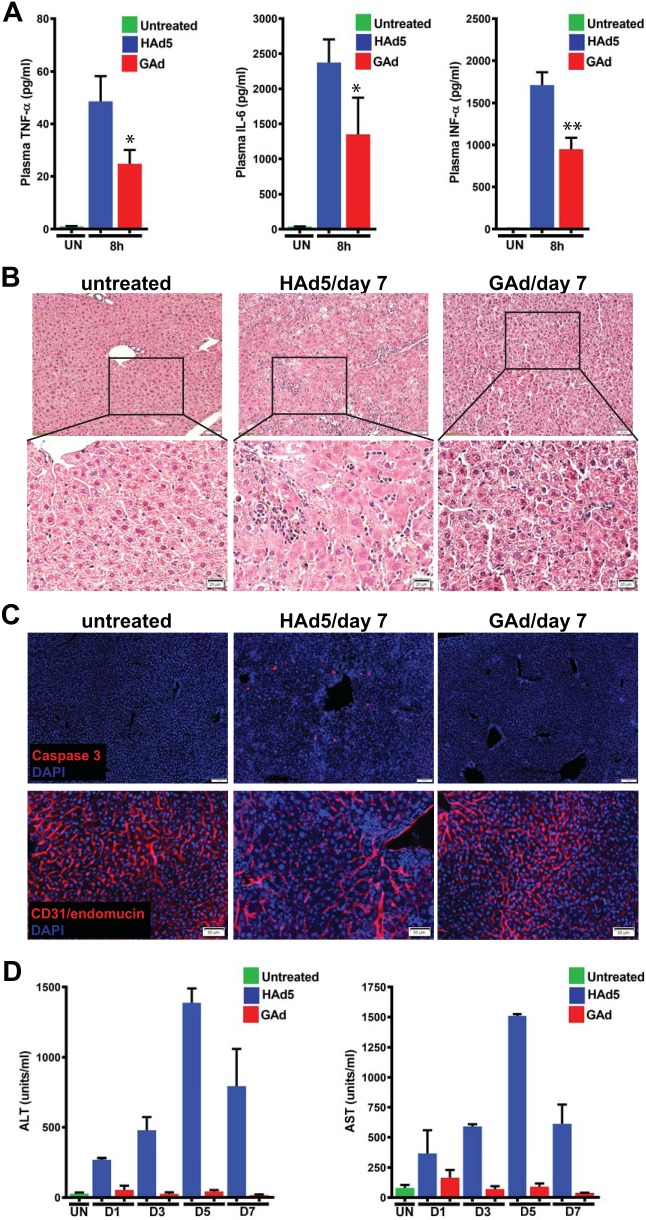
Human adenoviruses have many attractive features for gene therapy applications. However, the high prevalence of preexisting immunity against these viruses in general populations worldwide has greatly limited their clinical utility. In addition, the most commonly used human adenovirus, human adenovirus subgroup C serotype 5 (HAd5), when systemically administered, triggers systemic inflammation and toxicity, with the liver being the most severely affected organ. Here, we evaluated the utility and safety of a new low-seroprevalence gorilla adenovirus (GAd; GC46) as a gene transfer vector in mice. Biodistribution studies revealed that systemically administered GAd had a selective and robust lung endothelial cell (EC) tropism with minimal vector expression throughout many other organs and tissues. Administration of a high dose of GAd accomplished extensive transgene expression in the lung yet elicited no detectable inflammatory histopathology in this organ. Furthermore, GAd, unlike HAd5, did not exhibit hepatotropism or induce liver inflammatory toxicity in mice, demonstrating the exceptional safety profile of the vector vis-à-vis systemic utility. We further demonstrated that the GAd capsid fiber shared the flexibility of the HAd5 equivalent for permitting genetic modification; GAd with the pan-EC-targeting ligand myeloid cell-binding peptide (MBP) incorporated in the capsid displayed a reduced lung tropism and efficiently retargeted gene expression to vascular beds in other organs. In the aggregate, our mouse studies suggest that GAd is a promising gene therapy vector that utilizes lung ECs as a source of therapeutic payload production and a highly desirable toxicity profile. Further genetic engineering of the GAd capsid holds the promise of vector tropism modification and targeting.
人类腺病毒具有许多吸引人的特点,非常适合基因治疗应用。然而,由于全球大多数人群中普遍存在针对这些病毒的预先存在的免疫,其临床应用受到了极大限制。此外,最常用的人类腺病毒,人腺病毒亚组 C 血清型 5(HAd5),全身给药时会引发全身炎症和毒性,肝脏是受影响最严重的器官。在这里,我们评估了新型低流行大猩猩腺病毒(GAd;GC46)作为基因转移载体在小鼠中的效用和安全性。生物分布研究表明,全身给药的 GAd 具有选择性和强大的肺内皮细胞(EC)趋向性,在许多其他器官和组织中表达最小的载体。给予高剂量的 GAd 可在肺部实现广泛的转基因表达,但在该器官中未检测到炎症组织病理学。此外,与 HAd5 不同,GAd 不会在小鼠中表现出嗜肝性或引起肝脏炎症毒性,这表明该载体在系统应用方面具有出色的安全性。我们进一步证明,GAd 衣壳纤维与 HAd5 等效物一样具有灵活性,允许进行基因修饰;衣壳中包含泛 EC 靶向配体髓样细胞结合肽(MBP)的 GAd 显示出降低的肺趋向性,并有效地将基因表达重新靶向到其他器官的血管床。总之,我们的小鼠研究表明,GAd 是一种很有前途的基因治疗载体,它利用肺 EC 作为治疗性有效载荷产生的来源,并具有理想的毒性特征。进一步对 GAd 衣壳进行基因工程有望实现对载体趋向性的修饰和靶向。