From the Center for Magnetoencephalography (B.R.G., A.I.W., T.W.W.), University of Nebraska Medical Center, Omaha, NE; Department of Neurological Sciences (A.I.W., M.T.R., T.W.W.), UNMC, Omaha; Department of Internal Medicine (J.O.N., S.S.), Division of Infectious Diseases, UNMC; Department of Neurology (K.R.R.), University of North Carolina School of Medicine, Chapel Hill, NC; and Department of Pharmacology and Experimental Neuroscience (H.S.F.), UNMC, Omaha, NE.
Neurol Neuroimmunol Neuroinflamm. 2020 Feb 26;7(3). doi: 10.1212/NXI.0000000000000690. Print 2020 May.
To investigate whether aging differentially affects neural activity serving visuospatial processing in a large functional neuroimaging study of HIV-infected participants and to determine whether such aging effects are attributable to differences in the duration of HIV infection.
A total of 170 participants, including 93 uninfected controls and 77 HIV-infected participants, underwent neuropsychological assessment followed by neuroimaging with magnetoencephalography (MEG). Time-frequency analysis of the MEG data followed by advanced image reconstruction of neural oscillatory activity and whole-brain statistical analyses were used to examine interactions between age, HIV infection, and cognitive status. Post hoc testing for a mediation effect of HIV infection duration on the relationship between age and neural activity was performed using a quasi-Bayesian approximation for significance testing.
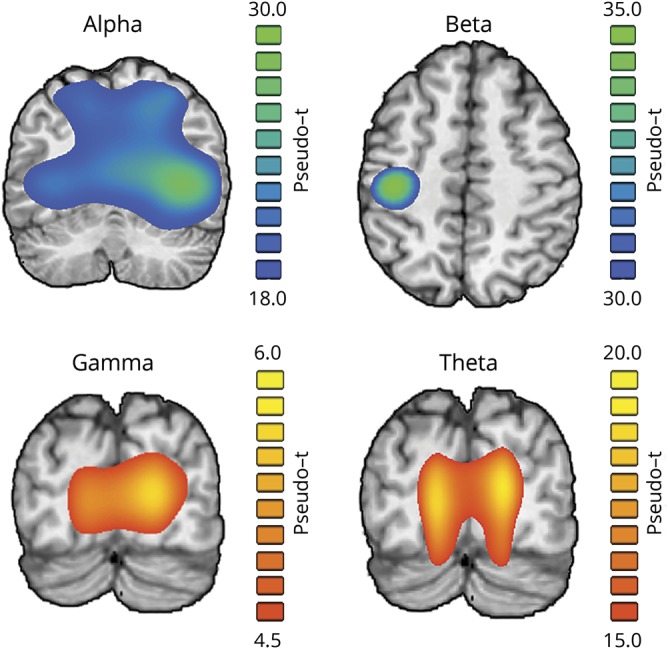
Cognitively impaired HIV-infected participants were distinguished from unimpaired HIV-infected and control participants by their unique association between age and gamma oscillations in the parieto-occipital cortex. This relationship between age and gamma was fully mediated by the duration of HIV infection in cognitively impaired participants. Impaired HIV-infected participants were also distinguished by their atypical relationship between alpha oscillations and age in the superior parietal cortex.
Impaired HIV-infected participants exhibited markedly different relationships between age and neural responses in the parieto-occipital cortices relative to their peers. This suggests a differential effect of chronological aging on the neural bases of visuospatial processing in a cognitively impaired subset of HIV-infected adults. Some of these relationships were fully accounted for by differences in HIV infection duration, whereas others were more readily associated with aging.
通过一项针对 HIV 感染者的大型功能神经影像学研究,调查衰老是否会对服务于视空间处理的神经活动产生差异影响,并确定这种衰老效应是否归因于 HIV 感染持续时间的差异。
共有 170 名参与者,包括 93 名未感染对照者和 77 名 HIV 感染者,他们接受了神经心理学评估,随后接受了脑磁图(MEG)神经影像学检查。对 MEG 数据进行时频分析,然后对神经振荡活动进行高级图像重建和全脑统计分析,以检查年龄、HIV 感染和认知状态之间的相互作用。使用拟贝叶斯近似法进行显著性检验,对 HIV 感染持续时间对年龄与神经活动之间关系的中介效应进行了事后检验。
认知障碍的 HIV 感染者与认知未受损的 HIV 感染者和对照组参与者的区别在于,他们在后顶叶皮层的年龄和伽马振荡之间存在独特的关联。在认知障碍的参与者中,这种年龄与伽马的关系完全由 HIV 感染的持续时间介导。认知障碍的 HIV 感染者还表现出顶叶上回阿尔法振荡与年龄之间的异常关系。
与认知未受损的同龄人相比,认知障碍的 HIV 感染者在后顶叶皮层的年龄与神经反应之间表现出明显不同的关系。这表明,在认知障碍的 HIV 感染者亚组中,神经处理视空间的能力随年龄的变化存在差异。这些关系中的一些完全由 HIV 感染持续时间的差异解释,而其他关系则更容易与衰老相关。