Drug Use Management, Kaiser Permanente, Oakland, CA, USA.
Pharmacy Outcomes Research Group, Kaiser Permanente, Downey, CA, USA.
BioDrugs. 2020 Jun;34(3):395-404. doi: 10.1007/s40259-020-00409-y.
The aim was to compare outcomes in adult patients with inflammatory bowel disease (IBD) who switched to infliximab-dyyb with those who remained on reference product (RP) infliximab in the United States (US) in a retrospective, propensity score-matched, non-inferiority cohort trial.
This study was a retrospective, non-inferiority study conducted within a US integrated healthcare system and included adult patients with a confirmed diagnosis of Crohn's disease or ulcerative colitis. A 1:1 propensity score matching was utilized to match patients who switched to infliximab-dyyb during the period April 2016-March 2018 to patients who remained on RP infliximab. The non-inferiority margin was set at + 10% of the upper limit. The primary outcome was a composite measure of disease worsening requiring acute care after the index date of switching to infliximab-dyyb or continuing RP infliximab. Disease worsening requiring acute care was defined as any IBD-related emergency room visit, hospitalization, or surgery. The secondary outcome was the composite measure of disease worsening requiring acute care or treatment failure. A switch to another biologic or tofacitinib was a proxy for treatment failure. All patients were followed for up to 9 months.
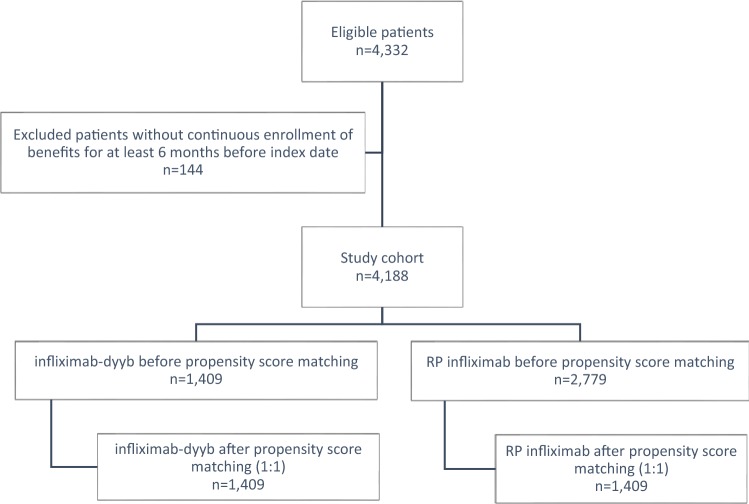
After propensity score matching, the matched cohort included 1409 patients in the infliximab-dyyb group and 1409 patients in the RP infliximab group. The overall mean age (± standard deviation) was 47.7 ± 17.0 years, 50.9% of patients were of male gender, and 51.8% of patients had Crohn's disease, while the remainder of the cohort had ulcerative colitis. There were 144 patients (10.2%) in the infliximab-dyyb group and 245 patients (17.4%) in the RP infliximab group who experienced disease worsening requiring acute care (P < 0.01 for non-inferiority). There were 347 patients (24.6%) in the infliximab-dyyb group who experienced disease worsening requiring acute care or treatment failure compared to 375 patients (26.6%) who remained on RP infliximab (P < 0.01 for non-inferiority).
There was no increased risk of (1) disease worsening requiring acute care or (2) disease worsening requiring acute care or treatment failure in patients with IBD who switched from RP infliximab to infliximab-dyyb when compared to patients who remained on RP infliximab in this US population. Infliximab-dyyb is an option for patients with IBD who need to use RP infliximab.
本研究旨在比较美国接受英夫利昔单抗-dyyb 转换治疗与继续接受英夫利昔单抗参考产品(RP)治疗的炎症性肠病(IBD)成年患者的结局,这是一项回顾性、倾向评分匹配、非劣效性队列研究。
这是一项在美国综合医疗体系内进行的回顾性非劣效性研究,纳入了确诊为克罗恩病或溃疡性结肠炎的成年患者。采用 1:1 倾向评分匹配,将 2016 年 4 月至 2018 年 3 月期间转换为英夫利昔单抗-dyyb 的患者与继续接受 RP 英夫利昔单抗的患者进行匹配。非劣效性边界设定为 +10%上限。主要结局是从转换到英夫利昔单抗-dyyb 或继续接受 RP 英夫利昔单抗的指数日期起,需要急性护理的疾病恶化的复合指标。需要急性护理的疾病恶化定义为任何与 IBD 相关的急诊就诊、住院或手术。次要结局是需要急性护理或治疗失败的疾病恶化复合指标。转换为另一种生物制剂或托法替尼被视为治疗失败的替代指标。所有患者均随访至 9 个月。
在进行倾向评分匹配后,匹配队列包括英夫利昔单抗-dyyb 组的 1409 例患者和 RP 英夫利昔单抗组的 1409 例患者。总体平均年龄(±标准差)为 47.7±17.0 岁,50.9%的患者为男性,51.8%的患者患有克罗恩病,而队列的其余部分患有溃疡性结肠炎。英夫利昔单抗-dyyb 组有 144 例(10.2%)和 RP 英夫利昔单抗组有 245 例(17.4%)患者发生需要急性护理的疾病恶化(非劣效性 P<0.01)。英夫利昔单抗-dyyb 组有 347 例(24.6%)患者发生需要急性护理或治疗失败的疾病恶化,而继续接受 RP 英夫利昔单抗的患者有 375 例(26.6%)(非劣效性 P<0.01)。
与继续接受 RP 英夫利昔单抗的患者相比,在这项美国人群中,从 RP 英夫利昔单抗转换为英夫利昔单抗-dyyb 的 IBD 患者在(1)需要急性护理的疾病恶化风险或(2)需要急性护理或治疗失败的疾病恶化风险方面没有增加。英夫利昔单抗-dyyb 是需要使用 RP 英夫利昔单抗的 IBD 患者的一种选择。