Fitzgerald Timothy, Melsheimer Richard, Lafeuille Marie-Hélène, Lefebvre Patrick, Morrison Laura, Woodruff Kimberly, Lin Iris, Emond Bruno
Real World Value & Evidence, Janssen Scientific Affairs, LLC, Titusville, New Jersey, USA.
Medical Affairs, Janssen Biologics BV, Leiden, the Netherlands.
Biologics. 2021 Jan 6;15:1-15. doi: 10.2147/BTT.S285610. eCollection 2021.
To compare switching and discontinuation patterns of patients stable on originator infliximab (IFX) who switched to an IFX biosimilar (switchers) or remained on originator IFX (continuers) in the United States.
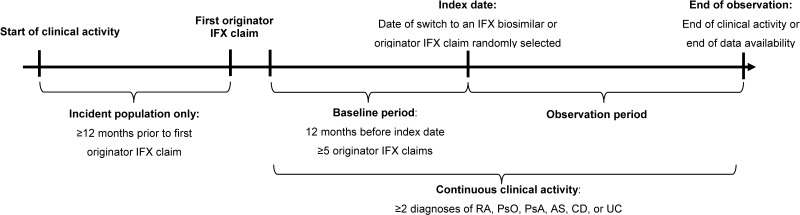
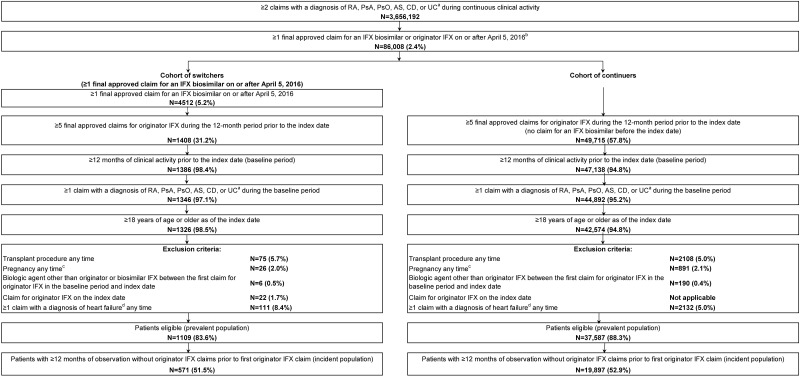
Symphony Health Solutions' Patient Transactional Datasets (10/2012-03/2019) were used to identify adults with ≥2 claims for either rheumatoid arthritis (RA), psoriatic arthritis, plaque psoriasis, ankylosing spondylitis, or inflammatory bowel disease (IBD); and ≥1 claim for originator or biosimilar IFX. The index date was the first IFX biosimilar claim for switchers or a random originator IFX claim for continuers. All patients were required to have ≥5 originator IFX claims during the 12 months pre-index (prevalent population). The subset of patients with ≥12 months of observation prior to the first originator IFX claim was also analyzed (incident population). Switchers were matched 1:3 to continuers. Discontinuation was defined as having ≥120 days between 2 consecutive index treatment claims.
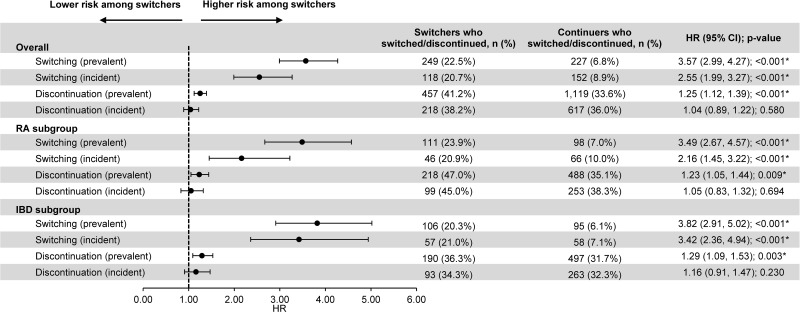
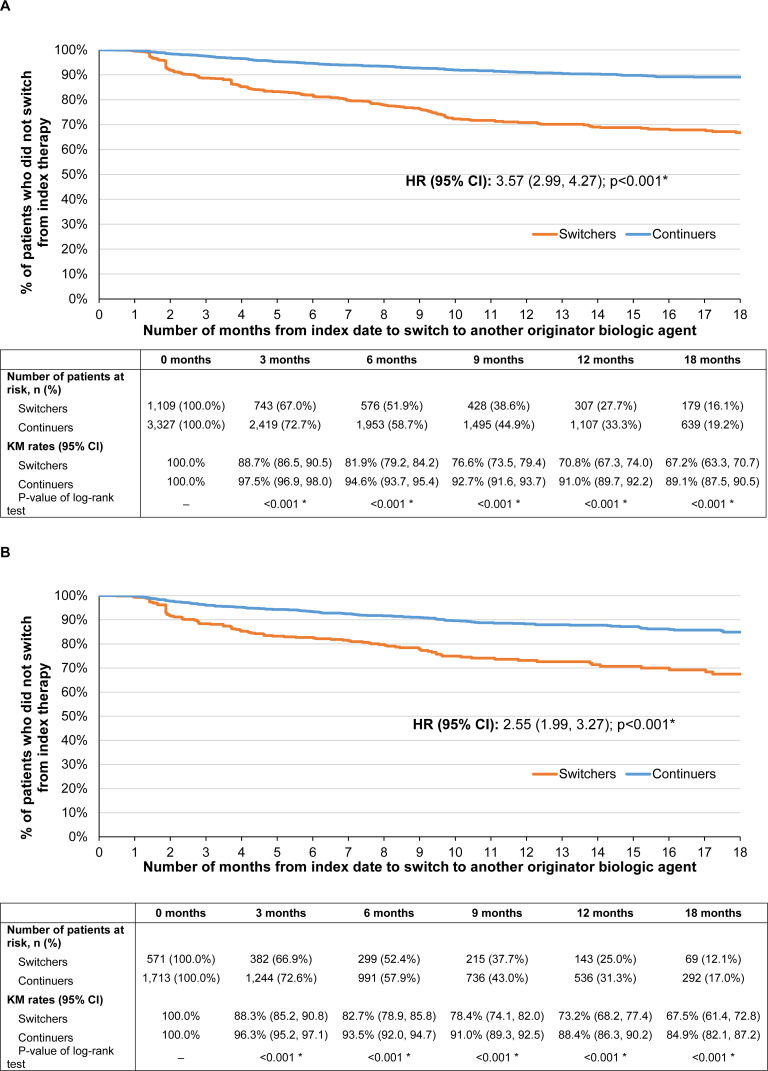
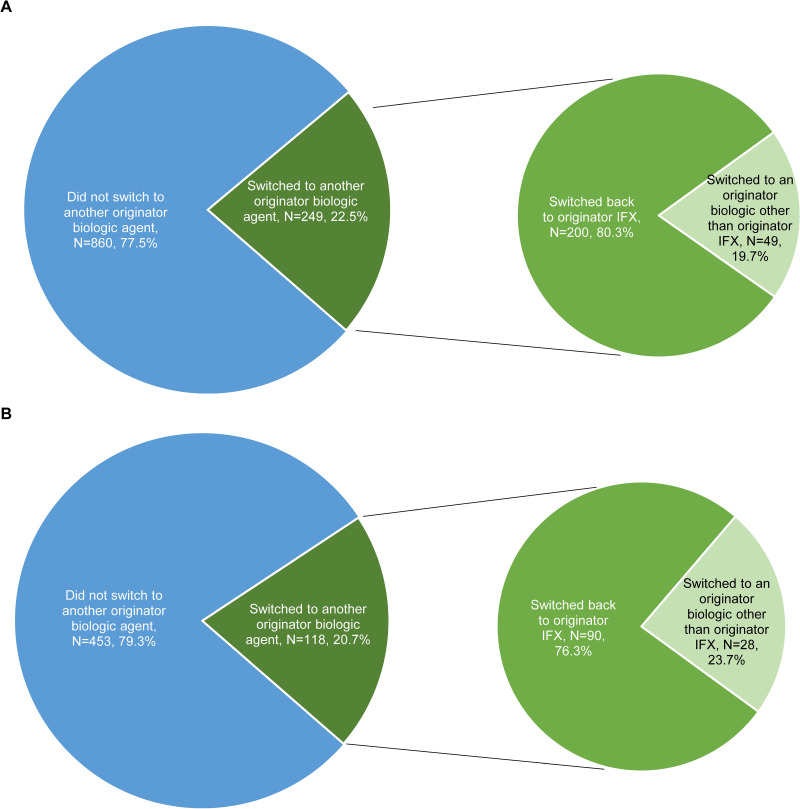
Prevalent switchers (N=1109) were 3.57-times more likely than continuers (N=3327) to switch to another originator biologic (hazard ratio [HR]=3.57, p<0.001). Of 249 prevalent switchers who switched to another originator biologic, 200 (80.3%) switched back to originator IFX. Incident switchers (N=571) were 2.55-times more likely than continuers (N=1713) to switch to another originator biologic (HR=2.55, p<0.001). Of 118 incident switchers who switched to another originator biologic, 90 (76.3%) switched back to originator IFX. Prevalent switchers were 1.25-times more likely than continuers to discontinue index therapy (HR=1.25, p<0.001). Similar results were observed in RA (prevalent population; switching: HR=3.49, p<0.001; discontinuation: HR=1.23, p=0.009) and IBD (prevalent population; switching: HR=3.82, p<0.001; discontinuation: HR=1.29, p=0.003) subgroups.
Patients switching from originator to biosimilar IFX were more likely to switch to another originator biologic (notably back to originator IFX) and discontinue index treatment than those remaining on originator IFX; however, reasons for switching are unknown.
比较在美国,由原研英夫利昔单抗(IFX)转换为IFX生物类似药(转换者)或继续使用原研IFX(持续使用者)且病情稳定的患者的转换和停药模式。
使用Symphony Health Solutions的患者交易数据集(2012年10月 - 2019年3月)来识别患有类风湿性关节炎(RA)、银屑病关节炎、斑块状银屑病、强直性脊柱炎或炎症性肠病(IBD)且有≥2次索赔记录的成年人;以及有≥1次原研或生物类似药IFX索赔记录的成年人。索引日期是转换者的首次IFX生物类似药索赔日期或持续使用者的随机原研IFX索赔日期。所有患者在索引前12个月内需有≥5次原研IFX索赔记录(现患人群)。还分析了在首次原研IFX索赔前有≥12个月观察期的患者子集(新发病例人群)。转换者与持续使用者按1:3匹配。停药定义为连续两次索引治疗索赔之间间隔≥120天。
现患转换者(N = 1109)转换为另一种原研生物制剂的可能性比持续使用者(N = 3327)高3.57倍(风险比[HR] = 3.57,p < 0.001)。在249名转换为另一种原研生物制剂的现患转换者中,200名(80.3%)又换回了原研IFX。新发病例转换者(N = 571)转换为另一种原研生物制剂的可能性比持续使用者(N = 1713)高2.55倍(HR = 2.55,p < 0.001)。在118名转换为另一种原研生物制剂的新发病例转换者中,90名(76.3%)又换回了原研IFX。现患转换者停止索引治疗的可能性比持续使用者高1.25倍(HR = 1.25,p < 0.001)。在RA(现患人群;转换:HR = 3.49,p < 0.001;停药:HR = 1.23,p = 0.009)和IBD(现患人群;转换:HR = 3.82,p < 0.001;停药:HR = 1.29,p = 0.003)亚组中观察到类似结果。
与继续使用原研IFX的患者相比,从原研IFX转换为生物类似药IFX的患者更有可能转换为另一种原研生物制剂(尤其是换回原研IFX)并停止索引治疗;然而,转换原因尚不清楚。