CERGAS, SDA Bocconi, Milan, Italy.
Institute of Health Research, University of Exeter Medical School, Exeter, UK.
BMC Med Res Methodol. 2020 Feb 27;20(1):41. doi: 10.1186/s12874-020-00928-w.
A Core Outcomes Set (COS) is an agreed minimum set of outcomes that should be reported in all clinical studies related to a specific condition. Using prostate cancer as a case study, we identified, summarized, and critically appraised published COS development studies and assessed the degree of overlap between them and selected real-world data (RWD) sources.
We conducted a scoping review of the Core Outcome Measures in Effectiveness Trials (COMET) Initiative database to identify all COS studies developed for prostate cancer. Several characteristics (i.e., study type, methods for consensus, type of participants, outcomes included in COS and corresponding measurement instruments, timing, and sources) were extracted from the studies; outcomes were classified according to a predefined 38-item taxonomy. The study methodology was assessed based on the recent COS-STAndards for Development (COS-STAD) recommendations. A 'mapping' exercise was conducted between the COS identified and RWD routinely collected in selected European countries.
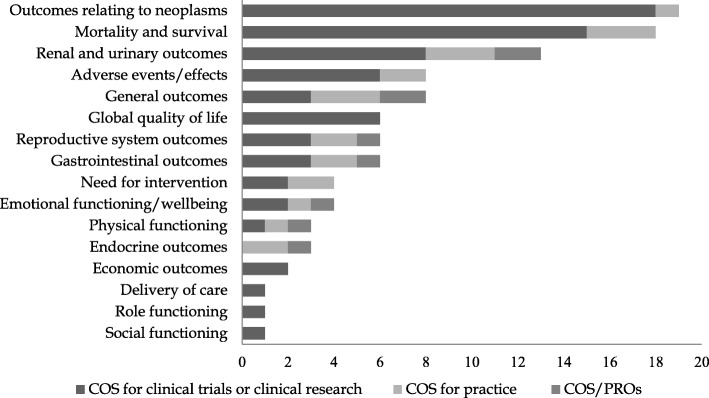
Eleven COS development studies published between 1995 and 2017 were retrieved, of which 8 were classified as 'COS for clinical trials and clinical research', 2 as 'COS for practice' and 1 as 'COS patient reported outcomes'. Recommended outcomes were mainly categorized into 'mortality and survival' (17%), 'outcomes related to neoplasm' (18%), and 'renal and urinary outcomes' (13%) with no relevant differences among COS study types. The studies generally fulfilled the criteria for the COS-STAD 'scope specification' domain but not the 'stakeholders involved' and 'consensus process' domains. About 72% overlap existed between COS and linked administrative data sources, with important gaps. Linking with patient registries improved coverage (85%), but was sometimes limited to smaller follow-up patient groups.
This scoping review identified few COS development studies in prostate cancer, some quite dated and with a growing level of methodological quality over time. This study revealed promising overlap between COS and RWD sources, though with important limitations; linking established, national patient registries to administrative data provide the best means to additionally capture patient-reported and some clinical outcomes over time. Thus, increasing the combination of different data sources and the interoperability of systems to follow larger patient groups in RWD is required.
核心结局集(COS)是一个约定的最小结局集,应在所有与特定疾病相关的临床研究中报告。以前列腺癌为例,我们确定、总结和批判性地评估了已发表的 COS 开发研究,并评估了它们之间的重叠程度以及与选定的真实世界数据(RWD)来源的重叠程度。
我们对核心结局测量有效性试验(COMET)倡议数据库进行了范围综述,以确定为前列腺癌开发的所有 COS 研究。从研究中提取了几个特征(即研究类型、共识方法、参与者类型、COS 中包含的结局和相应的测量工具、时间和来源);根据预先确定的 38 项分类法对结局进行分类。根据最近的 COS-STAndards for Development(COS-STAD)建议评估了研究方法。对确定的 COS 与选定的欧洲国家常规收集的 RWD 进行了“映射”练习。
共检索到 1995 年至 2017 年期间发表的 11 项 COS 开发研究,其中 8 项被归类为“临床试验和临床研究用 COS”,2 项为“实践用 COS”,1 项为“患者报告结局用 COS”。推荐的结局主要分为“死亡率和生存率”(17%)、“与肿瘤相关的结局”(18%)和“肾脏和泌尿系统结局”(13%),不同类型的 COS 研究之间没有显著差异。这些研究通常符合 COS-STAD“范围规范”域的标准,但不符合“利益相关者参与”和“共识过程”域的标准。COS 与相关的行政数据源之间存在约 72%的重叠,但存在重要差距。与患者登记处的链接提高了覆盖率(85%),但有时仅限于随访患者人数较少的患者群体。
本范围综述确定了前列腺癌中很少有 COS 开发研究,其中一些相当陈旧,随着时间的推移,其方法学质量不断提高。本研究表明 COS 与 RWD 来源之间存在有希望的重叠,但存在重要限制;将已建立的国家患者登记处与行政数据相结合,是随着时间的推移额外捕获患者报告和一些临床结局的最佳手段。因此,需要增加不同数据源的组合和 RWD 中系统的互操作性,以跟踪更多的患者群体。