Institute of Biomedical Research, Shandong University of Technology, Zibo, Shandong, People's Republic of China.
Shandong Provincial Research Center for Bioinformatic Engineering and Technique, Zibo Key Laboratory of New Drug Development of Neurodegenerative Diseases, School of Life Sciences, Shandong University of Technology, Zibo, Shandong, People's Republic of China.
Microb Cell Fact. 2020 Feb 27;19(1):50. doi: 10.1186/s12934-020-01313-4.
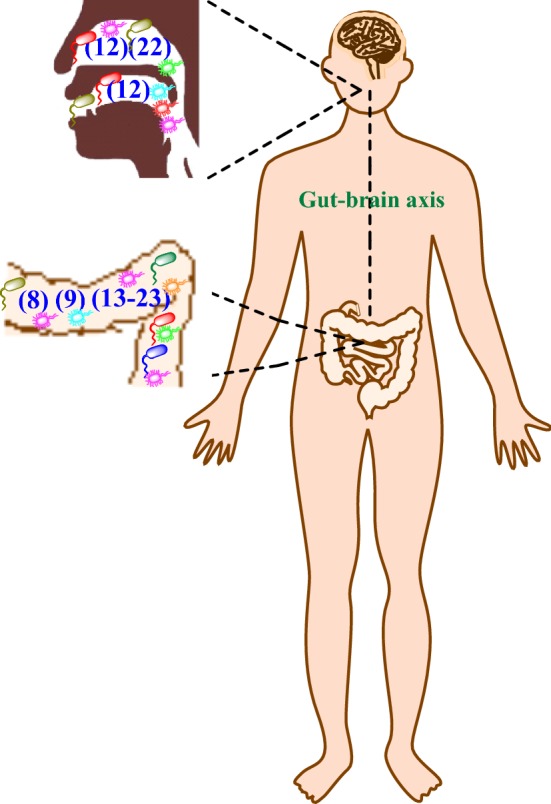
Parkinson's disease (PD) is the second most prevalent neurodegenerative disease, and in an effort to identify novel therapeutic target for this disease in recent years, human microbiota has attracted much interest. This paper briefly summarizes the main findings concerning the differences of human microbiome across several important mucosal interfaces, including nose, mouth, and gut between PD patients and controls as obtained from a total of 13 studies published since 2015, which covered a total of 943 PD patients and 831 matched controls from 6 countries. Overall, these studies supported the differences of gut microbiota between PD patients and matched controls, while significantly altered bacterial taxa among studies were not identical. Due to relatively limited number of available studies and covered patients, the associations between oral and nasal microbiota and PD remain inconclusive. The therapeutic and diagnostic potentials of gut microbiota for PD are discussed. More well-designed clinical studies recruiting large-scale PD patients are encouraged in future.
帕金森病(PD)是第二大常见的神经退行性疾病,近年来,为了寻找针对这种疾病的新的治疗靶点,人类微生物群引起了广泛关注。本文简要总结了自 2015 年以来总共发表的 13 项研究中,获得的关于 PD 患者和对照组在几个重要黏膜界面(包括鼻子、口腔和肠道)的人类微生物组差异的主要发现。这些研究共纳入了来自 6 个国家的 943 名 PD 患者和 831 名匹配对照,结果总体上支持 PD 患者与匹配对照组之间肠道微生物组的差异,但不同研究中显著改变的细菌分类群并不完全相同。由于现有研究和纳入患者的数量相对有限,口腔和鼻腔微生物组与 PD 之间的关联仍不确定。本文还讨论了肠道微生物组对 PD 的治疗和诊断潜力。鼓励未来开展更多设计良好的、招募大规模 PD 患者的临床研究。