Yang Xiaodong, Qian Yiwei, Xu Shaoqing, Song Yanyan, Xiao Qin
Department of Neurology, Ruijin Hospital, Shanghai Jiao Tong University School of Medicine, Shanghai, China.
Department of Biostatistics, Institute of Medical Sciences, Shanghai Jiao Tong University School of Medicine, Shanghai, China.
Front Aging Neurosci. 2018 Jan 8;9:441. doi: 10.3389/fnagi.2017.00441. eCollection 2017.
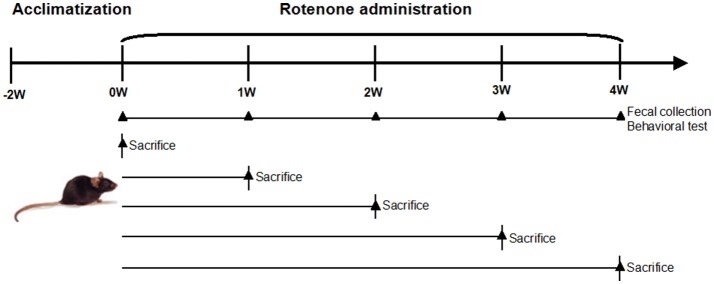
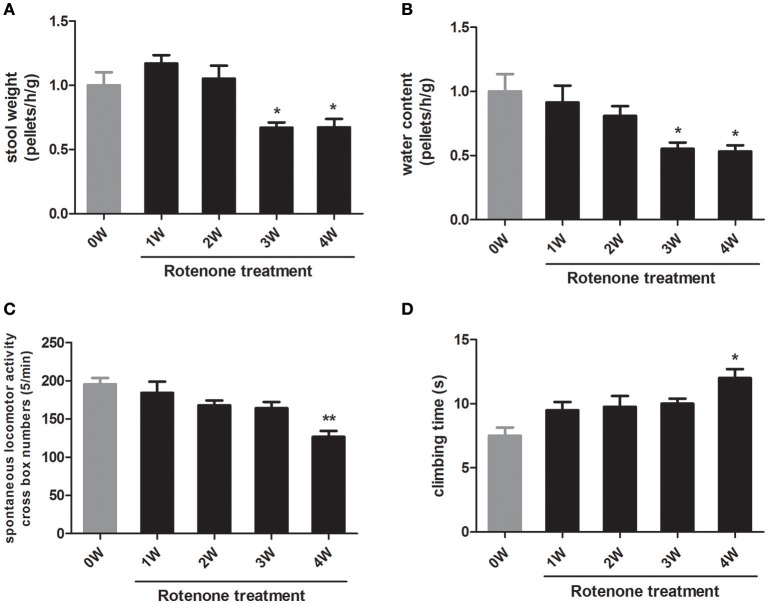
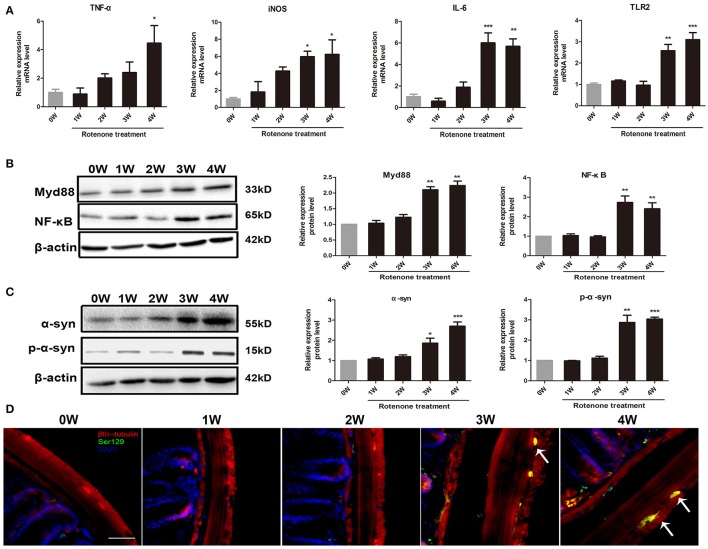
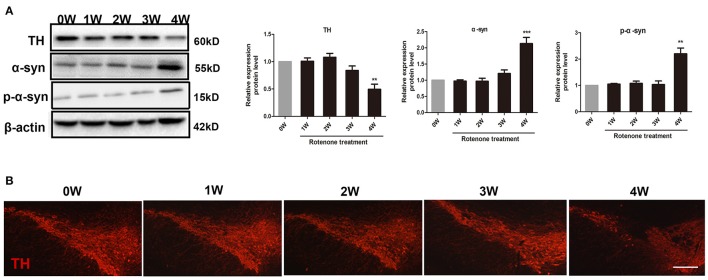
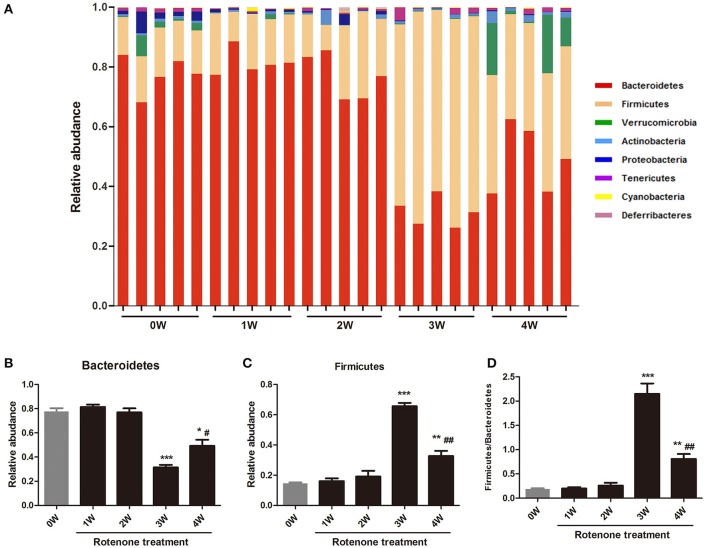
Recent studies reported an association between gut microbiota composition and Parkinson's disease (PD). However, we know little about the relationship between microbiome dysbiosis and the pathogenesis of PD. The objective of this study was to describe the evolution of fecal microbiota using an oral rotenone model of PD from a longitudinal study over a period of 4 weeks. Gastrointestinal function was assessed by measuring fecal pellet output, motor functions was assessed by open-field and pole tests every week. α-synuclein pathology, inflammation and tyrosine hydroxylase (TH) neuron loss from the middle brain were also analyzed. Fecal samples were collected every week followed by 16S rRNA sequencing and bioinformatics analysis. We reported that chronically oral administered rotenone caused gastrointestinal dysfunction and microbiome dysbiosis prior to motor dysfunction and central nervous system (CNS) pathology. 16S rRNA sequencing of fecal microbiome showed rotenone-treated mice exhibited fecal microbiota dysbiosis characterized by an overall decrease in bacterial diversity and a significant change of microbiota composition, notably members of the phyla Firmicutes and Bacteroidetes, with an increase in Firmicutes/Bacteroidetes ratio after 3 weeks of rotenone treatment. Moreover, rotenone-induced gastrointestinal and motor dysfunctions were observed to be robustly correlated with changes in the composition of fecal microbiota. Our results demonstrated that gut microbiome perturbation might contribute to rotenone toxicity in the initiation of PD and brought a new insight in the pathogenesis of PD. Novel therapeutic options aimed at modifying the gut microbiota composition might postpone the onset and following cascade of neurodegeneration.
最近的研究报道了肠道微生物群组成与帕金森病(PD)之间的关联。然而,我们对微生物群失调与PD发病机制之间的关系知之甚少。本研究的目的是通过为期4周的纵向研究,使用PD的口服鱼藤酮模型来描述粪便微生物群的演变。通过测量粪便颗粒输出量评估胃肠功能,每周通过旷场试验和杆式试验评估运动功能。还分析了中脑的α-突触核蛋白病理学、炎症和酪氨酸羟化酶(TH)神经元损失。每周收集粪便样本,随后进行16S rRNA测序和生物信息学分析。我们报告称,长期口服鱼藤酮在运动功能障碍和中枢神经系统(CNS)病理学之前就导致了胃肠功能障碍和微生物群失调。粪便微生物群的16S rRNA测序显示,鱼藤酮处理的小鼠表现出粪便微生物群失调,其特征是细菌多样性总体下降,微生物群组成发生显著变化,尤其是厚壁菌门和拟杆菌门的成员,鱼藤酮处理3周后厚壁菌门/拟杆菌门的比例增加。此外,观察到鱼藤酮诱导的胃肠和运动功能障碍与粪便微生物群组成的变化密切相关。我们的结果表明,肠道微生物群扰动可能在PD发病初期导致鱼藤酮毒性,并为PD的发病机制带来了新的见解。旨在改变肠道微生物群组成的新型治疗选择可能会推迟神经退行性变的发作及后续连锁反应。