Rajha Eva, Chaftari Patrick, Kamal Mona, Maamari Julian, Chaftari Christopher, Yeung Sai-Ching Jim
Department of Emergency Medicine, The University of Texas MD Anderson Cancer Center, Houston, TX, USA.
Schoool of Medicine, Lebanese American University, Byblos, Lebanon.
Gastroenterol Rep (Oxf). 2019 Dec 17;8(1):25-30. doi: 10.1093/gastro/goz065. eCollection 2020 Feb.
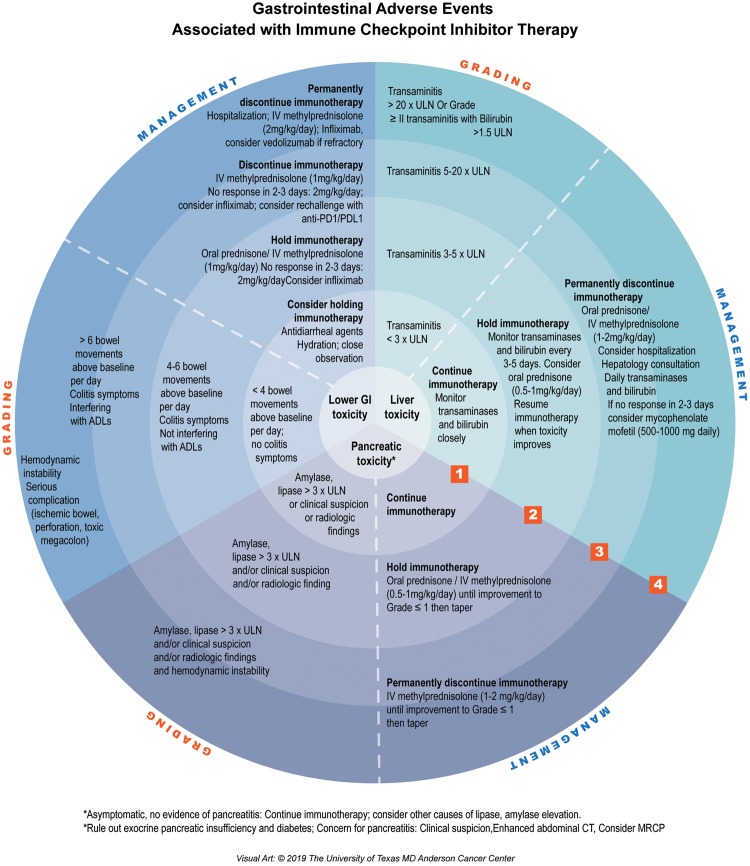
Immunotherapy with checkpoint inhibitors has revolutionized cancer therapy and is now the standard treatment for several different types of cancer, supported by favorable outcomes and good tolerance. However, it is linked to multiple immune manifestations, referred to as immune-related adverse events (irAEs). These adverse events frequently affect the skin, colon, endocrine glands, lungs, and liver. The gastrointestinal system is one of the most commonly affected organ systems and is responsible for the most frequent emergency visits resulting from irAEs. However, because immune checkpoint inhibitors are a recent addition to our arsenal of cancer drugs, many health-care providers remain unfamiliar with the management of irAEs. Gastroenterologists involved in the treatment of oncology patients who have received checkpoint inhibitors are currently encountering cases of abdominal pain, diarrhea, and other nonspecific symptoms that may be challenging to manage. This article reviews the gastrointestinal, hepatic, and pancreatic toxicities of checkpoint inhibitors and provides an approach to their diagnosis and recommended workup. It also highlights the management of irAEs according to their toxicity grading and specifically discusses the instances in which corticosteroids should be administered and/or the immune checkpoint inhibitors should be withheld.
使用检查点抑制剂进行免疫治疗已经彻底改变了癌症治疗方式,目前已成为几种不同类型癌症的标准治疗方法,其疗效良好且耐受性佳。然而,它与多种免疫表现相关,即免疫相关不良事件(irAE)。这些不良事件经常影响皮肤、结肠、内分泌腺、肺和肝脏。胃肠道系统是最常受影响的器官系统之一,也是因免疫相关不良事件导致急诊就诊最频繁的原因。然而,由于免疫检查点抑制剂是癌症药物库中的新成员,许多医疗保健提供者仍不熟悉免疫相关不良事件的管理。参与治疗接受过检查点抑制剂治疗的肿瘤患者的胃肠病学家目前正遇到腹痛、腹泻和其他非特异性症状的病例,这些症状可能难以处理。本文综述了检查点抑制剂的胃肠道、肝脏和胰腺毒性,并提供了其诊断方法和推荐的检查流程。它还根据毒性分级强调了免疫相关不良事件的管理,并特别讨论了应给予皮质类固醇和/或停用免疫检查点抑制剂的情况。