School of Social Sciences, Hellenic Open University, Parodos Aristotelous 18, Patras 26 335, Greece.
Biomed Res Int. 2020 Feb 12;2020:9379756. doi: 10.1155/2020/9379756. eCollection 2020.
This study aims to (i) translate, culturally adapt, and validate the Jefferson Scale of Patient Perception of Physician Empathy questionnaire for the Greek population (Gr-JSPPPE) and (ii) estimate physicians' self-assessed empathy and patients' perceptions of physicians' empathy, investigate their relationship, and assess their predictors.
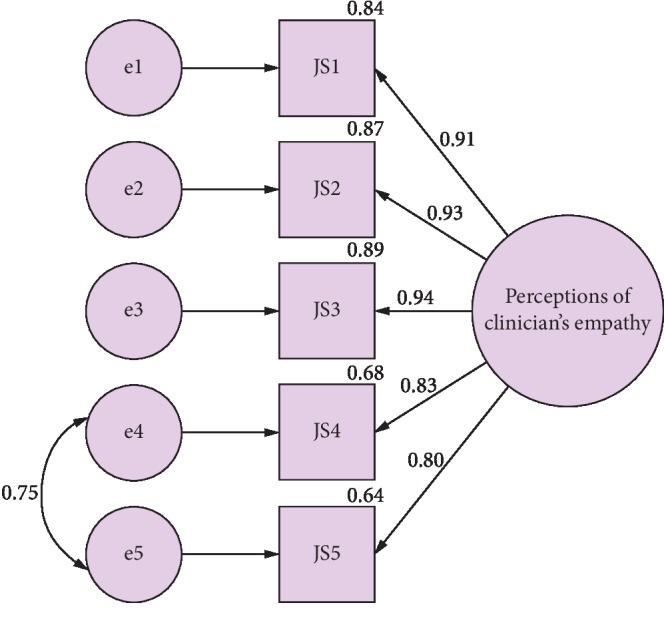
A total of 189 patients and 17 physicians from an internal medicine clinic took part in the study. A composite questionnaire was administered to the patients, consisting of (1) sociodemographic items, (2) hospitalization-related questions, (3) the Zung Self-Rating Anxiety Scale, (4) the Patient Health Questionnaire (PHQ-9), (5) the EQ-5D-5L Questionnaire, (6) the Gr-JSPPPE, and (7) the Visual Analog Scale for pain. The physicians' composite questionnaire comprised (1) sociodemographic items, (2) the EQ-5D-5L questionnaire, and (3) the Toronto Composite Empathy Scale (TCES). Exploratory and confirmatory factor analyses were conducted to assess the psychometric properties of the Gr-JS PPPE. Univariate comparisons were performed between (a) empathy measures and (b) sociodemographic and health-related measures of both groups; multivariate regression analysis for the Gr-JSPPPE adjusting for baseline confounders was executed.
Statistically significant negative correlations were found between the Gr-JSPPPE mean score and the TCES personal/cognitive, professional/cognitive, and professional/emotional subscales. Female sex, being married, duration of employment in current post, and physicians' EQ-5D index score emerged as important predictors of increased physician empathy. Patients' EQ-VAS "thermometer" scale was significantly associated with the Gr-JSPPPE total score at the multivariate level.
The Gr-JSPPPE is a psychometrically sound tool to assess patient perceptions of physician empathy. Physician empathy assessed by the self-reported scale is inversely associated with patient perceptions.
本研究旨在:(i)将杰斐逊医生同理心患者感知量表(Gr-JSPPPE)翻译、文化调适并验证为希腊语版本;(ii)评估医生的自我同理心评估和患者对医生同理心的感知,研究两者的关系,并评估其预测因素。
共有来自内科诊所的 189 名患者和 17 名医生参与了这项研究。向患者发放综合问卷,内容包括:(1)社会人口学项目;(2)住院相关问题;(3)zung 自评焦虑量表;(4)患者健康问卷(PHQ-9);(5)EQ-5D-5L 问卷;(6)Gr-JSPPPE;(7)疼痛视觉模拟量表。医生的综合问卷包括:(1)社会人口学项目;(2)EQ-5D-5L 问卷;(3)多伦多综合同理心量表(TCES)。采用探索性和验证性因子分析评估 Gr-JS PPPE 的心理测量特性。对两组患者的(a)同理心测量值和(b)社会人口学和健康相关测量值进行单变量比较;对 Gr-JSPPPE 进行多元回归分析,调整基线混杂因素。
Gr-JSPPPE 平均分与 TCES 个人/认知、专业/认知和专业/情感分量表呈显著负相关。女性、已婚、当前职位的工作年限和医生的 EQ-5D 指数得分是医生同理心增加的重要预测因素。患者的 EQ-VAS“温度计”量表在多变量水平上与 Gr-JSPPPE 总分显著相关。
Gr-JSPPPE 是评估患者对医生同理心感知的可靠心理测量工具。自我报告量表评估的医生同理心与患者的感知呈负相关。