National Heart and Lung Institute, Faculty of Medicine, Imperial College London, London, U.K.
Biochem Soc Trans. 2020 Feb 28;48(1):61-70. doi: 10.1042/BST20190247.
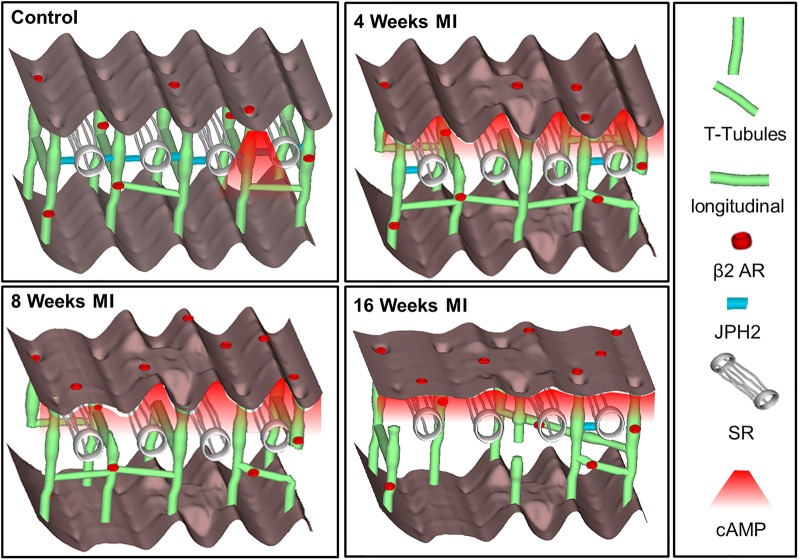
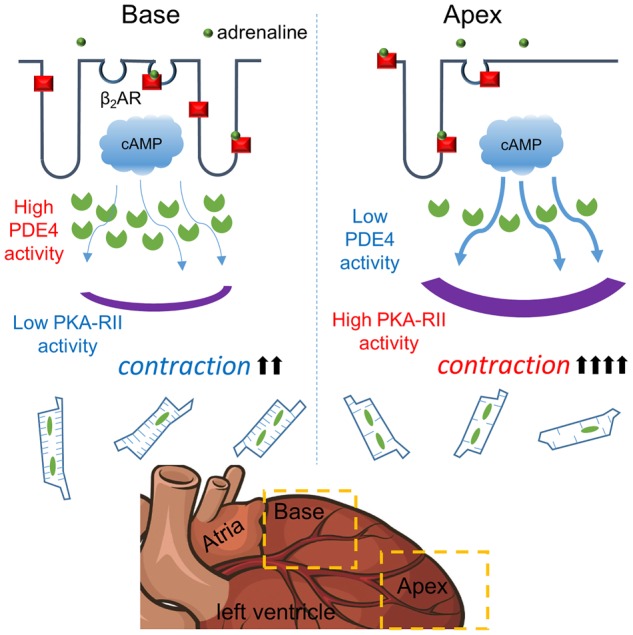
Multiple intra-cellular signalling pathways rely on calcium and 3'-5' cyclic adenosine monophosphate (cAMP) to act as secondary messengers. This is especially true in cardiomyocytes which act as the force-producing units of the cardiac muscle and are required to react rapidly to environmental stimuli. The specificity of functional responses within cardiomyocytes and other cell types is produced by the organellar compartmentation of both calcium and cAMP. In this review, we assess the role of molecular localisation and relative contribution of active and passive processes in producing compartmentation. Active processes comprise the creation and destruction of signals, whereas passive processes comprise the release or sequestration of signals. Cardiomyocytes display a highly articulated membrane structure which displays significant cell-to-cell variability. Special attention is paid to the way in which cell membrane caveolae and the transverse-axial tubule system allow molecular localisation. We explore the effects of cell maturation, pathology and regional differences in the organisation of these processes. The subject of signal compartmentation has had a significant amount of attention within the cardiovascular field and has undergone a revolution over the past two decades. Advances in the area have been driven by molecular imaging using fluorescent dyes and genetically encoded constructs based upon fluorescent proteins. We also explore the use of scanning probe microscopy in the area. These techniques allow the analysis of molecular compartmentation within specific organellar compartments which gives researchers an entirely new perspective.
多种细胞内信号通路依赖钙和 3'-5' 环磷酸腺苷 (cAMP) 作为第二信使发挥作用。这在心肌细胞中尤其如此,心肌细胞是心肌的力产生单位,需要迅速对环境刺激做出反应。心肌细胞和其他细胞类型中功能反应的特异性是由钙和 cAMP 的细胞器区室化产生的。在这篇综述中,我们评估了分子定位的作用以及主动和被动过程在产生区室化方面的相对贡献。主动过程包括信号的产生和破坏,而被动过程包括信号的释放或隔离。心肌细胞显示出高度发达的膜结构,表现出显著的细胞间变异性。特别关注细胞膜陷窝和横向轴突小管系统允许分子定位的方式。我们探讨了细胞成熟、病理学和这些过程组织的区域差异的影响。信号区室化在心血管领域受到了相当多的关注,并在过去二十年中经历了一场革命。该领域的进展是由使用荧光染料的分子成像和基于荧光蛋白的遗传编码构建体推动的。我们还探讨了扫描探针显微镜在该领域的应用。这些技术允许在特定细胞器区室中分析分子区室化,为研究人员提供了全新的视角。