Montefiore-Einstein Cancer Center, Montefiore Medical Center, Bronx, NY, USA.
University of Arkansas for Medical Sciences, Little Rock, AR, USA.
Haematologica. 2021 Mar 1;106(3):730-735. doi: 10.3324/haematol.2019.243386.
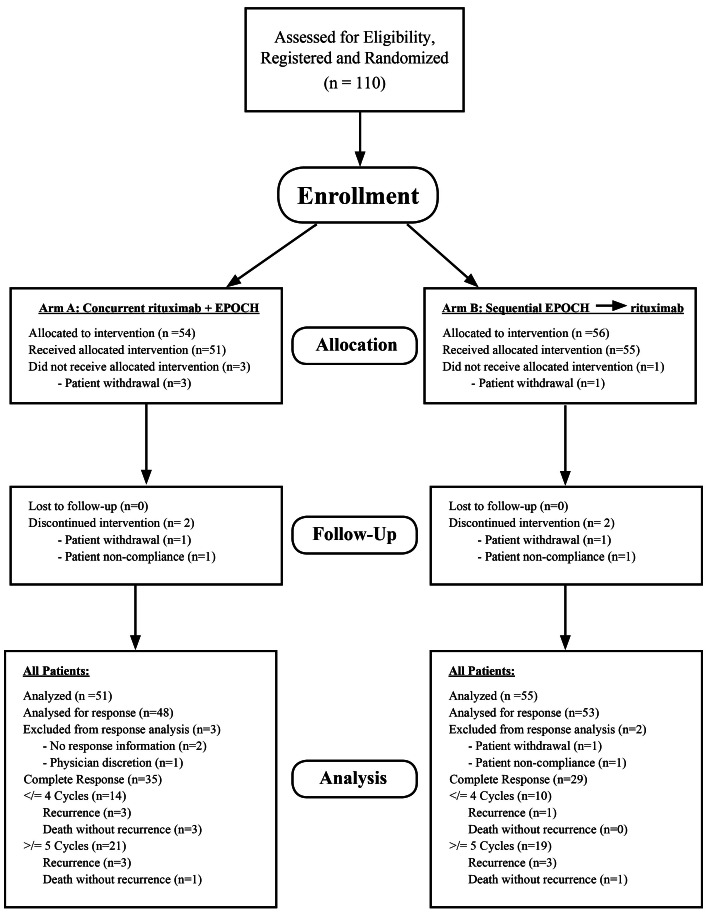
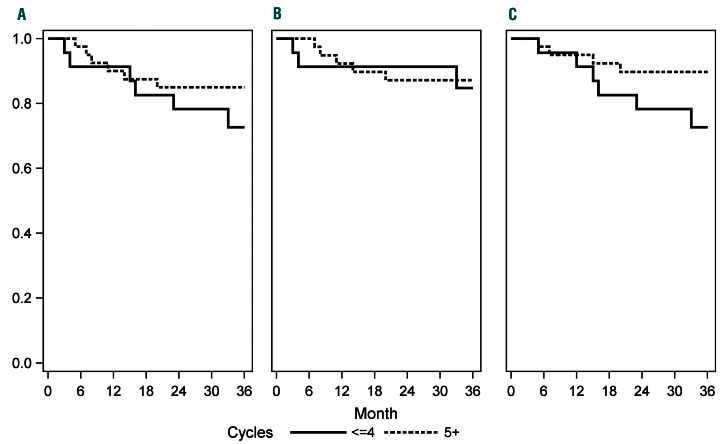
Four cycles of rituximab plus CHOP chemotherapy is as effective as 6 cycles in low-risk diffuse large B-cell lymphoma (DLBCL). Here we report a post-hoc analysis of a prospective clinical trial in patients with HIV-associated DLBCL and high-grade lymphoma treated with 4-6 cycles of EPOCH plus rituximab based a response-adapted treatment strategy. 106 evaluable patients with HIV-associated DLBCL or high-grade CD20-positive non-Hodgkin's lymphoma were randomized to receive rituximab (375 mg/m2) given either concurrently prior to each infusional EPOCH cycle, or sequentially (weekly for 6 weeks) following completion of EPOCH. EPOCH consisted of a 96-hour IV infusion of etoposide, doxorubicin, and vincristine plus oral prednisone followed by IV bolus cyclophosphamide every 21 days for 4 to 6 cycles. Patients received 2 additional cycles of therapy after documentation of a complete response (CR) by computerized tomography after cycles 2 and 4. 64 of 106 evaluable patients (60%, 95% CI 50%, 70%) had a CR in both treatment arms. The 2-year event-free survival (EFS) rates were similar in the 24 patients with CR who received 4 or fewer EPOCH cycles (78%, 95% confidence intervals [55%, 90%]) due to achieving a CR after 2 cycles, compared with those who received 5-6 cycles of EPOCH (85%, 95% CI 70%, 93%) because a CR was first documented after cycle 4. A response-adapted strategy may permit a shorter treatment duration without compromising therapeutic efficacy in patients with HIV-associated lymphoma treated with EPOCH plus rituximab, which merits further evaluation in additional prospective trials. Clinical Trials.gov identifier NCT00049036.
四项周期的利妥昔单抗联合 CHOP 化疗与六项周期的利妥昔单抗联合 CHOP 化疗在低危弥漫性大 B 细胞淋巴瘤(DLBCL)中同样有效。在这里,我们报告了一项前瞻性临床试验的事后分析,该试验针对的是接受基于反应适应性治疗策略的 4-6 个周期 EPOCH 加利妥昔单抗治疗的 HIV 相关弥漫性大 B 细胞淋巴瘤和高级别淋巴瘤患者。106 例可评估的 HIV 相关弥漫性大 B 细胞淋巴瘤或高级别 CD20 阳性非霍奇金淋巴瘤患者被随机分为两组,一组在每个 EPOCH 周期前同时给予利妥昔单抗(375mg/m2),另一组在 EPOCH 完成后序贯(每周 6 周)给予利妥昔单抗。EPOCH 包括为期 96 小时的静脉注射依托泊苷、多柔比星和长春新碱加口服泼尼松,随后每 21 天静脉注射环磷酰胺,共 4-6 个周期。在第 2 周期和第 4 周期后通过计算机断层扫描(CT)检查记录到完全缓解(CR)后,患者接受了另外 2 个周期的治疗。在两组治疗中,106 例可评估患者中有 64 例(60%,95%置信区间 [50%,70%])达到了 CR。在 24 例接受 4 个或更少 EPOCH 周期的 CR 患者中,由于在第 2 周期后获得 CR,2 年无事件生存率(EFS)率相似(78%,95%置信区间 [55%,90%]),而接受 5-6 个 EPOCH 周期的患者则不同(85%,95%置信区间 [70%,93%]),因为 CR 首先在第 4 周期后被记录。对于接受 EPOCH 加利妥昔单抗治疗的 HIV 相关淋巴瘤患者,反应适应性策略可能允许缩短治疗持续时间而不影响治疗效果,这值得在其他前瞻性试验中进一步评估。临床试验注册编号 NCT00049036。