Swedish University of Agricultural Sciences, Department of Aquatic Resources, Institute of Coastal Research, Skolgatan 6, 74242, Öregrund, Sweden.
Swedish Agency of Water and Marine Management, Gullbergs Strandgata 15, 41104, Göteborg, Sweden.
Environ Manage. 2020 May;65(5):575-586. doi: 10.1007/s00267-020-01260-1. Epub 2020 Feb 27.
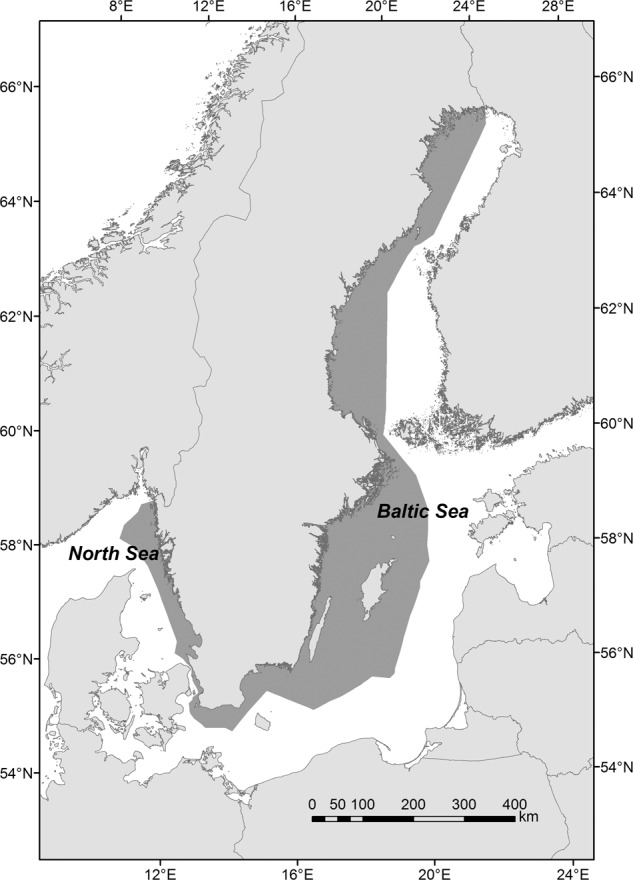
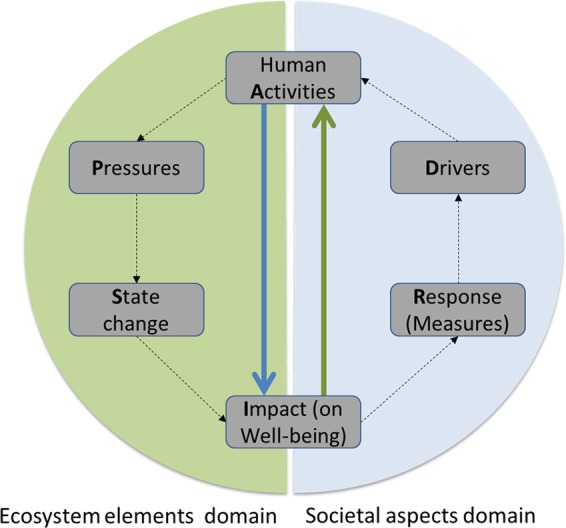
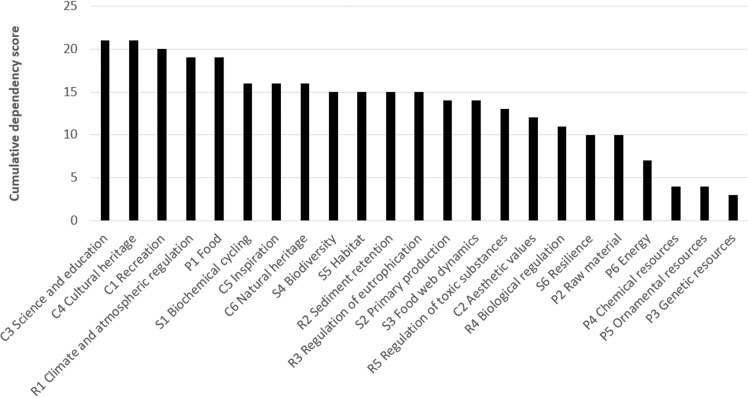
Understanding and communicating the links among human activities and marine ecosystem services are fundamental for ecosystem-based management, which aims at attaining ecological, economic and social sustainability in the use of our seas. Relationships are typically complex and may differ between geographic areas. Here, an assessment model that combines available quantitative, semi-quantitative and qualitative information, rooted in the DAPSIR (Driver-Activity-Pressure-State-Impact-Response) framework and assessment requirements of the EU Marine Strategy Framework Directive, is developed and applied. Focusing on Swedish marine waters, major human activities at sea are evaluated in relation to their dependencies and impacts on the status of marine ecosystem services. This case study is a consensus assessment based on evaluation of available literature and data. By relating degrees of dependencies and impacts to values of different economic sectors, discrepancies among sectors with respect to their impact versus their monetary value can be identified. In our case, commercial fishing depends on and influences a wide range of ecosystem services, while other sectors, such as shipping, depend little on marine ecosystem services. At the extreme end of the range, pressures from human activities in the past, such as historical nutrient emissions, still have prominent influence on ecosystem services today, entailing considerable losses. Marine tourism and commercial fishing show similar dependencies on ecosystem services, but tourism has a clearly lower impact on ecosystem services and a higher monetary value. The model may serve as a useful tool for communicating and guiding priorities in integrated environmental management and maritime spatial planning.
理解和沟通人类活动与海洋生态系统服务之间的联系是基于生态系统的管理的基础,其目的是实现海洋利用的生态、经济和社会可持续性。这些关系通常很复杂,并且在不同的地理区域之间可能有所不同。在这里,开发并应用了一种评估模型,该模型结合了可用的定量、半定量和定性信息,其基础是 DAPSIR(驱动因素-活动-压力-状态-影响-响应)框架和欧盟海洋战略框架指令的评估要求。以瑞典沿海水域为例,评估了主要的海上人类活动与其对海洋生态系统服务状况的依赖关系和影响。本案例研究是基于对现有文献和数据的评估达成的共识评估。通过将依赖程度和影响程度与不同经济部门的价值联系起来,可以确定各部门在其影响与其货币价值之间的差异。在我们的案例中,商业捕鱼依赖于并影响广泛的生态系统服务,而其他部门,如航运,对海洋生态系统服务的依赖程度较低。在范围的极端,过去人类活动的压力,如历史养分排放,仍然对今天的生态系统服务产生显著影响,导致了相当大的损失。海洋旅游和商业捕鱼对生态系统服务有类似的依赖关系,但旅游业对生态系统服务的影响较小,货币价值较高。该模型可作为沟通和指导综合环境管理和海洋空间规划优先事项的有用工具。