Valleywise Health Medical Center (formerly known as Maricopa Integrated Health System), Phoenix, Arizona, USA.
MiraVista Diagnostics, Indianapolis, Indiana, USA.
Clin Infect Dis. 2021 Mar 15;72(6):968-975. doi: 10.1093/cid/ciaa188.
Antibody detection is the main method for diagnosis of coccidioidomycosis, but it has limitations. The Coccidioides antigen enzyme immunoassay is recommended for testing cerebrospinal fluid in suspected meningitis. Reports on urine and serum antigen detection evaluated small numbers of patients who were mostly immunocompromised. The purpose of this study was to assess the accuracy of combined antibody and antigen detection for diagnosis.
A retrospective study, including all patients in whom Coccidioides antigen detection in serum was performed between January 2013 and May 2017, was conducted at Valleywise Health Medical Center (formerly Maricopa Integrated Health System). Sensitivity and specificity of antigen and antibody were evaluated in 158 cases and 487 controls.
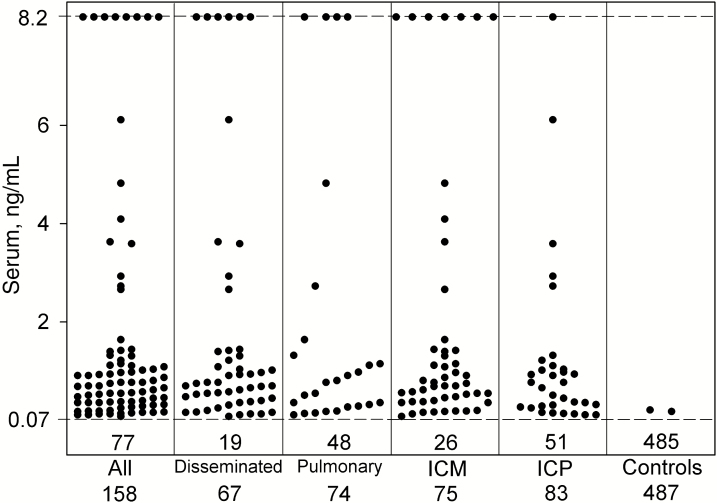
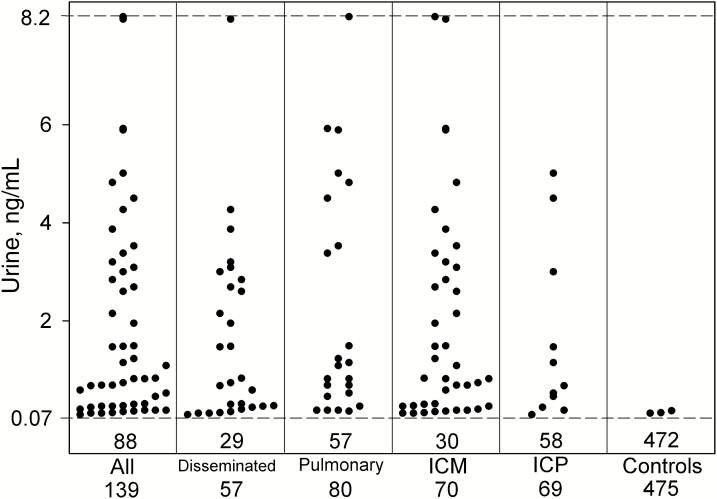
The sensitivity of antibody detection by immunodiffusion (ID) was 84.2%. The sensitivity of antigen detection was 57.0% if both urine and serum were tested and 36.7% if urine alone was tested. The sensitivity of combining antigen and ID antibody detection was 93.0%. The sensitivity of urine and serum antigen detection was 55.4% in proven and 58.7% in probable cases, 79.1% in disseminated and 41.6% in pulmonary cases, and 74.7% in immunocompromised and 40.0% in immunocompetent patients. Specificity was 99.4% for antigen detection and 96.5% for ID antibody detection. Diagnostic accuracy was 95.4% for ID antibody and antigen detection, 93.6% for ID antibody alone, and 89.1% for pathology or culture.
These findings support combined antibody and antigen detection for diagnosis of progressive coccidioidomycosis. The diagnosis may have been missed if antigen detection was not performed.
抗体检测是诊断球孢子菌病的主要方法,但存在局限性。对于疑似脑膜炎的患者,推荐使用球孢子菌抗原酶免疫测定法检测脑脊液。有关尿和血清抗原检测的报告评估了数量较少的患者,这些患者大多免疫功能低下。本研究的目的是评估联合抗体和抗原检测诊断的准确性。
在 Valleywise 健康医疗中心(前身为马里科帕综合卫生系统)进行了一项回顾性研究,纳入了 2013 年 1 月至 2017 年 5 月间进行血清球孢子菌抗原检测的所有患者。在 158 例病例和 487 例对照中评估了抗原和抗体的敏感性和特异性。
免疫扩散(ID)检测抗体的敏感性为 84.2%。如果同时检测尿液和血清,抗原检测的敏感性为 57.0%;如果仅检测尿液,敏感性为 36.7%。联合抗原和 ID 抗体检测的敏感性为 93.0%。在确诊和可能病例中,尿液和血清抗原检测的敏感性分别为 55.4%和 58.7%;在播散性和肺部病例中分别为 79.1%和 41.6%;在免疫功能低下和免疫功能正常的患者中分别为 74.7%和 40.0%。抗原检测的特异性为 99.4%,ID 抗体检测的特异性为 96.5%。ID 抗体和抗原联合检测的诊断准确性为 95.4%,ID 抗体单独检测的准确性为 93.6%,病理学或培养检测的准确性为 89.1%。
这些发现支持联合抗体和抗原检测用于诊断进行性球孢子菌病。如果未进行抗原检测,可能会导致诊断遗漏。