German Center for Neurodegenerative Diseases (DZNE), Site Rostock/Greifswald, Ellernholzstrasse 1-2, 17487, Greifswald, Germany.
Department of Health Research Methods, Evidence and Impact (Formerly Clinical Epidemiology and Biostatistics), McMaster University, 1280 Main Street West, Hamilton, Canada.
Eur J Health Econ. 2020 Jul;21(5):717-728. doi: 10.1007/s10198-020-01166-z. Epub 2020 Feb 27.
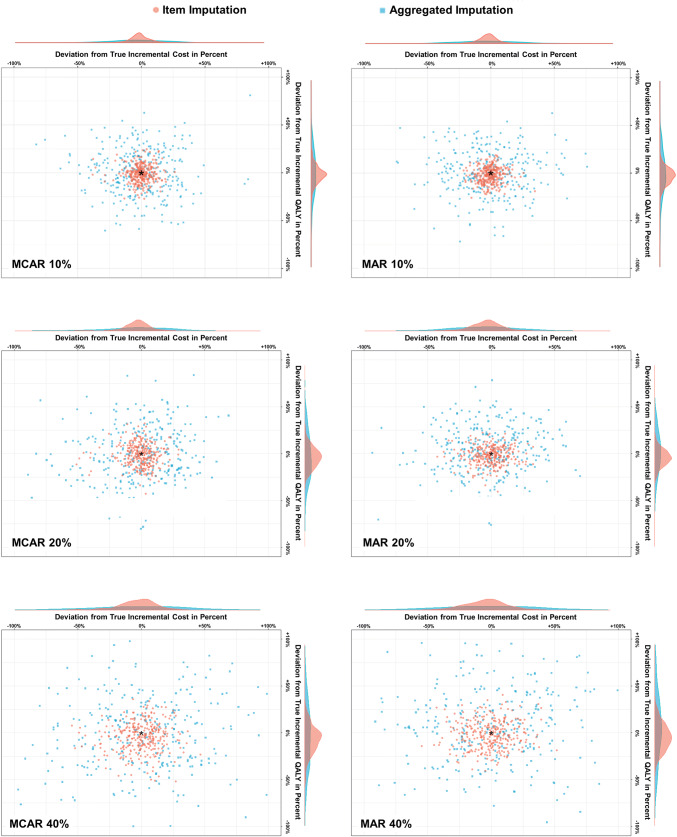
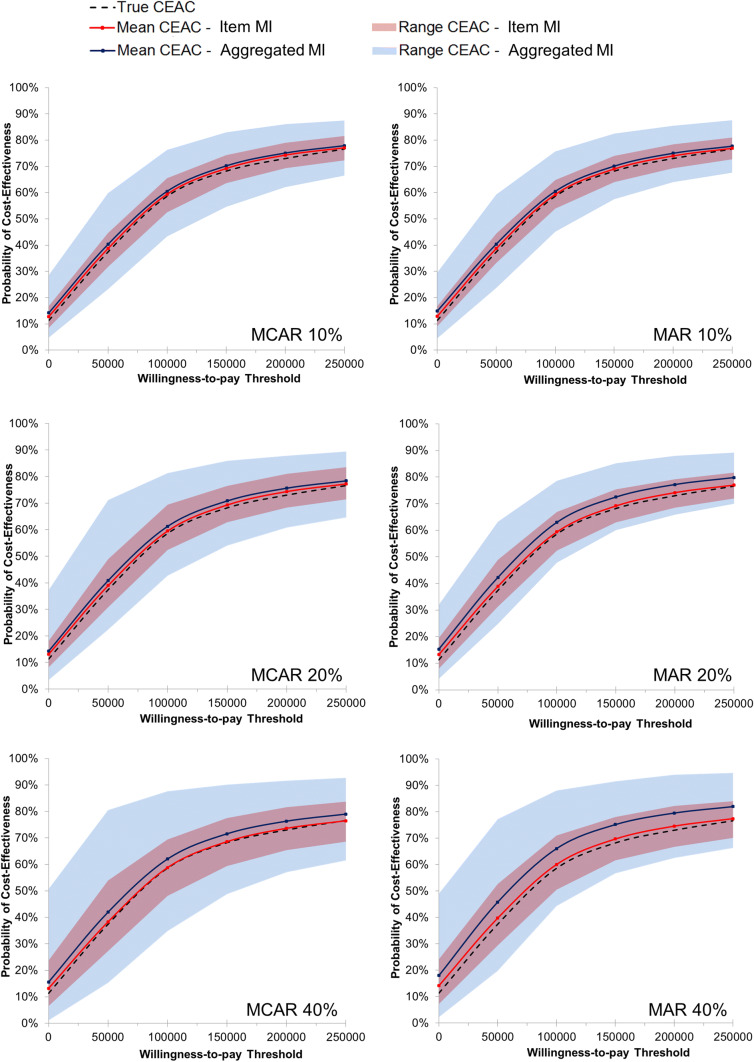
Outcomes in economic evaluations, such as health utilities and costs, are products of multiple variables, often requiring complete item responses to questionnaires. Therefore, missing data are very common in cost-effectiveness analyses. Multiple imputations (MI) are predominately recommended and could be made either for individual items or at the aggregate level. We, therefore, aimed to assess the precision of both MI approaches (the item imputation vs. aggregate imputation) on the cost-effectiveness results. The original data set came from a cluster-randomized, controlled trial and was used to describe the missing data pattern and compare the differences in the cost-effectiveness results between the two imputation approaches. A simulation study with different missing data scenarios generated based on a complete data set was used to assess the precision of both imputation approaches. For health utility and cost, patients more often had a partial (9% vs. 23%, respectively) rather than complete missing (4% vs. 0%). The imputation approaches differed in the cost-effectiveness results (the item imputation: - 61,079€/QALY vs. the aggregate imputation: 15,399€/QALY). Within the simulation study mean relative bias (< 5% vs. < 10%) and range of bias (< 38% vs. < 83%) to the true incremental cost and incremental QALYs were lower for the item imputation compared to the aggregate imputation. Even when 40% of data were missing, relative bias to true cost-effectiveness curves was less than 16% using the item imputation, but up to 39% for the aggregate imputation. Thus, the imputation strategies could have a significant impact on the cost-effectiveness conclusions when more than 20% of data are missing. The item imputation approach has better precision than the imputation at the aggregate level.
经济评估的结果(如健康效用和成本)是多个变量的产物,通常需要完整的问卷项目应答来实现。因此,成本效益分析中非常常见数据缺失。多重插补(MI)是主要推荐的方法,可以对单个项目或汇总水平进行插补。因此,我们旨在评估两种 MI 方法(单项插补与汇总插补)对成本效益结果的精度。原始数据集来自一项集群随机对照试验,用于描述缺失数据模式,并比较两种插补方法在成本效益结果上的差异。使用基于完整数据集生成的不同缺失数据情景的模拟研究来评估两种插补方法的精度。对于健康效用和成本,患者更常出现部分缺失(分别为 9%和 23%)而不是完全缺失(分别为 4%和 0%)。两种插补方法在成本效益结果上存在差异(单项插补:-61079€/QALY 与汇总插补:15399€/QALY)。在模拟研究中,与真实增量成本和增量 QALYs 的平均相对偏差(<5%与<10%)和偏差范围(<38%与<83%)相比,单项插补的范围更小。即使有 40%的数据缺失,使用单项插补时,对真实成本效益曲线的相对偏差也小于 16%,但使用汇总插补时,相对偏差高达 39%。因此,当缺失数据超过 20%时,插补策略可能会对成本效益结论产生重大影响。单项插补方法比汇总水平插补方法更精确。