Jian Liumeng, Yang Guangda
Department of Neurology, Zengcheng District People's Hospital of Guangzhou, (BoJi-Affiliated Hospital of Sun Yat-Sen University), Guangzhou, People's Republic of China.
Department of Cancer Chemotherapy, Zengcheng District People's Hospital of Guangzhou (BoJi-Affiliated Hospital of Sun Yat-Sen University), Guangzhou, People's Republic of China.
Diabetes Metab Syndr Obes. 2020 Feb 19;13:463-476. doi: 10.2147/DMSO.S235011. eCollection 2020.
Diabetes mellitus (DM) patients suffer from high morbidity and premature mortality due to various diabetic complications and even cancers. Therefore, this study aimed to identify key genes involved in the pathogenesis of diabetic peripheral neuropathy (DPN) and pancreatic cancer (PC).
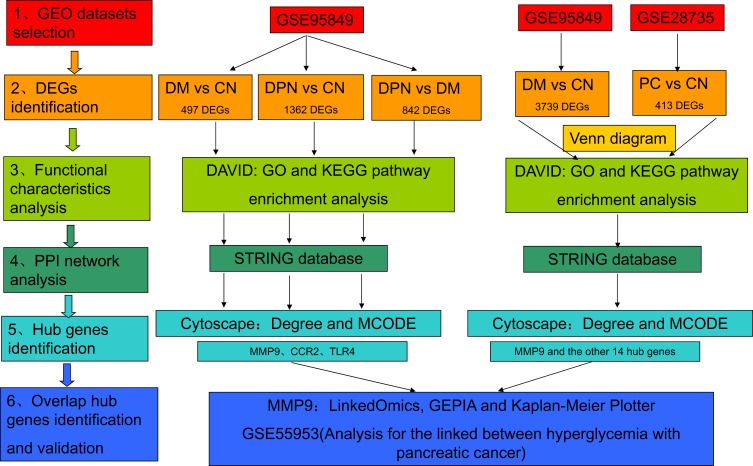
We analyzed three gene expression profiles (GSE95849, GSE28735 and GSE59953) to obtain differentially expressed genes (DEGs). Then, Gene Ontology (GO) analysis and Kyoto Encyclopedia of Genes and Genomes (KEGG) pathway analysis were performed by using the Database for Annotation, Visualization, and Integrated Discovery (DAVID). The Search Tool for the Retrieval of Interacting Genes/Proteins (STRING) database was then used to establish a protein-protein interaction (PPI) network. The MCODE and cytoHubba plug-ins of Cytoscape were used to select hub genes. Finally, survival analysis of the hub genes was performed using the Kaplan-Meier plotter and GEPIA online tool.
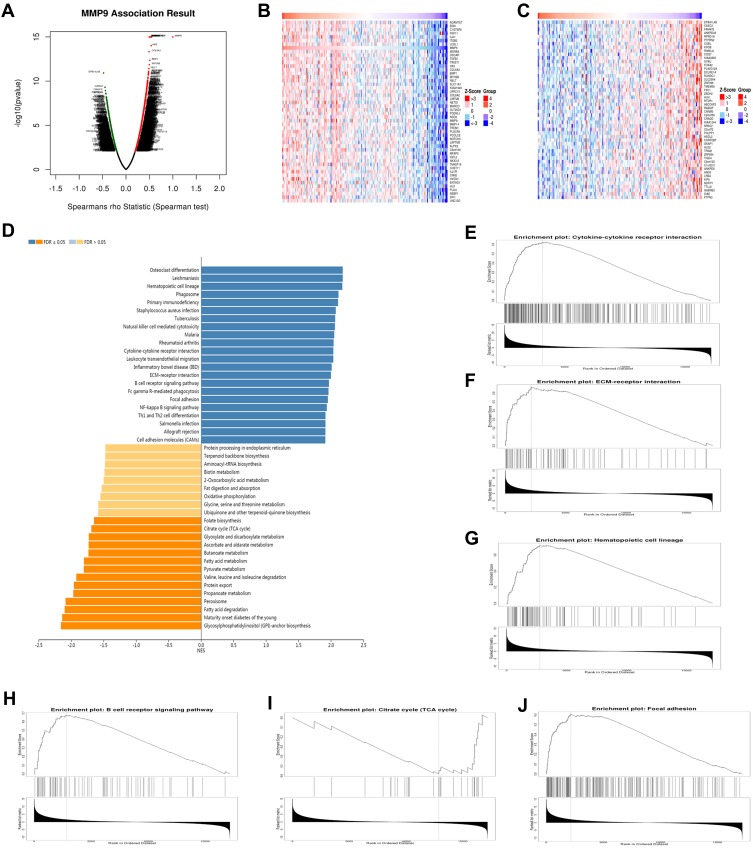
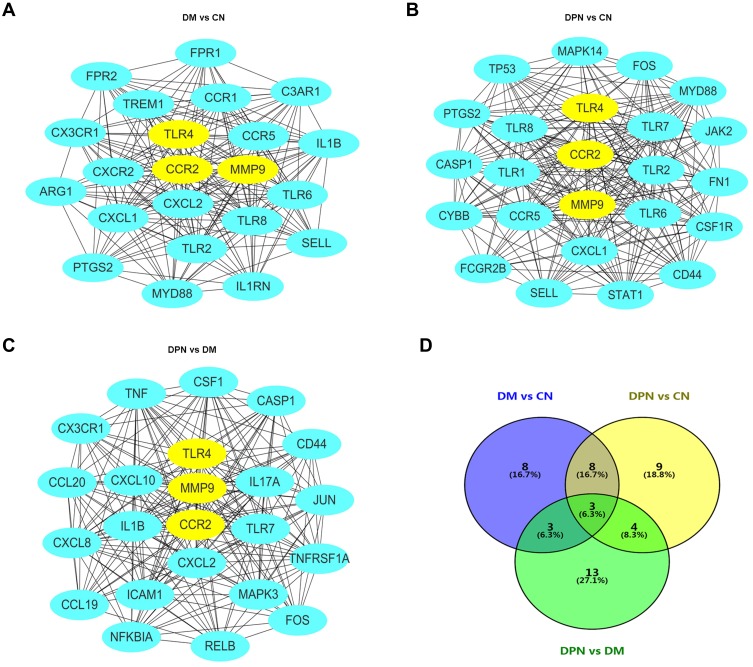
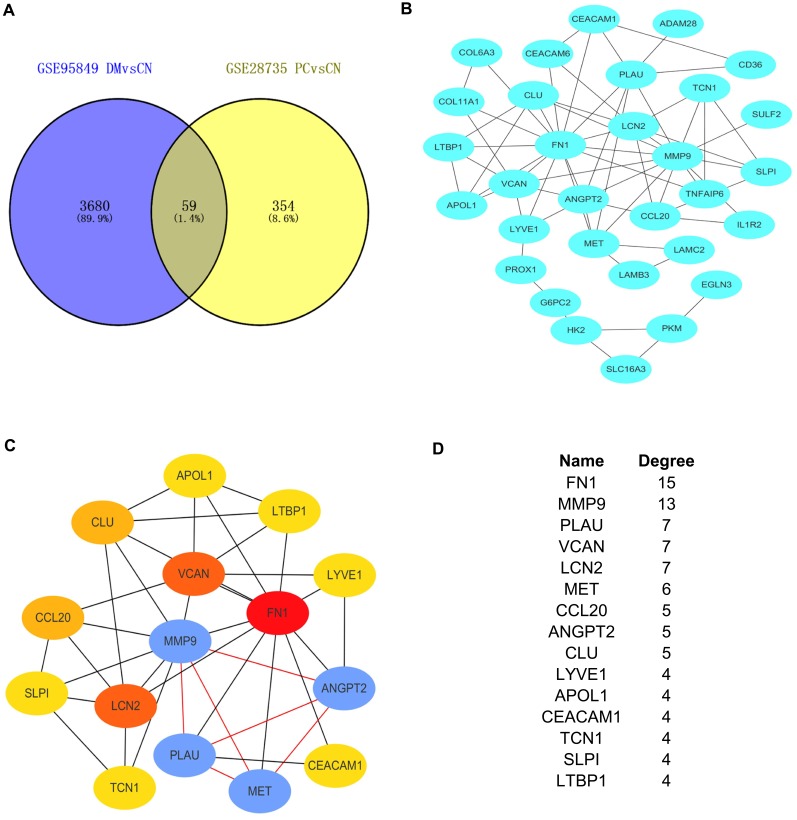
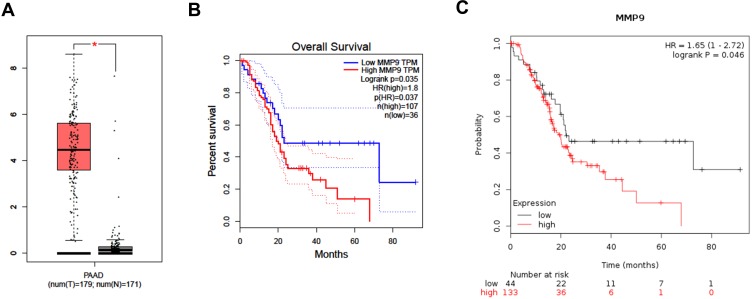
We first analyzed GSE95849 to obtain DPN-related genes. DEGs were obtained from three groups in GSE95849. The DEGs were enriched in the Toll-like receptor signaling pathway, hematopoietic cell lineage and chemokine signaling pathway. Importantly, we identified three shared genes as hub genes, including TLR4, CCR2 and MMP9. We then analyzed and integrated GSE95849 and GSE28735 to obtain genes common in DM and PC. A total of 58 mutual DEGs were identified, and these DEGs were enriched in the ECM-receptor interaction, focal adhesion and pathways in cancer. Five hub genes (including PLAU, MET, CLU, APOL1 and MMP9) were associated with the overall survival of PC patients. However, the results from the analysis of GSE59953 showed that hyperglycemia or TGF-β1 treatment did not affect the expression level of these hub genes, but the DEGs based on hyperglycemia or TGF-β1 treatment were mostly enriched in the ECM-receptor interaction, focal adhesion and pathways in cancer. Finally, functional enrichment analysis of MMP9 showed that significant genes correlated with MMP9 were associated with the tumorigenicity of cancers, insulin resistance, development of DM and inflammation.
In summary, inflammation and immunity-related pathways may play an important role in DM and DPN, while the ECM-receptor interaction, focal adhesion and pathways in cancer pathways may play significant roles in DM and PC. MMP9 may be used as a prognostic marker for PC and may be helpful for the treatment of DM, DPN and PC.
糖尿病(DM)患者由于各种糖尿病并发症甚至癌症而具有高发病率和过早死亡率。因此,本研究旨在鉴定参与糖尿病周围神经病变(DPN)和胰腺癌(PC)发病机制的关键基因。
我们分析了三个基因表达谱(GSE95849、GSE28735和GSE59953)以获得差异表达基因(DEG)。然后,使用注释、可视化和综合发现数据库(DAVID)进行基因本体(GO)分析和京都基因与基因组百科全书(KEGG)通路分析。接着使用检索相互作用基因/蛋白质的搜索工具(STRING)数据库建立蛋白质-蛋白质相互作用(PPI)网络。使用Cytoscape的MCODE和cytoHubba插件选择枢纽基因。最后,使用Kaplan-Meier绘图仪和GEPIA在线工具对枢纽基因进行生存分析。
我们首先分析GSE95849以获得与DPN相关的基因。从GSE95849的三组中获得了DEG。这些DEG在Toll样受体信号通路、造血细胞谱系和趋化因子信号通路中富集。重要的是,我们鉴定出三个共享基因作为枢纽基因,包括TLR4、CCR2和MMP9。然后我们分析并整合GSE95849和GSE28735以获得DM和PC中共同的基因。共鉴定出58个共同的DEG,这些DEG在细胞外基质-受体相互作用、粘着斑和癌症通路中富集。五个枢纽基因(包括PLAU、MET、CLU、APOL1和MMP9)与PC患者的总生存期相关。然而,对GSE59953的分析结果表明,高血糖或TGF-β1处理不影响这些枢纽基因的表达水平,但基于高血糖或TGF-β1处理的DEG大多在细胞外基质-受体相互作用、粘着斑和癌症通路中富集。最后,对MMP9的功能富集分析表明,与MMP9相关的显著基因与癌症的致瘤性、胰岛素抵抗、DM的发展和炎症相关。
总之,炎症和免疫相关通路可能在DM和DPN中起重要作用,而细胞外基质-受体相互作用、粘着斑和癌症通路可能在DM和PC中起重要作用。MMP9可用作PC的预后标志物,可能有助于DM、DPN和PC的治疗。