Thomsen Louise T, Kjær Susanne K, Munk Christian, Frederiksen Kirsten, Ørnskov Dorthe, Waldstrøm Marianne
Unit of Virus, Lifestyle and Genes, Danish Cancer Society Research Center, Copenhagen, Denmark.
Department of Gynecology, Copenhagen University Hospital Rigshospitalet, Copenhagen, Denmark.
Clin Epidemiol. 2020 Feb 21;12:203-213. doi: 10.2147/CLEP.S243546. eCollection 2020.
Human papillomavirus (HPV) testing is increasingly used as the primary cervical cancer screening test. In a large pilot implementation, we compared participation, referrals and detection of high-grade cervical intraepithelial neoplasia (CIN) in HPV- versus cytology-based cervical cancer screening.
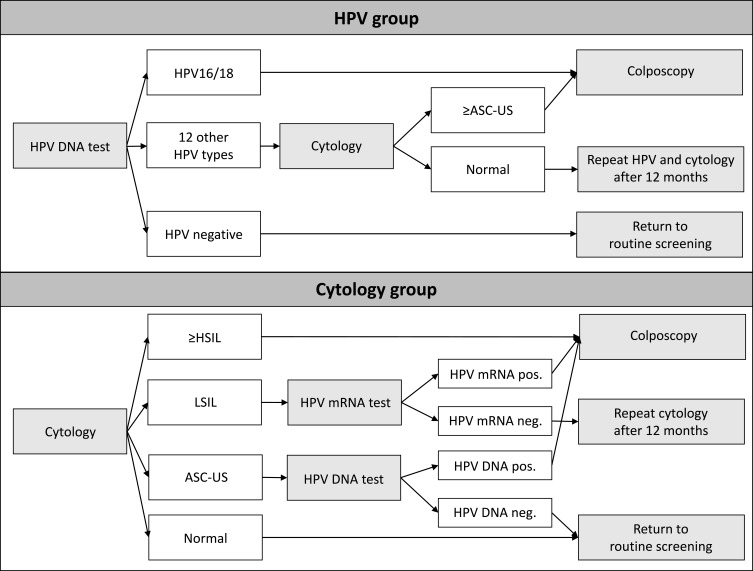
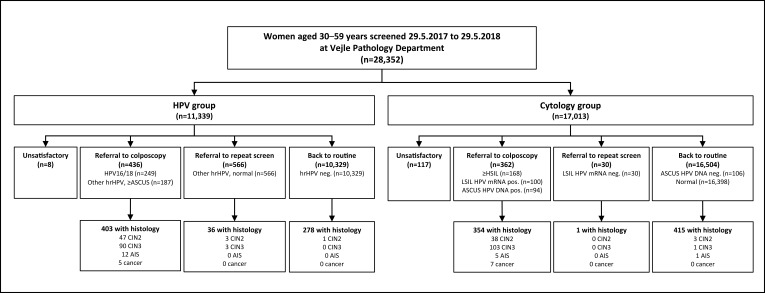
The implementation was embedded into the routine screening program at Lillebaelt Hospital, Department of Pathology, Vejle, Denmark. Based on the area of residence, women aged 30-59 years were screened by either HPV testing (with HPV16/18 genotyping and cytology triage) or cytology (with HPV triage for minor abnormalities). Our analysis includes women invited or screened during May 2017-May 2018 (invited: n=35,081; screened: n=28,352) with 6 months of follow-up. Information on screening results and sociodemographic characteristics were obtained from registers. Using logistic regression, we estimated odds ratios (ORs) with 95% confidence intervals (CIs) of participation, referral and CIN3+-detection in HPV- versus cytology-based screening, adjusting for sociodemographic characteristics.
Participation was virtually identical in the HPV- and cytology group (58.4% vs 58.8%; OR=0.97, 95% CI, 0.93-1.01). Referral to colposcopy was more common in the HPV- than cytology group (3.8% vs 2.1%; OR=1.88, 95% CI, 1.63-2.17). More cases of CIN3+ were detected in the HPV- than cytology group (1.0% vs 0.7%, OR=1.47; 95% CI, 1.13-1.91).
Participation did not differ between HPV- and cytology-based screening. HPV-based screening detected more cases of CIN3+, but in this initial screening round also led to more colposcopies than cytology-based screening.
人乳头瘤病毒(HPV)检测越来越多地被用作宫颈癌的主要筛查检测方法。在一项大型试点实施中,我们比较了基于HPV与基于细胞学的宫颈癌筛查中高级别宫颈上皮内瘤变(CIN)的参与率、转诊率和检出率。
该实施被纳入丹麦韦勒市利勒拜尔医院病理科的常规筛查项目。根据居住区域,30至59岁的女性通过HPV检测(进行HPV16/18基因分型和细胞学分流)或细胞学检查(对轻微异常进行HPV分流)进行筛查。我们的分析包括在2017年5月至2018年5月期间受邀或接受筛查的女性(受邀:n = 35,081;筛查:n = 28,352),并进行了6个月的随访。筛查结果和社会人口统计学特征信息从登记册中获取。使用逻辑回归,我们估计了基于HPV与基于细胞学的筛查中参与、转诊和CIN3 + 检测的优势比(OR)及95%置信区间(CI),并对社会人口统计学特征进行了调整。
HPV组和细胞学组的参与率几乎相同(58.4%对58.8%;OR = 0.97,95% CI,0.93 - 1.01)。HPV组转诊至阴道镜检查比细胞学组更常见(3.8%对2.1%;OR = 1.88,95% CI,1.63 - 2.17)。HPV组检测到的CIN3 + 病例比细胞学组更多(1.0%对0.7%,OR = 1.47;95% CI,1.13 - 1.91)。
基于HPV和基于细胞学的筛查在参与率上没有差异。基于HPV的筛查检测到更多CIN3 + 病例,但在这第一轮筛查中,也比基于细胞学的筛查导致更多的阴道镜检查。