Chen Lanlan, Xu Shuai, Li Wei, Ren Tianbing, Yuan Lin, Zhang Shusheng, Zhang Xiao-Bing
Collaborative Innovation Center of Tumor Marker Detection Technology , Equipment and Diagnosis-Therapy Integration in Universities of Shandong , Shandong Provincial Key Laboratory of Detection Technology for Tumor Markers , College of Chemistry and Chemical Engineering , Linyi University , Linyi , Shandong 276005 , P. R. China . Email:
The Key Lab of Analysis and Detection Technology for Food Safety of the MOE , College of Chemistry , Fuzhou University , Fuzhou 350002 , P. R. China.
Chem Sci. 2019 Aug 20;10(40):9351-9357. doi: 10.1039/c9sc03781k. eCollection 2019 Oct 28.
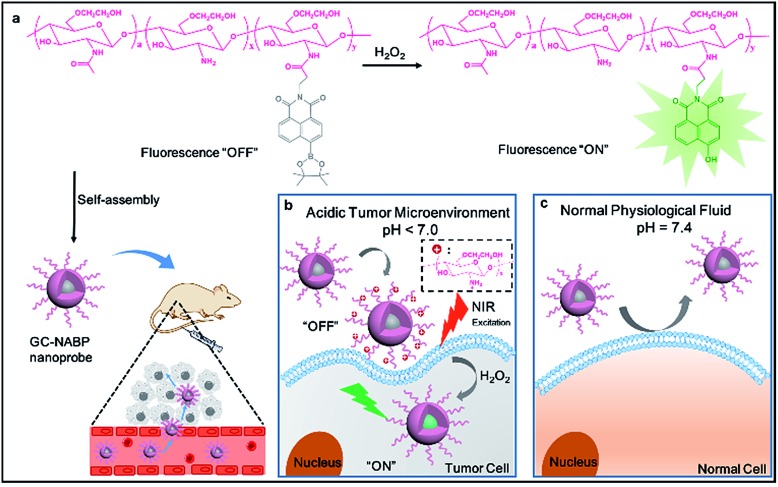
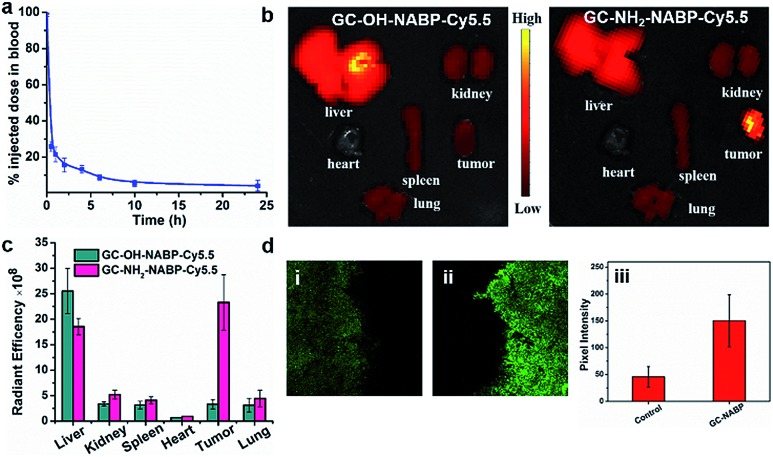
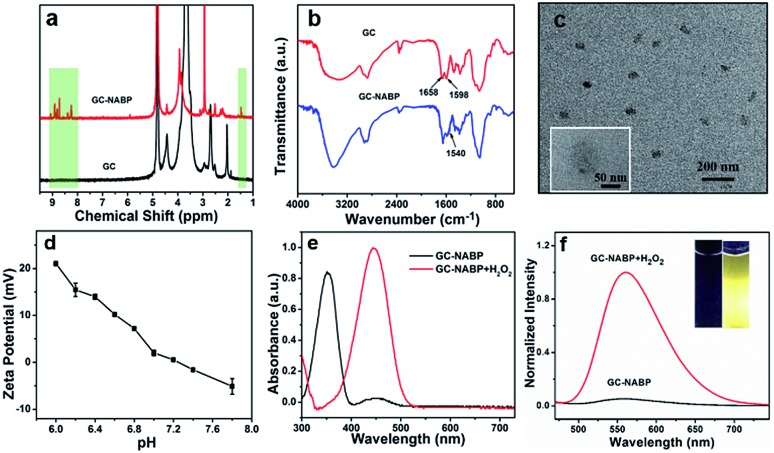
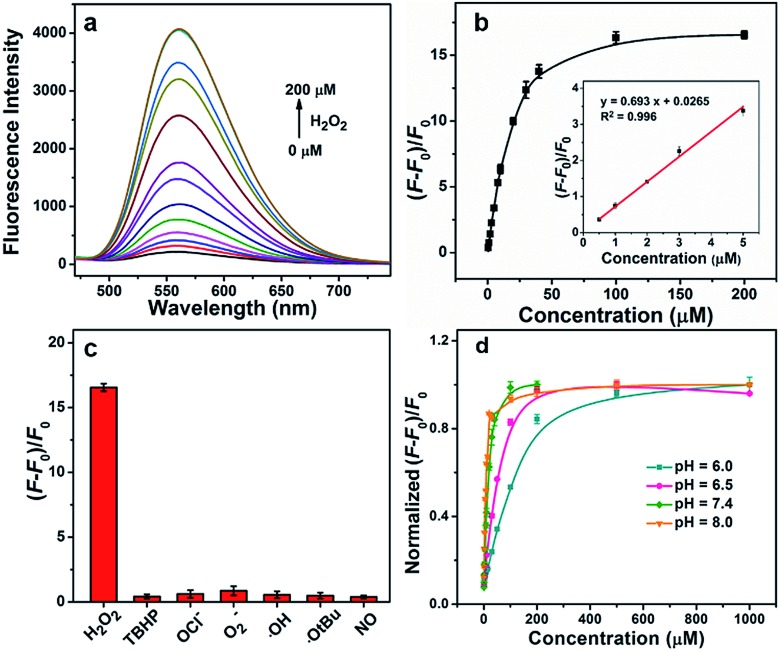
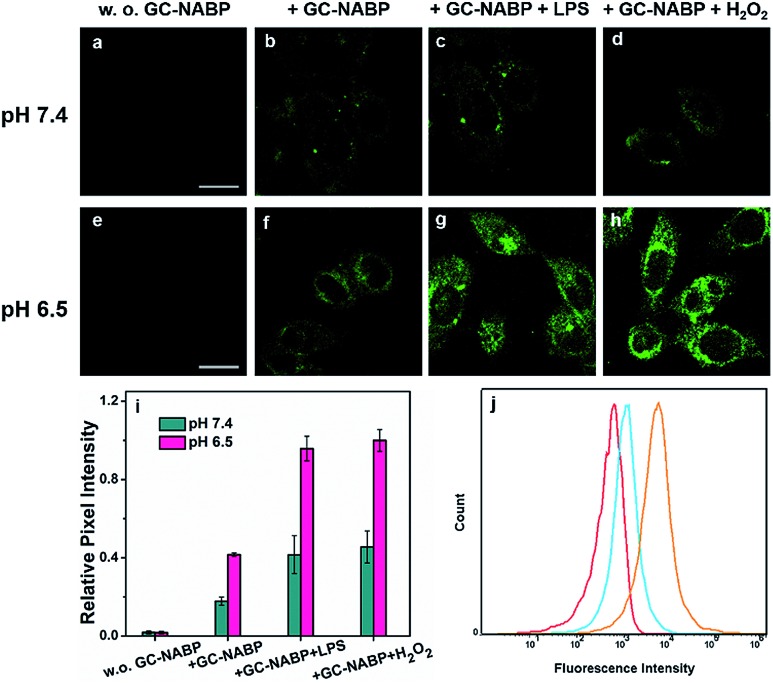
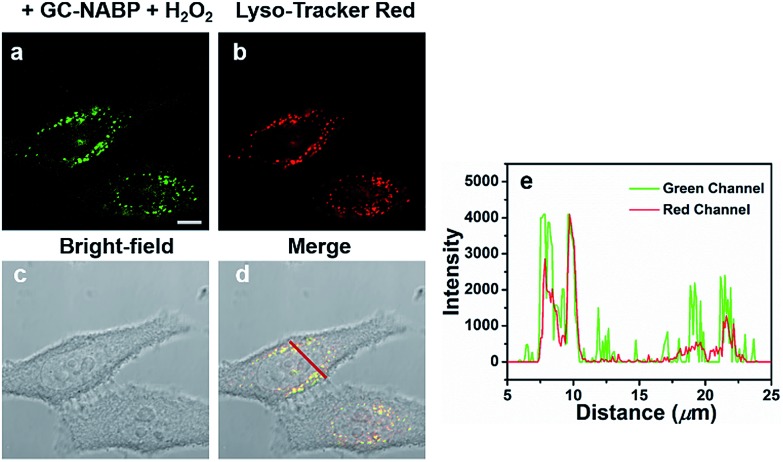
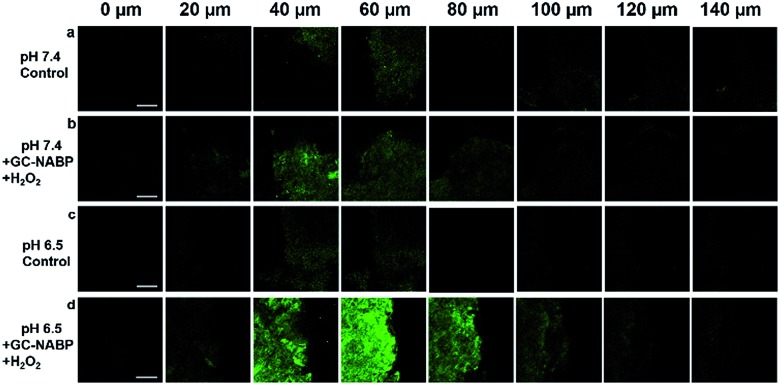
Elevated levels of intracellular hydrogen peroxide (HO) are closely related to the development of cancers. Specific imaging of HO in tumor sites would be significant not only for cancer diagnosis but also for gaining a deep understanding of the role of HO in cancer. However, traditional fluorescent probes based only on responses to overexpression levels of HO in cancer cells are insufficient to distinguish cancer cells from other unhealthy or healthy cells in complex biological systems. Herein, we developed a smart, two-photon fluorescent GC-NABP nanoprobe with pH-dependent surface charge conversion for tumor-targeted imaging of HO. The nanoprobe was constructed by the self-assembly of amphiphilic GC-NABP, which was synthesized by grafting the hydrophobic, HO-responsive and two-photon fluorophore, NABP, onto hydrophilic biopolymer glycol chitosan (GC). Taking advantage of pH-titratable amino groups on GC, the nanoprobe had the capability of surface charge conversion from negative at physiologic pH to positive in the acidic tumor microenvironment. The positive charge of the nanoprobe promoted electrostatic interactions with cell membranes, leading to enhanced cellular uptake in acidic environment. Upon cellular uptake, the high level of HO in tumor cells triggered boronate deprotections of the nanoprobe, generating a "turn-on" fluorescence emission for HO imaging. The nanoprobe exhibited good sensitivity and selectivity to HO with a detection limit down to 110 nM . The results from flow cytometry and two-photon fluorescence imaging of HO in living cells and tissues evidenced the enhanced cellular uptake and targeted imaging of intracellular HO in acidic environment. Compared to control nanoparticles that lack pH sensitivity, our nanoprobe showed enhanced accumulation in tumor sites and was applied to targeted imaging of HO in a tumor-bearing mouse model. This work demonstrates that the nanoprobe GC-NABP holds great promise for tumor-specific imaging of cellular HO, providing a potential tool to explore the role of HO in tumor sites.
细胞内过氧化氢(HO)水平升高与癌症的发生密切相关。对肿瘤部位的HO进行特异性成像不仅对癌症诊断具有重要意义,而且对于深入了解HO在癌症中的作用也具有重要意义。然而,传统的仅基于对癌细胞中HO过表达水平响应的荧光探针,不足以在复杂的生物系统中将癌细胞与其他不健康或健康细胞区分开来。在此,我们开发了一种智能的双光子荧光GC-NABP纳米探针,其具有pH依赖性表面电荷转换功能,用于肿瘤靶向HO成像。该纳米探针由两亲性GC-NABP自组装构建而成,GC-NABP是通过将疏水性、HO响应性和双光子荧光团NABP接枝到亲水性生物聚合物壳聚糖(GC)上合成的。利用GC上可pH滴定的氨基,该纳米探针具有在生理pH下表面电荷从负转换为酸性肿瘤微环境中的正电荷的能力。纳米探针的正电荷促进了与细胞膜的静电相互作用,导致在酸性环境中细胞摄取增强。细胞摄取后,肿瘤细胞中高水平的HO触发了纳米探针的硼酸酯去保护反应,产生用于HO成像的“开启”荧光发射。该纳米探针对HO表现出良好的灵敏度和选择性,检测限低至110 nM。活细胞和组织中HO的流式细胞术和双光子荧光成像结果证明了在酸性环境中细胞摄取增强和细胞内HO的靶向成像。与缺乏pH敏感性的对照纳米颗粒相比,我们的纳米探针在肿瘤部位的积累增强,并应用于荷瘤小鼠模型中HO的靶向成像。这项工作表明,纳米探针GC-NABP在细胞HO的肿瘤特异性成像方面具有巨大潜力,为探索HO在肿瘤部位的作用提供了一种潜在工具。