Mao Zhiqiang, Ye Miantai, Hu Wei, Ye Xiaoxue, Wang Yanying, Zhang Huijuan, Li Chunya, Liu Zhihong
Key Laboratory of Analytical Chemistry of the State Ethnic Affairs Commission , College of Chemistry and Materials Science , South-Central University for Nationalities , Wuhan 430074 , China . Email:
Key Laboratory of Analytical Chemistry for Biology and Medicine (Ministry of Education) , College of Chemistry and Molecular Sciences , Wuhan University , Wuhan 430072 , China . Email:
Chem Sci. 2018 May 18;9(28):6035-6040. doi: 10.1039/c8sc01697f. eCollection 2018 Jul 28.
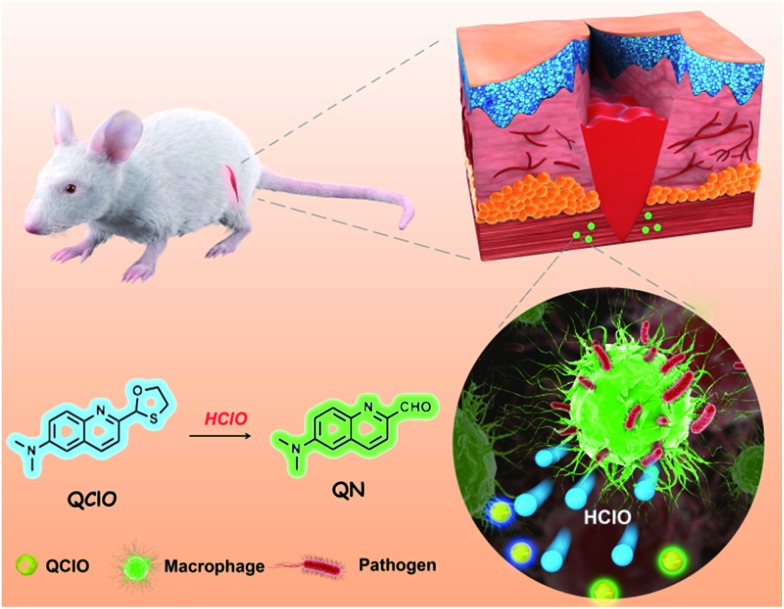
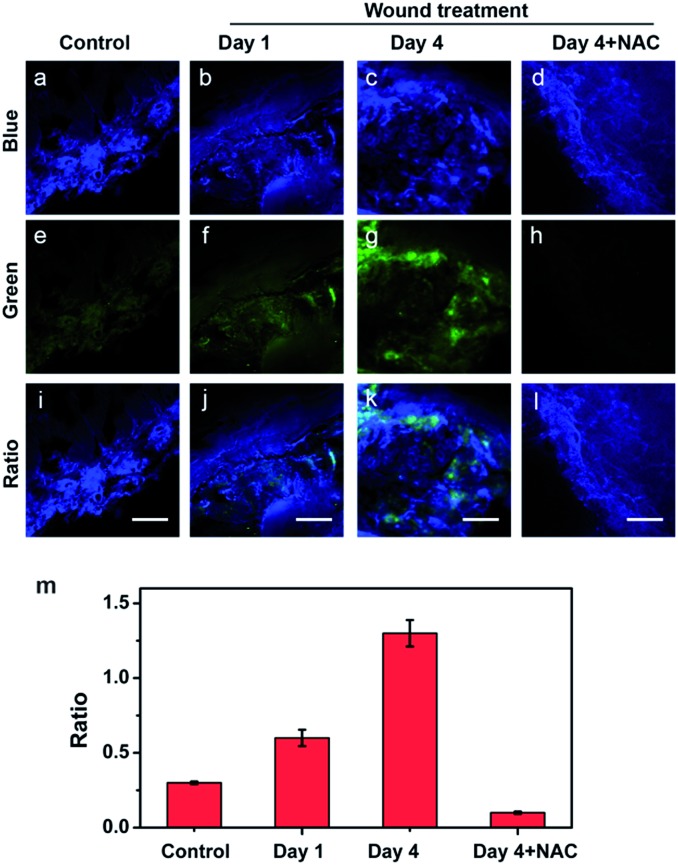
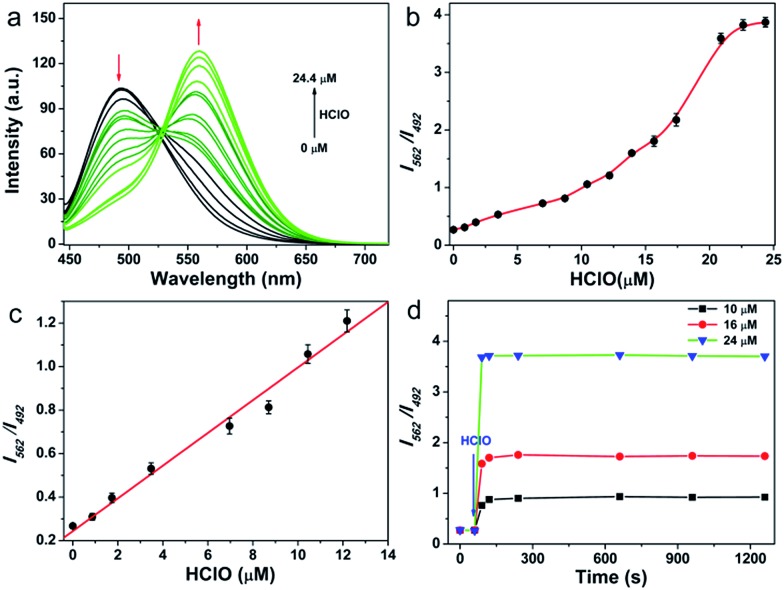
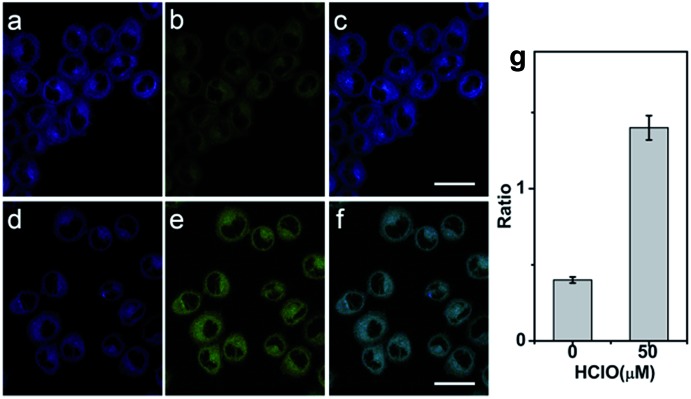
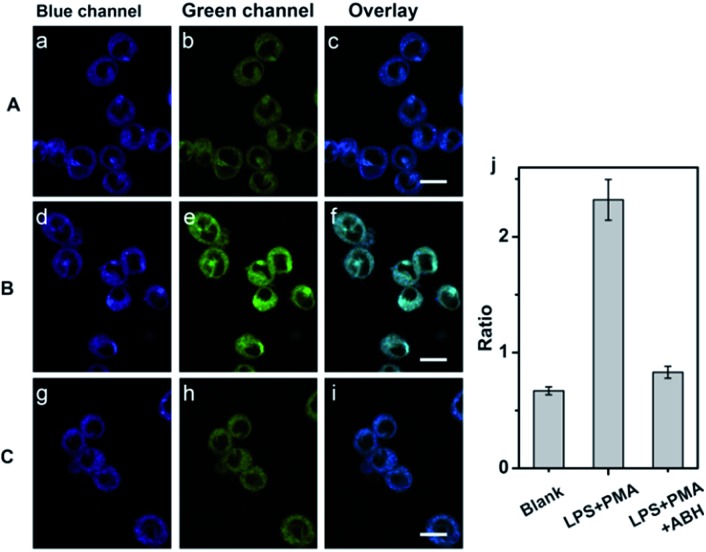
HClO plays crucial roles in a wide range of biological and pathological processes. Recent studies have revealed that the generation of HClO has close links with the wound healing process. It's thus meaningful to develop a reliable method for monitoring HClO in wounded tissues. Toward this purpose, we herein report a rationally designed quinolone-based ratiometric two-photon fluorescent probe, , for HClO. The probe rapidly displays a drop in blue emission and an increase of green emission in response to HClO due to the oxidation of oxathiolane. The fluorescence intensity ratio (green/blue) can serve as the ratiometric detection signal for HClO with high sensitivity. After confirming its excellent sensing performance , the probe was validated by detecting exogenous and endogenous HClO in living cells. The probe was capable of monitoring HClO in the wounded tissues of mice by two-photon microscopy, which demonstrated the production profile of HClO during the wound-healing process. This work affords a simple and reliable tool for the detection and imaging of HClO, which promises to find more applications in HClO-related biological and pathological studies.
次氯酸在广泛的生物和病理过程中发挥着关键作用。最近的研究表明,次氯酸的产生与伤口愈合过程密切相关。因此,开发一种可靠的方法来监测受伤组织中的次氯酸具有重要意义。为此,我们在此报告一种合理设计的基于喹诺酮的比率型双光子荧光探针,用于检测次氯酸。由于氧硫杂环戊烷的氧化,该探针对次氯酸迅速表现出蓝色发射下降和绿色发射增加。荧光强度比(绿色/蓝色)可作为次氯酸的比率检测信号,具有高灵敏度。在确认其优异的传感性能后,该探针通过检测活细胞中的外源性和内源性次氯酸得到验证。该探针能够通过双光子显微镜监测小鼠受伤组织中的次氯酸,这展示了伤口愈合过程中次氯酸的产生情况。这项工作为次氯酸的检测和成像提供了一种简单可靠的工具,有望在与次氯酸相关的生物和病理研究中找到更多应用。