Almedlej Raghad, Aldosary Reem, Barakah Rana, Alkhalifah Abeer, Adlan Abdallah, AlSaffan Abdulrahman D, Baseer Mohammad A
Dental Intern, King Saud Bin Abdulaziz University for Health Sciences, Riyadh, Saudi Arabia.
Dental Student, King Saud University, Riyadh, Saudi Arabia.
J Family Med Prim Care. 2020 Jan 28;9(1):276-281. doi: 10.4103/jfmpc.jfmpc_742_19. eCollection 2020 Jan.
Person's physical, dental appearance, and sexual identity are the characteristics most obvious to others. Prior researches suggest that visible sign of unhealthy dental status may lead to an individual's social or professional exclusion, so the aim of the study was to measure the influence of dental appearance on hiring managers' perception of intelligence, honesty and efficiency of job applicants in Saudi Arabia, and the likelihood of employment opportunity.
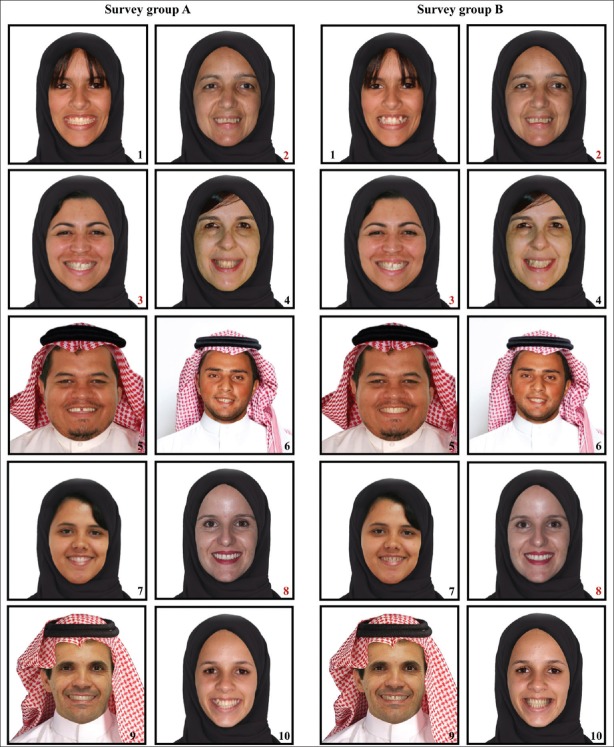
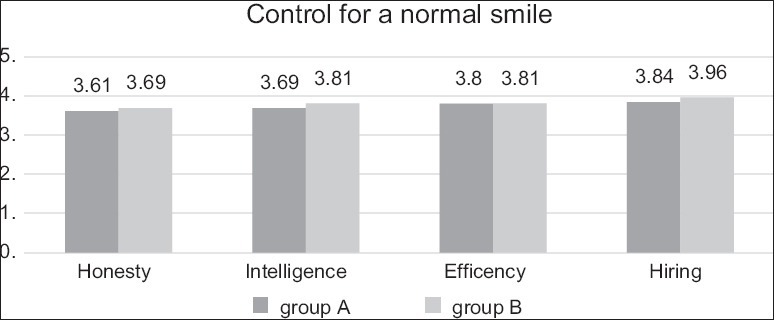
This cross-sectional study comprised 280 hiring managers. All participants were assigned randomly into two groups and received a survey with 10 different images for hypothetical job applicants. The images were digitally manipulated to have the Saudi national dress and to represent different dental conditions. The photos in both surveys were the opposite with no repetition except for 3 for reliability. Each evaluator randomly received one survey without knowing of the other. Participants were asked questions about their perception of honesty, intelligence, efficiency, and potential employability of the provided applicants' photos.
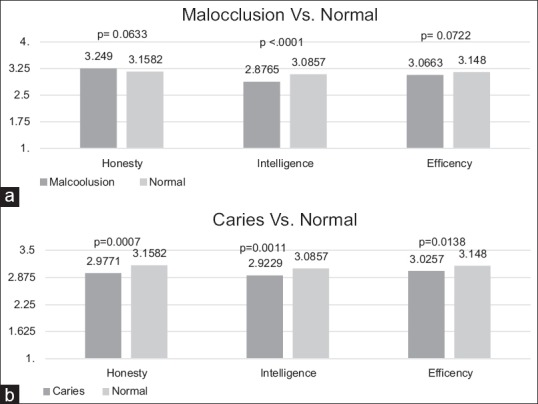
There was no statistically significant difference in demographics data between the hiring managers assigned to both groups. Hypothetical job applicants with smiles affected by malocclusion were perceived to be less intelligent with value = 0.0001, but there was no altered perception for honesty and efficiency. Moreover, applicants with caries were perceived to be less honest, intelligent, and efficient by the hiring managers with value of 0.0007, 0.0011 and 0.0138, respectively. Applicants with dental imperfections compared to normal smile were 52% less likely to be employed.
Dental appearance might alter people perception about the character of the affected person, and it might influence the judgment of future employers when screening for candidates; as a result, we recommend more educational programs for the public and hiring managers.
人的外貌、牙齿外观和性别认同是最容易被他人注意到的特征。先前的研究表明,不健康牙齿状况的明显迹象可能导致个人在社交或职业上被排斥,因此本研究的目的是衡量牙齿外观对沙特阿拉伯招聘经理对求职者智力、诚实和效率的看法以及就业机会可能性的影响。
这项横断面研究包括280名招聘经理。所有参与者被随机分为两组,并收到一份包含10张不同假设求职者图片的调查问卷。这些图片经过数字处理,使其身着沙特民族服装,并呈现不同的牙齿状况。两份调查问卷中的照片除了3张用于可靠性验证外均不重复且相反。每位评估者随机收到一份调查问卷,且不知道另一份的情况。参与者被问及他们对所提供求职者照片的诚实、智力、效率和潜在可雇佣性的看法。
两组招聘经理的人口统计学数据没有统计学上的显著差异。受错颌影响而微笑的假设求职者被认为智力较低,P值 = 0.0001,但在诚实和效率方面的看法没有改变。此外,有龋齿的求职者被招聘经理认为诚实度、智力和效率较低,P值分别为0.0007、0.0011和0.0138。与正常微笑相比,有牙齿缺陷的求职者被雇佣的可能性低52%。
牙齿外观可能会改变人们对受影响者性格的看法,并且在筛选候选人时可能会影响未来雇主的判断;因此,我们建议为公众和招聘经理开展更多的教育项目。