University of Geneva, Department of Cell Biology, Sciences III, Geneva, Switzerland.
Institute for Integrative Biology of the Cell (I2BC), CEA, CNRS, Univ. Paris Sud, Université Paris-Saclay, 1 Avenue de la Terrasse, 91198 Gif-sur-Yvette, France.
Sci Adv. 2020 Feb 14;6(7):eaaz4137. doi: 10.1126/sciadv.aaz4137. eCollection 2020 Feb.
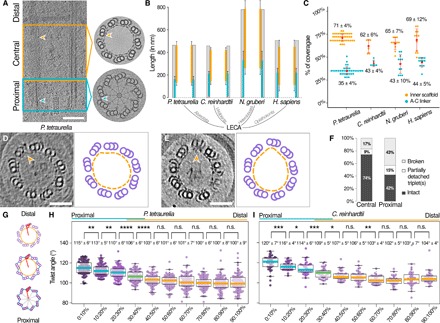
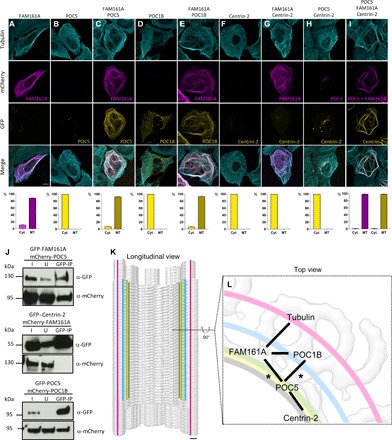
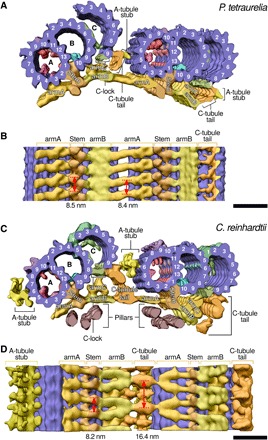
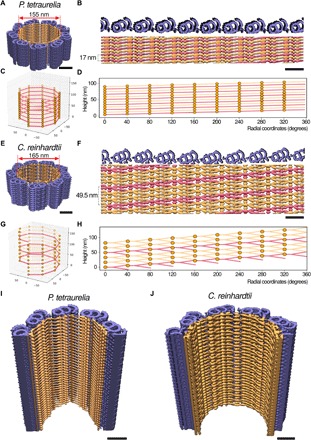
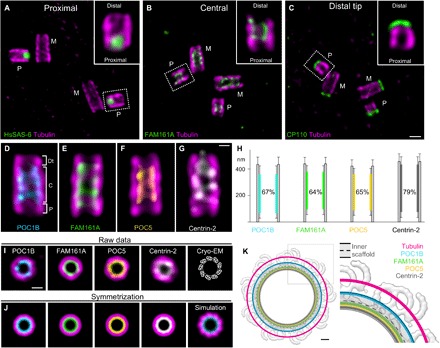
The ninefold radial arrangement of microtubule triplets (MTTs) is the hallmark of the centriole, a conserved organelle crucial for the formation of centrosomes and cilia. Although strong cohesion between MTTs is critical to resist forces applied by ciliary beating and the mitotic spindle, how the centriole maintains its structural integrity is not known. Using cryo-electron tomography and subtomogram averaging of centrioles from four evolutionarily distant species, we found that MTTs are bound together by a helical inner scaffold covering ~70% of the centriole length that maintains MTTs cohesion under compressive forces. Ultrastructure Expansion Microscopy (U-ExM) indicated that POC5, POC1B, FAM161A, and Centrin-2 localize to the scaffold structure along the inner wall of the centriole MTTs. Moreover, we established that these four proteins interact with each other to form a complex that binds microtubules. Together, our results provide a structural and molecular basis for centriole cohesion and geometry.
微管三联体(MTTs)的九倍向心排列是中心粒的标志,中心粒是一种保守的细胞器,对于中心体和纤毛的形成至关重要。虽然 MTTs 之间的强相互作用对于抵抗纤毛跳动和有丝分裂纺锤体施加的力至关重要,但中心粒如何保持其结构完整性尚不清楚。使用冷冻电子断层扫描和来自四个进化上不同的物种的中心粒亚图平均法,我们发现 MTTs 由一个覆盖约 70%中心粒长度的螺旋内支架结合在一起,该支架在压缩力下保持 MTTs 的相互作用。超微结构扩展显微镜(U-ExM)表明,POC5、POC1B、FAM161A 和 Centrin-2 沿中心粒 MTTs 的内壁定位于支架结构上。此外,我们确定这四种蛋白质相互作用形成一个结合微管的复合物。总之,我们的结果为中心粒的凝聚和几何形状提供了结构和分子基础。