Robinson Research Institute, Faculty of Health and Medical Sciences, the University of Adelaide, Adelaide 5005, Australia.
Department of Pediatrics, the Aga Khan University, Karachi 74800, Pakistan.
Nutrients. 2020 Feb 26;12(3):606. doi: 10.3390/nu12030606.
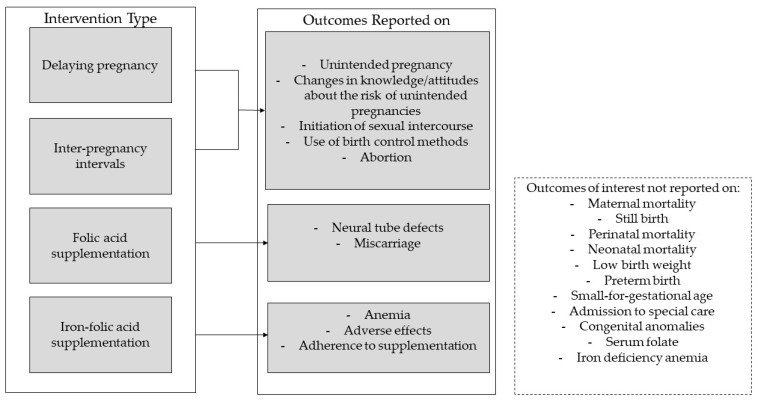
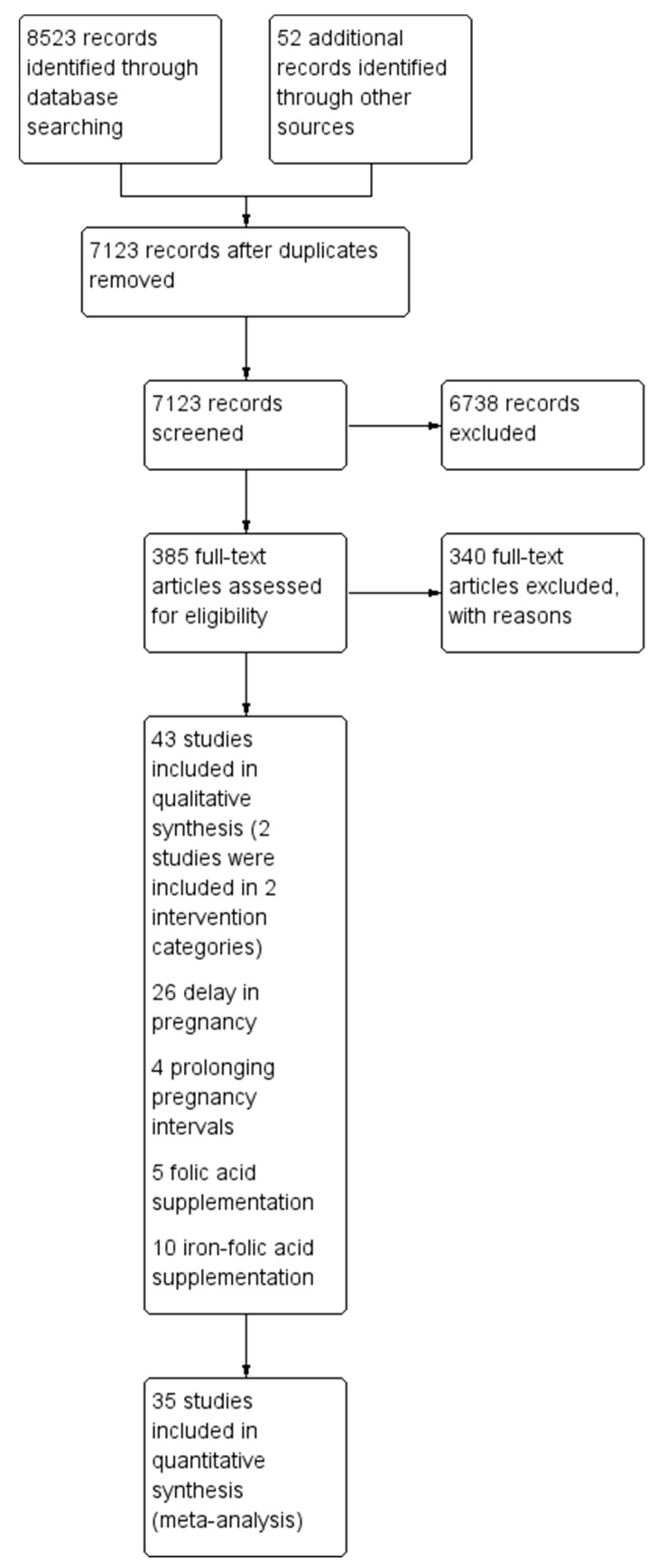
Pregnancy in adolescence and malnutrition are common challenges in low- and middle-income countries (LMICs), and are associated with many complications and comorbidities. The preconception period is an ideal period for intervention as a preventative tactic for teenage pregnancy, and to increase micronutrient supplementation prior to conception. Over twenty databases and websites were searched and 45 randomized controlled trials (RCTs) or quasi-experimental interventions with intent to delay the age at first pregnancy ( = 26), to optimize inter-pregnancy intervals ( = 4), and supplementation of folic acid ( = 5) or a combination of iron and folic acid ( = 10) during the periconception period were included. The review found that educational interventions to delay the age at first pregnancy and optimizing inter-pregnancy intervals significantly improved the uptake of contraception use (RR = 1.71, 95% CI = 1.42-2.05; two studies, = 911; I = 0%) and (RR = 2.25, 95% CI = 1.29-3.93; one study, = 338), respectively. For periconceptional folic acid supplementation, the incidence of neural tube defects were reduced (RR = 0.53; 95% CI = 0.41-0.77; two studies, = 248,056; I = 0%), and iron-folic acid supplementation improved the rates of anemia (RR = 0.66, 95% CI = 0.53-0.81; six studies; = 3430, I = 88%), particularly when supplemented weekly and in a school setting. Notwithstanding the findings, more robust RCTs are required from LMICs to further support the evidence.
青春期怀孕和营养不良是中低收入国家(LMICs)的常见挑战,与许多并发症和合并症有关。受孕前阶段是进行干预的理想时期,可以作为预防青少年怀孕的策略,并在受孕前增加微量营养素的补充。共搜索了二十多个数据库和网站,纳入了 45 项随机对照试验(RCT)或准实验干预,旨在延迟首次怀孕年龄(=26),优化妊娠间隔(=4),并在围孕期补充叶酸(=5)或铁和叶酸的组合(=10)。综述发现,教育干预措施可延迟首次怀孕年龄和优化妊娠间隔,显著提高了避孕措施的使用率(RR=1.71,95%CI=1.42-2.05;两项研究,=911;I=0%)和(RR=2.25,95%CI=1.29-3.93;一项研究,=338)。对于围孕期叶酸补充,神经管缺陷的发生率降低(RR=0.53;95%CI=0.41-0.77;两项研究,=248056;I=0%),铁叶酸补充可提高贫血发生率(RR=0.66,95%CI=0.53-0.81;六项研究;=3430,I=88%),特别是每周补充和在学校环境中补充时。尽管有这些发现,但仍需要来自 LMICs 的更有力的 RCT 来进一步支持证据。