
牛原代成纤维细胞的方波电穿孔条件的系统优化。
Systematic optimization of square-wave electroporation conditions for bovine primary fibroblasts.
机构信息
Institute of Farm Animal Genetics, Friedrich-Loeffler-Institute, 31535, Neustadt, Germany.
Department of Veterinary Physiology, NTR College of Veterinary Science, Gannavaram, India.
出版信息
BMC Mol Cell Biol. 2020 Feb 28;21(1):9. doi: 10.1186/s12860-020-00254-5.
BACKGROUND
Gene transfer by electroporation is an established method for the non-viral mediated transfection of mammalian cells. Primary cells pose a particular challenge for electroporation-mediated gene transfer, since they are more vulnerable than immortalized cells, and have a limited proliferative capacity. Improving the gene transfer by using square wave electroporation in difficult to transfect cells, like bovine fetal fibroblasts, is a prerequisite for transgenic and further downstream experiments.
RESULTS
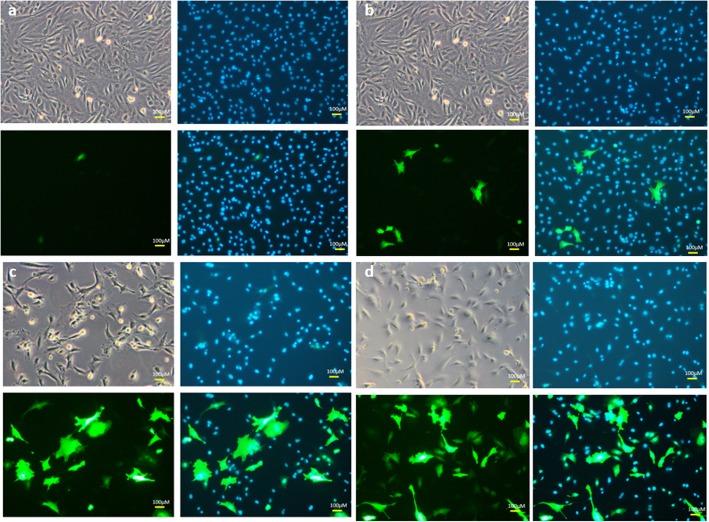
Here, bovine fetal fibroblasts were used for square-wave electroporation experiments in which the following parameters were systematically tested: electroporation buffer, electroporation temperature, pulse voltage, pulse duration, pulse number, cuvette type and plasmid DNA amount. For the experiments a commercially available square-wave generator was applied. Post electroporation, the bovine fetal fibroblasts were observed after 24 h for viability and reporter expression. The best results were obtained with a single 10 millisecond square-wave pulse of 400 V using 10 μg supercoiled plasmid DNA and 0.3 × 10 cells in 100 μl of Opti-MEM medium in 4 mm cuvettes. Importantly, the electroporation at room temperature was considerably better than with pre-cooled conditions.
CONCLUSIONS
The optimized electroporation conditions will be relevant for gene transfer experiments in bovine fetal fibroblasts to obtain genetically engineered donor cells for somatic cell nuclear transfer and for reprogramming experiments in this species.
背景
电穿孔基因转移是一种将哺乳动物细胞进行非病毒转染的成熟方法。原代细胞对电穿孔介导的基因转移提出了特殊的挑战,因为它们比永生化细胞更脆弱,且增殖能力有限。通过在难以转染的细胞(如牛胎儿成纤维细胞)中使用方波电穿孔来提高基因转移效率,是转基因和进一步下游实验的前提。
结果
本研究使用牛胎儿成纤维细胞进行了方波电穿孔实验,系统地测试了以下参数:电转缓冲液、电转温度、脉冲电压、脉冲持续时间、脉冲数、比色杯类型和质粒 DNA 量。实验采用了一种市售的方波发生器。电穿孔后,在 24 小时后观察牛胎儿成纤维细胞的活力和报告基因表达。使用 4 毫米比色杯中的 100μl Opti-MEM 培养基,将 10μl 超螺旋质粒 DNA 和 0.3×10⁶个细胞施加单个 10 毫秒、400V 的方波脉冲,可获得最佳结果。重要的是,室温下的电穿孔明显优于预冷条件。
结论
优化的电穿孔条件将与牛胎儿成纤维细胞中的基因转移实验相关,以获得用于体细胞核转移的基因工程供体细胞,以及该物种的重编程实验。

 Zotero 插件