Department of Pediatrics, Division of Neonatology, Erasmus MC - Sophia Children's Hospital, Dr. Molewaterplein 40, 3015GD, Rotterdam, The Netherlands.
Department of Biomechanical Engineering, Delft University of Technology, Mekelweg 5, 2628CD, Delft, The Netherlands.
BMC Pediatr. 2020 Feb 28;20(1):94. doi: 10.1186/s12887-020-1987-4.
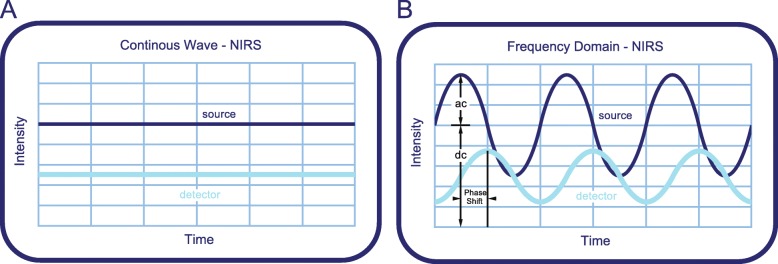
Non-invasive monitoring of cerebral tissue oxygen saturation (rcSO) during transition is of growing interest. Different near-infrared spectroscopy (NIRS) techniques have been developed to measure rcSO. We compared rcSO values during the immediate transition in preterm neonates measured with frequency-domain NIRS (FD-NIRS) with those measured with continuous-wave NIRS (CW-NIRS) devices in prospective observational studies.
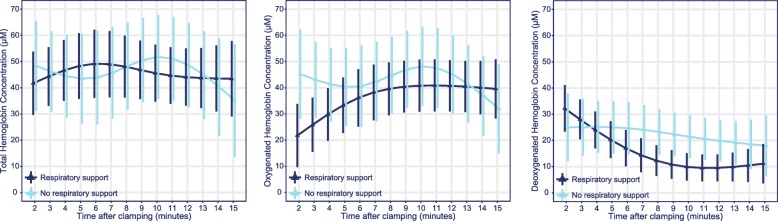
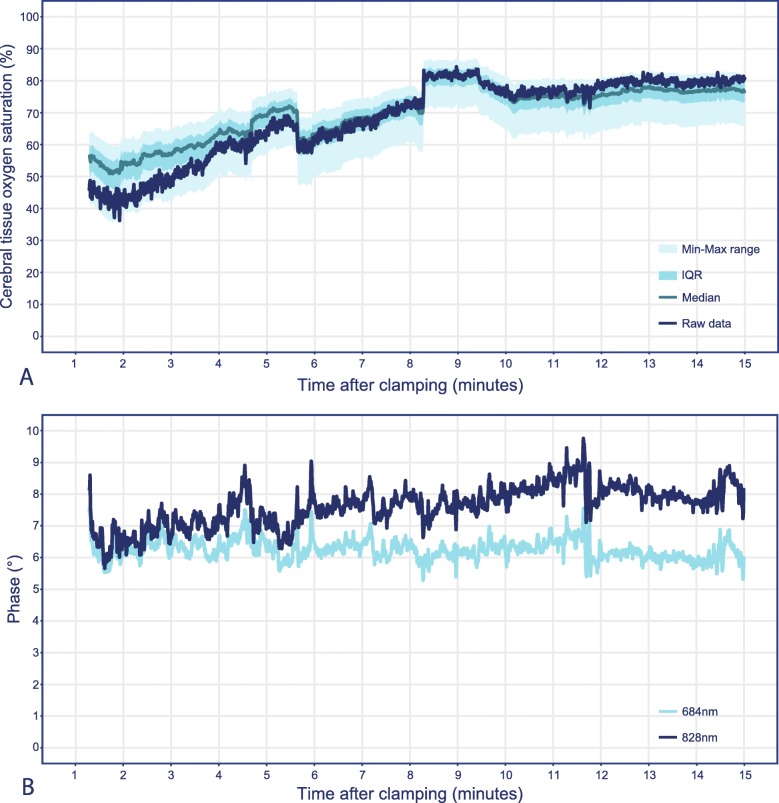
We compared rcSO values measured with an FD-NIRS device during the first 15 min after birth in neonates with a gestational age ≥ 30 weeks but < 37 weeks born at the Erasmus MC- Sophia Children's Hospital, Rotterdam, the Netherlands, with similar values measured with a CW-NIRS device in neonates born at the Medical University of Graz, Austria. Mixed models were used to adjust for repeated rcSO measurements, with fixed effects for time (non-linear), device, respiratory support and the interaction of device and respiratory support with time. Additionally, parameters such as total haemoglobin concentration and oxygenated and deoxygenated haemoglobin concentrations measured by FD-NIRS were analysed.
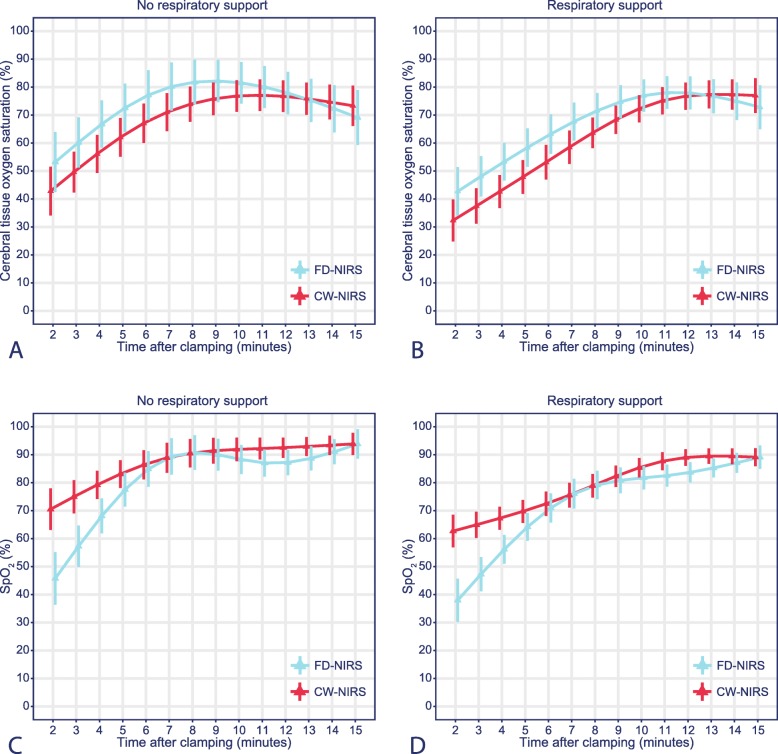
Thirty-eight FD-NIRS measurements were compared with 58 CW-NIRS measurements. The FD-NIRS rcSO values were consistently higher than the CW-NIRS rcSO values in the first 12 min, irrespective of respiratory support. After adjustment for respiratory support, the time-dependent trend in rcSO differed significantly between techniques (p < 0.01).
As cerebral saturation measured with the FD-NIRS device differed significantly from that measured with the CW-NIRS device, differences in absolute values need to be interpreted with care. Although FD-NIRS devices have technical advantages over CW-NIRS devices, FD-NIRS devices may overestimate true cerebral oxygenation and their benefits might not outweigh the usability of the more clinically viable CW-NIRS devices.
在过渡期间,对脑氧饱和度(rcSO)的无创监测越来越受到关注。已经开发出不同的近红外光谱(NIRS)技术来测量 rcSO。我们比较了在荷兰鹿特丹伊拉斯谟医学中心出生的胎龄≥30 但<37 周的早产儿出生后最初 15 分钟内使用频域近红外光谱(FD-NIRS)和连续波近红外光谱(CW-NIRS)设备测量的 rcSO 值。
我们比较了在荷兰鹿特丹伊拉斯谟医学中心出生的胎龄≥30 但<37 周的早产儿出生后最初 15 分钟内使用 FD-NIRS 设备测量的 rcSO 值,与在奥地利格拉茨医科大学出生的早产儿使用 CW-NIRS 设备测量的类似值。使用混合模型来调整重复测量的 rcSO 值,固定效应包括时间(非线性)、设备、呼吸支持以及设备和呼吸支持与时间的相互作用。此外,还分析了 FD-NIRS 测量的总血红蛋白浓度和氧合血红蛋白浓度和去氧血红蛋白浓度等参数。
比较了 38 次 FD-NIRS 测量值和 58 次 CW-NIRS 测量值。无论呼吸支持如何,FD-NIRS rcSO 值在前 12 分钟内始终高于 CW-NIRS rcSO 值。调整呼吸支持后,两种技术的 rcSO 时间依赖性趋势差异具有统计学意义(p<0.01)。
由于 FD-NIRS 设备测量的脑饱和度与 CW-NIRS 设备测量的脑饱和度存在显著差异,因此需要谨慎解释绝对值的差异。尽管 FD-NIRS 设备在技术上优于 CW-NIRS 设备,但 FD-NIRS 设备可能高估了真正的脑氧合作用,其优势可能不及更具临床可行性的 CW-NIRS 设备。