Health and Biosecurity, CSIRO, Canberra, 2601, ACT, Australia.
Energy, CSIRO, 3169, Melbourne, VIC, Australia.
Sci Rep. 2020 Feb 28;10(1):3774. doi: 10.1038/s41598-020-60730-y.
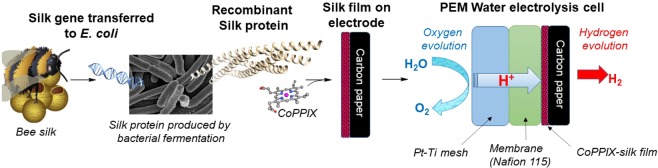
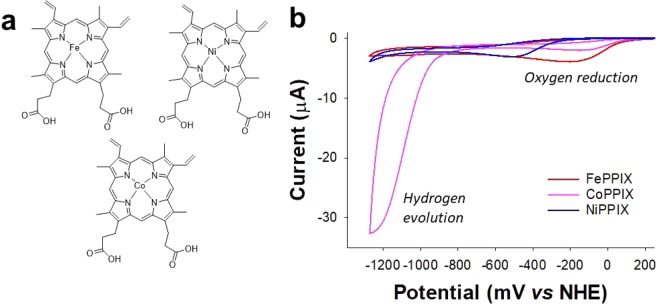
Hydrogen has the potential to play an important role in decarbonising our energy systems. Crucial to achieving this is the ability to produce clean sources of hydrogen using renewable energy sources. Currently platinum is commonly used as a hydrogen evolution catalyst, however, the scarcity and expense of platinum is driving the need to develop non-platinum-based catalysts. Here we report a protein-based hydrogen evolution catalyst based on a recombinant silk protein from honeybees and a metal macrocycle, cobalt protoporphyrin (CoPPIX). We enhanced the hydrogen evolution activity three fold compared to the unmodified silk protein by varying the coordinating ligands to the metal centre. Finally, to demonstrate the use of our biological catalyst, we built a proton exchange membrane (PEM) water electrolysis cell using CoPPIX-silk as the hydrogen evolution catalyst that is able to produce hydrogen with a 98% Faradaic efficiency. This represents an exciting advance towards allowing protein-based catalysts to be used in electrolysis cells.
氢气在我们的能源系统脱碳方面具有重要作用。实现这一目标的关键是能够使用可再生能源生产清洁的氢气源。目前,铂通常被用作析氢催化剂,但铂的稀缺性和昂贵性促使人们需要开发非铂基催化剂。在这里,我们报告了一种基于来自蜜蜂的重组丝蛋白和金属大环配合物钴原卟啉(CoPPIX)的基于蛋白质的析氢催化剂。我们通过改变金属中心的配位配体,将氢的析出活性提高了三倍,与未经修饰的丝蛋白相比。最后,为了展示我们的生物催化剂的用途,我们使用 CoPPIX-丝作为析氢催化剂构建了质子交换膜(PEM)水电解池,该催化剂能够以 98%的法拉第效率生产氢气。这是朝着允许基于蛋白质的催化剂在电解池中使用迈出的令人兴奋的一步。