Key Laboratory for Experimental Teratology of Ministry of Education, Department of Immunology, Shandong University School of Basic Medical Sciences, 44# Wenhua Xi Road, Jinan, Shandong 250012, PR China.
Key Laboratory for Experimental Teratology of Ministry of Education, Department of Immunology, Shandong University School of Basic Medical Sciences, 44# Wenhua Xi Road, Jinan, Shandong 250012, PR China; Department of Gastroenterology, Qilu Hospital of Shandong University, Jinan, Shandong, PR China.
EBioMedicine. 2020 Mar;53:102676. doi: 10.1016/j.ebiom.2020.102676. Epub 2020 Feb 27.
Liver cancer stem cells (CSCs) are critical determinants of HCC relapse and therapeutic resistance, but the mechanisms underlying the maintenance of CSCs are poorly understood. We aimed to explore the role of tumor repressor Zinc-fingers and homeoboxes 2 (ZHX2) in liver CSCs.
CD133 or EPCAM stem-like liver cancer cells were sorted from tumor tissues of HCC patients and HCC cell lines by flow cytometry. In addition, sorafenib-resistant cells, tumor-sphere forming cells and side population (SP) cells were respectively cultured and isolated as hepatic CSCs. The tumor-initiating and chemoresistance properties of ZHX2-overexpressing and ZHX2-knockdown cells were analyzed in vivo and in vitro. Microarray, luciferase reporter assay, chromatin immunoprecipitation (ChIP) and ChIP-on-chip analyses were performed to explore ZHX2 target genes. The expression of ZHX2 and its target gene were determined by quantitative RT-PCR, western blot, immunofluorescence and immunohistochemical staining in hepatoma cells and tumor and adjacent tissues from HCC patients.
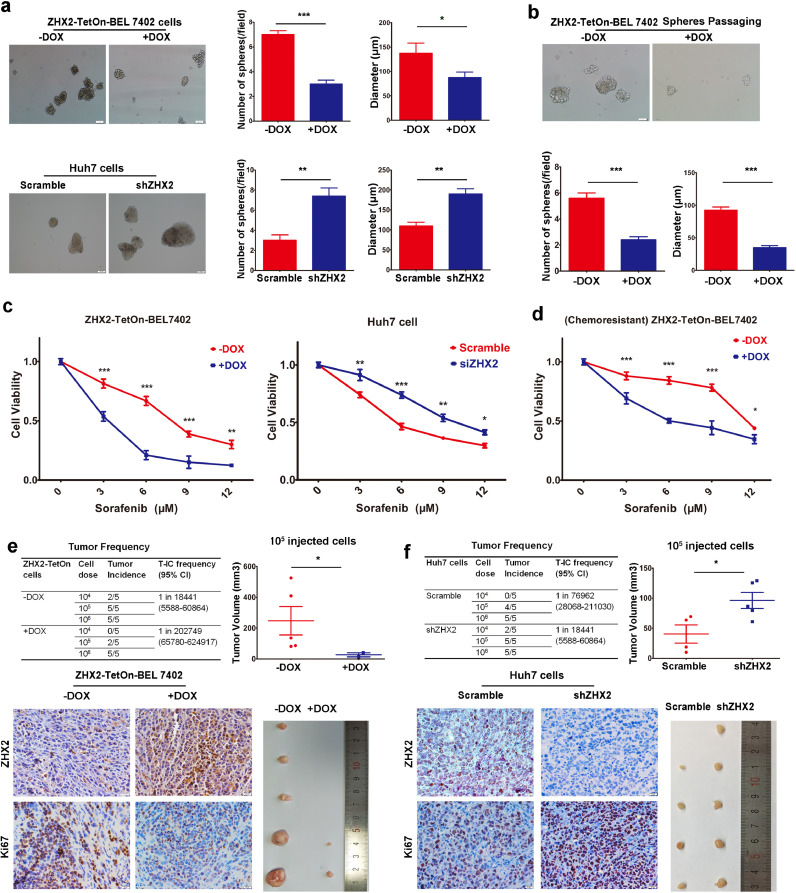
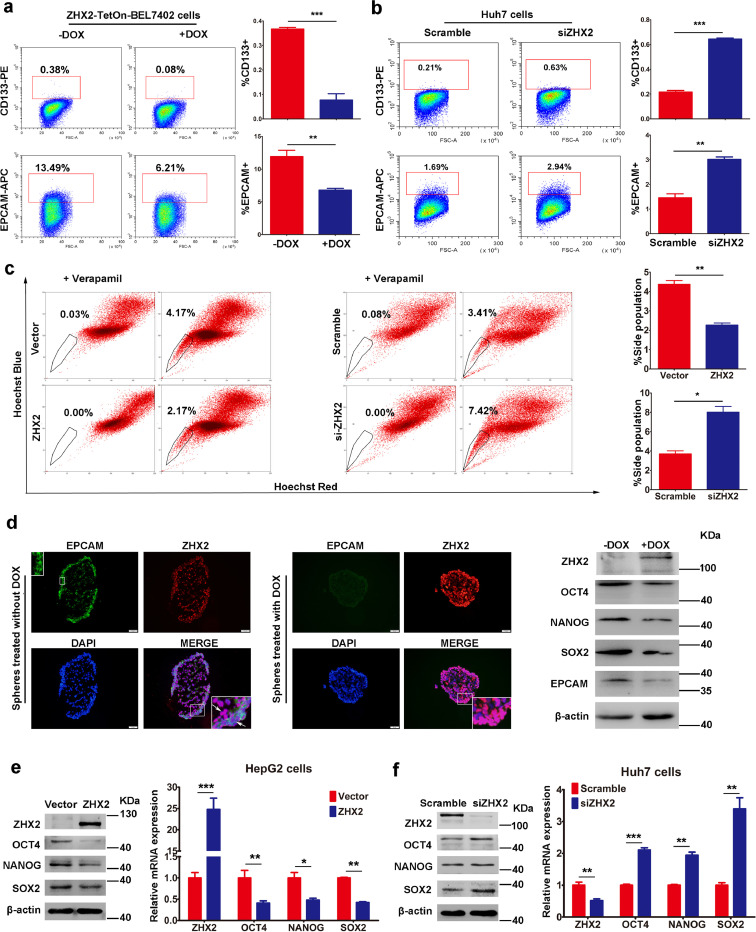
ZHX2 expression was significantly reduced in liver CSCs from different origins. ZHX2 deficiency led to enhanced liver tumor progression and expansion of CSC populations in vitro and in vivo. Re-expression of ZHX2 restricted capabilities of hepatic CSCs in supporting tumor initiation, self-renewal and sorafenib-resistance. Mechanically, ZHX2 suppressed liver CSCs via inhibiting KDM2A-mediated demethylation of histone H3 lysine 36 (H3K36) at the promoter regions of stemness-associated transcription factors, such as NANOG, SOX4 and OCT4. Moreover, patients with lower expression of ZHX2 and higher expression of KDM2A in tumor tissues showed significantly poorer survival.
ZHX2 counteracts stem cell traits through transcriptionally repressing KDM2A in HCC. Our data will aid in a better understanding of molecular mechanisms underlying HCC relapse and drug resistance.
肝癌干细胞(CSC)是 HCC 复发和治疗耐药的关键决定因素,但维持 CSC 的机制仍知之甚少。我们旨在探索肿瘤抑制因子锌指和同源盒蛋白 2(ZHX2)在肝 CSC 中的作用。
采用流式细胞术从 HCC 患者肿瘤组织和 HCC 细胞系中分选 CD133 或 EPCAM 样肝癌干细胞。此外,分别培养和分离索拉非尼耐药细胞、肿瘤球形成细胞和侧群(SP)细胞作为肝 CSC。通过体内和体外实验分析 ZHX2 过表达和 ZHX2 敲低细胞的肿瘤起始和化疗耐药特性。进行微阵列、荧光素酶报告基因检测、染色质免疫沉淀(ChIP)和 ChIP-on-chip 分析,以探讨 ZHX2 的靶基因。采用定量 RT-PCR、western blot、免疫荧光和免疫组织化学染色法检测肝癌细胞和 HCC 患者肿瘤及相邻组织中 ZHX2 及其靶基因的表达。
不同来源的肝 CSC 中 ZHX2 的表达明显降低。ZHX2 缺失导致体内外肝肿瘤进展和 CSC 群体扩增。ZHX2 的重新表达限制了肝 CSCs 支持肿瘤起始、自我更新和索拉非尼耐药的能力。机制上,ZHX2 通过抑制 KDM2A 介导的组蛋白 H3 赖氨酸 36(H3K36)在干性相关转录因子(如 NANOG、SOX4 和 OCT4)启动子区域的去甲基化,抑制肝 CSCs。此外,肿瘤组织中 ZHX2 表达较低和 KDM2A 表达较高的患者生存明显较差。
ZHX2 通过转录抑制 HCC 中的 KDM2A 来拮抗干细胞特性。我们的数据将有助于更好地理解 HCC 复发和耐药的分子机制。