Houston Methodist Cancer Center, Houston, Texas, USA
Houston Methodist Research Institute, Houston, Texas, USA.
J Immunother Cancer. 2020 Feb;8(1). doi: 10.1136/jitc-2019-000104.
Murine model suggests programmed cell death-1 (PD-1), an immune checkpoint not only plays role in tumor escape but is also a tumor suppressor for T-cells. But until, no reports of secondary T-cell lymphoma postuse of immune checkpoint inhibitors (ICIs) has been reported. Herein, we present a hitherto unreported phenomenon of secondary T-cell lymphoma when PD-1 inhibitor was used in a patient diagnosed with a tumor of epithelial origin.
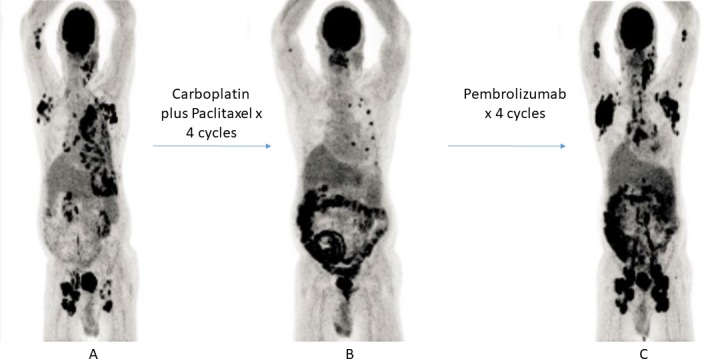
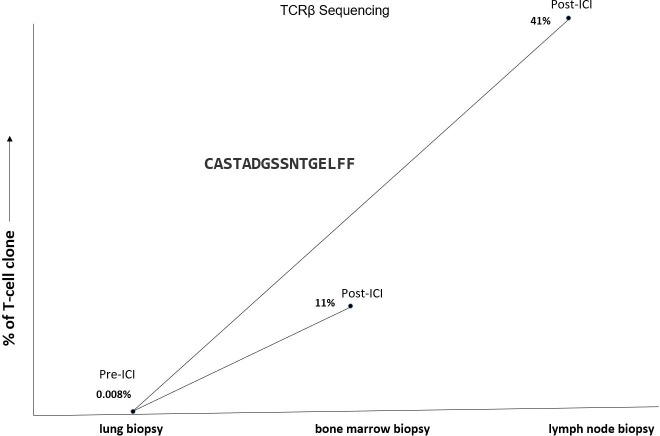
A man in mid-70s presented with biopsy-proven metastatic tumor of epithelial origin. Patient received carboplatin in combination with paclitaxel for four cycles leading to partial remission. The patient was subsequently switched to pembrolizumab due to persistent disease in the mediastinum. After four cycles of PD-1 inhibitor, patient presented with progression of disease and was diagnosed with biopsy-proven peripheral T-cell lymphoma-not otherwise specified. Based on the reported tumor suppressor function of PD-1 in murine models, we hypothesized that the use of PD-1 inhibitor caused clonal proliferation of abnormal T-cell clone leading to T-cell lymphoma. T-cell receptor (TCR) sequencing was performed by TCRβ sequencing and T-cell clones from pre-ICI treatment specimen were compared with post-ICI treatment specimens. We show that one of the T-cell clones present in pre-ICI treatment specimen at a low frequency of had massive expansion to become most dominant clone in post-ICI treatment specimens leading to lymphoma. Moreover, targeted exome sequencing revealed a new TET2 mutation in the clone representing the lymphoma.Next, we retrospectively reviewed the Food and Drug Administration (FDA) Adverse Events Reporting System (FAERS), the pharmacovigilance database from 2012 to 2018 to find the reported incidence of this phenomenon and calculated the reporting OR (ROR) for disproportionality analysis for risk of T-cell lymphoma due to checkpoint inhibitors compared with other drugs. In FAERS, the incidence of T-cell lymphoma post-ICIs (pembrolizumab, nivolumab and ipilimumab) was found to be 0.02% with 17% mortality. The ROR probability of risk of T-cell lymphoma compared with other drugs in pharmacovigilance database was increased at 1.91.
T-cell lymphoma is a rare sequela of ICIs with high mortality. Larger studies with long-term follow-up of patients receiving ICIs is needed.
小鼠模型表明,程序性细胞死亡受体-1(PD-1)不仅在肿瘤逃逸中发挥作用,还是 T 细胞的肿瘤抑制因子。但截至目前,尚无使用免疫检查点抑制剂(ICI)后发生继发 T 细胞淋巴瘤的报告。在此,我们报告了一例使用 PD-1 抑制剂治疗上皮来源肿瘤患者时出现继发 T 细胞淋巴瘤的现象。
一名 70 多岁的男性患者活检证实为转移性上皮来源肿瘤。患者接受卡铂联合紫杉醇治疗 4 个周期,达到部分缓解。由于纵隔内疾病持续存在,患者随后改用帕博利珠单抗。使用 PD-1 抑制剂 4 个周期后,患者疾病进展,并被诊断为活检证实的外周 T 细胞淋巴瘤-非特指型。根据 PD-1 在小鼠模型中的肿瘤抑制功能,我们假设 PD-1 抑制剂的使用导致异常 T 细胞克隆的克隆性增殖,从而导致 T 细胞淋巴瘤。通过 TCRβ 测序进行 T 细胞受体(TCR)测序,并将 ICI 治疗前标本中的 T 细胞克隆与 ICI 治疗后标本进行比较。我们发现,ICI 治疗前标本中存在的一个 T 细胞克隆以低频率存在,大量扩增成为 ICI 治疗后标本中最主要的克隆,导致淋巴瘤。此外,靶向外显子组测序显示,在代表淋巴瘤的克隆中发现了一个新的 TET2 突变。
接下来,我们回顾性地审查了 2012 年至 2018 年期间食品和药物管理局(FDA)不良事件报告系统(FAERS)的药物警戒数据库,以寻找该现象的报告发生率,并进行了药物警戒数据库中因检查点抑制剂导致 T 细胞淋巴瘤的报告比值比(ROR)分析,以评估与其他药物相比的风险。在 FAERS 中,ICI(帕博利珠单抗、纳武利尤单抗和伊匹单抗)治疗后 T 细胞淋巴瘤的发生率为 0.02%,死亡率为 17%。药物警戒数据库中与其他药物相比,T 细胞淋巴瘤风险的 ROR 概率增加到 1.91。
T 细胞淋巴瘤是 ICI 的罕见后遗症,死亡率较高。需要对接受 ICI 治疗的患者进行更大规模、长期随访的研究。