Reñosa Mark Donald, Dalglish Sarah, Bärnighausen Kate, McMahon Shannon
Heidelberg Institute of Global Health, Ruprecht-Karls-Universität Heidelberg, Heidelberg, Germany.
Department of Epidemiology and Biostatistics, Research Institute for Tropical Medicine - Department of Health, Manila, Philippines.
Glob Health Action. 2020;13(1):1732669. doi: 10.1080/16549716.2020.1732669.
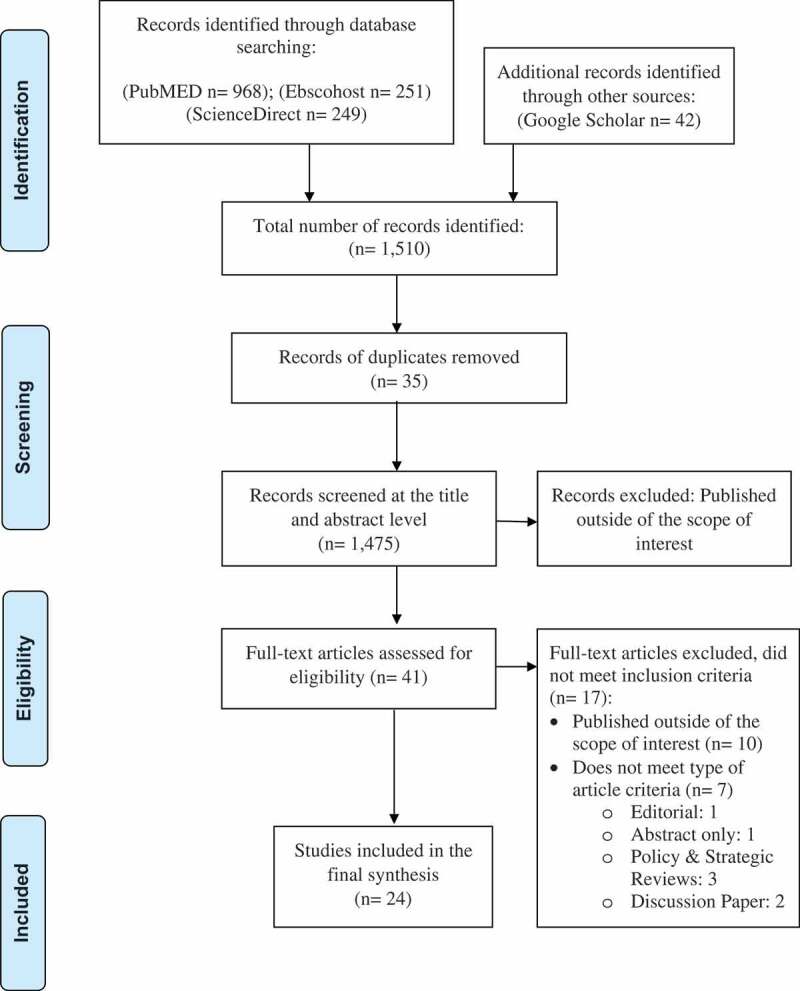
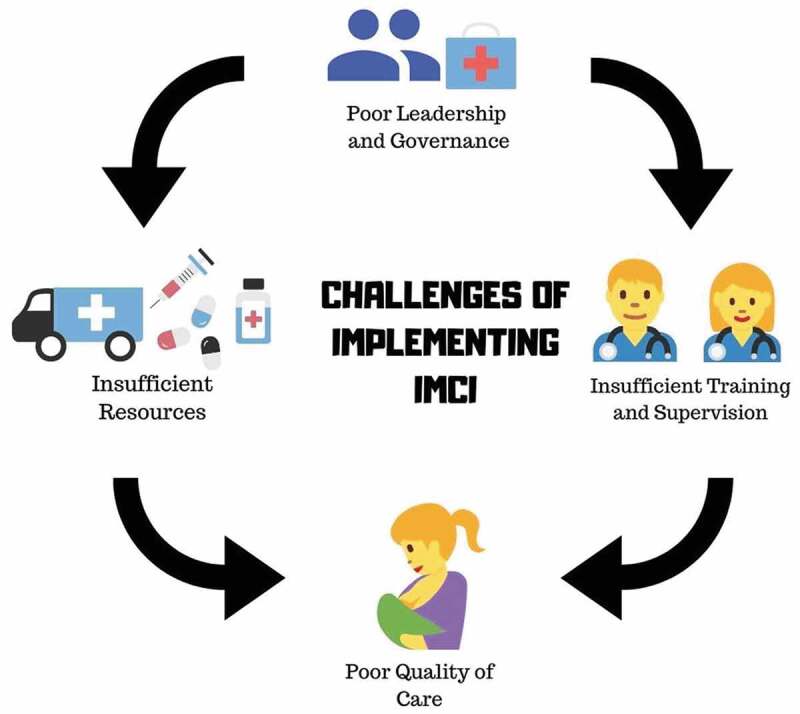
: Several evaluative studies demonstrate that a well-coordinated Integrated Management of Childhood Illnesses (IMCI) program can reduce child mortality. However, there is dearth of information on how frontline providers perceive IMCI and how, in their view, the program is implemented and how it could be refined and revitalized.: To determine the key challenges affecting IMCI implementation from the perspective of health care workers (HCWs) in primary health care facilities.: A scoping review based on the five-step framework of Arskey and O'Malley was utilized to identify key challenges faced by HCWs implementing the IMCI program in primary health care facilities. A comprehensive search of peer-reviewed literature through PubMed, ScienceDirect, EBSCOhost and Google Scholar was conducted. A total of 1,475 publications were screened for eligibility and 41 publications identified for full-text evaluation. Twenty-four (24) published articles met our inclusion criteria, and were investigated to tease out common themes related to challenges of HCWs in terms of implementing the IMCI program.: Four key challenges emerged from our analysis: 1) Insufficient financial resources to fund program activities, 2) Lack of training, mentoring and supervision from the tertiary level, 3) Length of time required for effective and meaningful IMCI consultations conflicts with competing demands and 4) Lack of planning and coordination between policy makers and implementers resulting in ambiguity of roles and accountability. Although the IMCI program can provide substantial benefits, more information is still needed regarding implementation processes and acceptability in primary health care settings.: Recognizing and understanding insights of those enacting health programs such as IMCI can spark meaningful strategic recommendations to improve IMCI program effectiveness. This review suggests four domains that merit consideration in the context of efforts to scale and expand IMCI programs.
多项评估研究表明,协调良好的儿童疾病综合管理(IMCI)项目可降低儿童死亡率。然而,关于一线工作人员如何看待IMCI,以及在他们看来该项目是如何实施的,以及如何对其进行完善和振兴,目前缺乏相关信息。
为了从初级卫生保健机构医护人员的角度确定影响IMCI实施的关键挑战。
采用基于Arskey和O'Malley五步框架的范围审查,以确定初级卫生保健机构中实施IMCI项目的医护人员面临的关键挑战。通过PubMed、ScienceDirect、EBSCOhost和谷歌学术对同行评审文献进行了全面检索。共筛选了1475篇出版物的资格,确定了41篇出版物进行全文评估。24篇已发表文章符合我们的纳入标准,并对其进行了调查,以梳理出与医护人员在实施IMCI项目方面的挑战相关的共同主题。
1)为项目活动提供资金的财政资源不足;2)缺乏来自三级机构的培训、指导和监督;3)有效且有意义的IMCI咨询所需时间与相互竞争的需求相冲突;4)政策制定者和实施者之间缺乏规划和协调,导致角色和问责不明确。尽管IMCI项目可以带来巨大益处,但在初级卫生保健环境中的实施过程和可接受性方面仍需要更多信息。
认识和理解实施IMCI等卫生项目的人员的见解,可以激发有意义的战略建议,以提高IMCI项目的有效性。本综述提出了在扩大和扩展IMCI项目的努力中值得考虑的四个领域。