Unterweger Julian, Seeber Martin, Zanos Stavros, Ojemann Jeffrey G, Scherer Reinhold
Institute of Neural Engineering, Graz University of Technology, Graz, Austria.
Functional Brain Mapping Laboratory, Department of Fundamental Neurosciences, University of Geneva, Geneva, Switzerland.
Front Neurosci. 2020 Feb 13;14:35. doi: 10.3389/fnins.2020.00035. eCollection 2020.
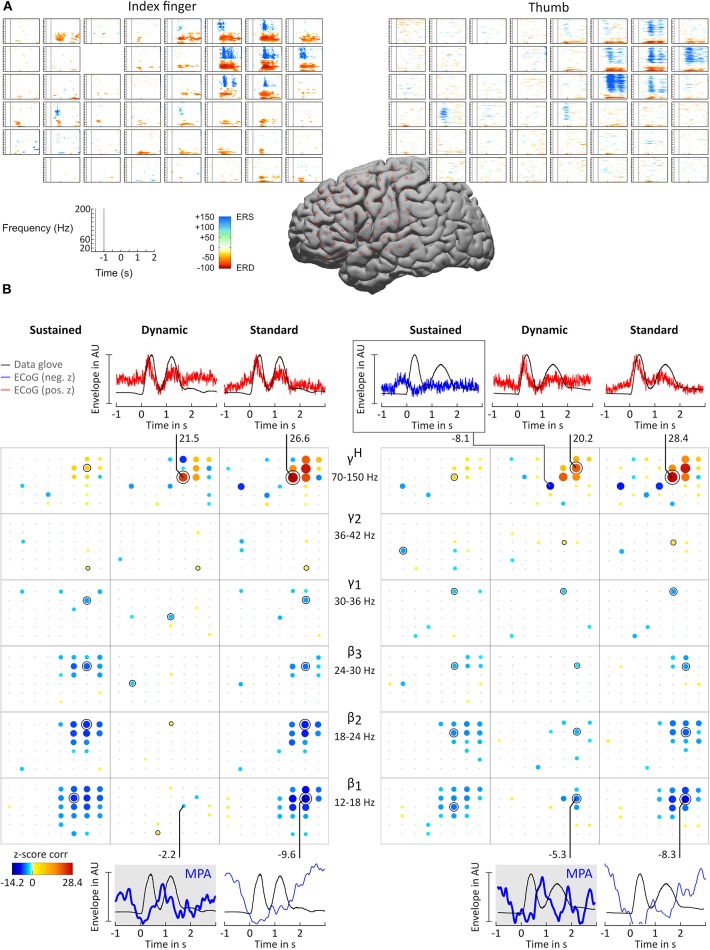
Neural oscillations originate predominantly from interacting cortical neurons and consequently reflect aspects of cortical information processing. However, their functional role is not yet fully understood and their interpretation is debatable. Amplitude modulations (AMs) in alpha (8-12 Hz), beta (13-30 Hz), and high gamma (70-150 Hz) band in invasive electrocorticogram (ECoG) and non-invasive electroencephalogram (EEG) signals change with behavior. Alpha and beta band AMs are typically suppressed (desynchronized) during motor behavior, while high gamma AMs highly correlate with the behavior. These two phenomena are successfully used for functional brain mapping and brain-computer interface (BCI) applications. Recent research found movement-phase related AMs (MPA) also in high beta/low gamma (24-40 Hz) EEG rhythms. These MPAs were found by separating the suppressed AMs into sustained and dynamic components. Sustained AM components are those with frequencies that are lower than the motor behavior. Dynamic components those with frequencies higher than the behavior. In this paper, we study ECoG beta/low gamma band (12-30 Hz/30-42 Hz) AM during repetitive finger movements addressing the question whether or not MPAs can be found in ECoG beta band. Indeed, MPA in the 12-18 Hz and 18-24 Hz band were found. This additional information may lead to further improvements in ECoG-based prediction and reconstruction of motor behavior by combining high gamma AM and beta band MPA.
神经振荡主要源于相互作用的皮层神经元,因此反映了皮层信息处理的各个方面。然而,它们的功能作用尚未完全明了,其解释也存在争议。侵入性脑电描记图(ECoG)和非侵入性脑电图(EEG)信号中,α(8 - 12赫兹)、β(13 - 30赫兹)和高γ(70 - 150赫兹)频段的振幅调制(AM)会随行为而变化。在运动行为期间,α和β频段的AM通常会受到抑制(去同步化),而高γ频段的AM与行为高度相关。这两种现象已成功应用于功能性脑图谱绘制和脑机接口(BCI)应用。最近的研究在高β/低γ(24 - 40赫兹)EEG节律中也发现了与运动阶段相关的AM(MPA)。这些MPA是通过将受抑制的AM分离为持续成分和动态成分而发现的。持续AM成分是指频率低于运动行为的成分。动态成分是指频率高于行为的成分。在本文中,我们研究了重复手指运动期间ECoG的β/低γ频段(12 - 30赫兹/30 - 42赫兹)的AM,探讨是否能在ECoG的β频段中发现MPA。实际上,在12 - 18赫兹和18 - 24赫兹频段中发现了MPA。通过结合高γ频段的AM和β频段的MPA,这些额外信息可能会进一步改善基于ECoG的运动行为预测和重建。