Nguyen Ho A T, Guo Chao, Homberg Judith R
Donders Institute for Brain, Cognition, and Behavior, Radboud University Medical Center, Nijmegen, Netherlands.
Front Behav Neurosci. 2020 Feb 12;14:14. doi: 10.3389/fnbeh.2020.00014. eCollection 2020.
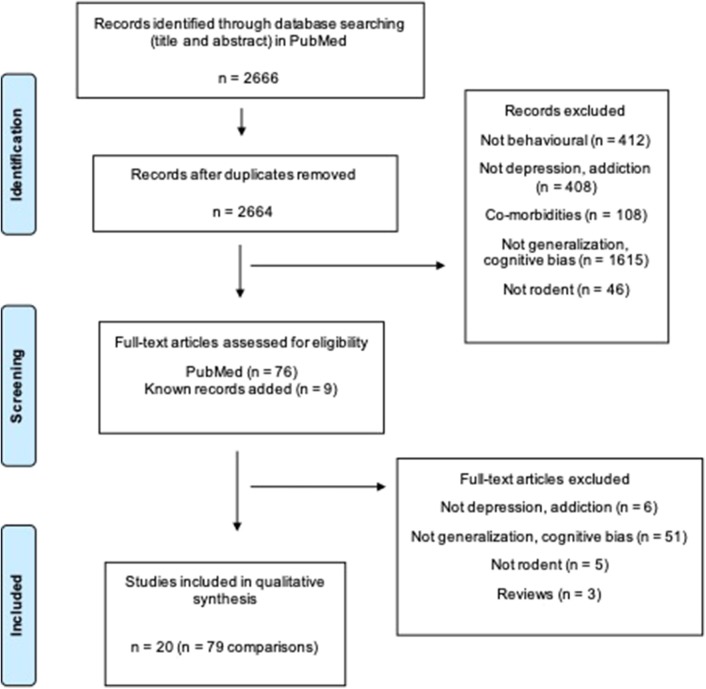
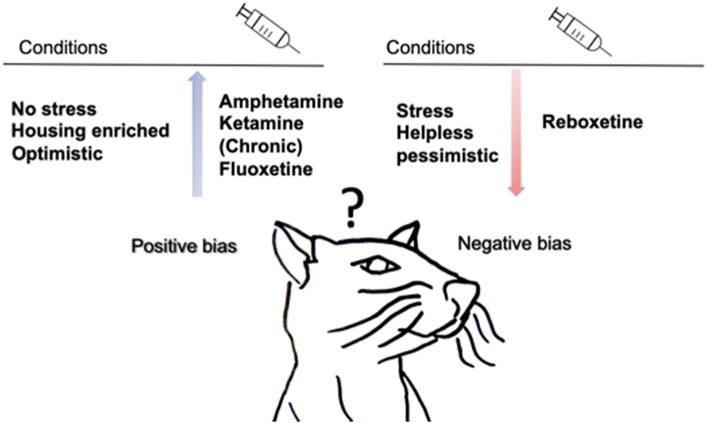
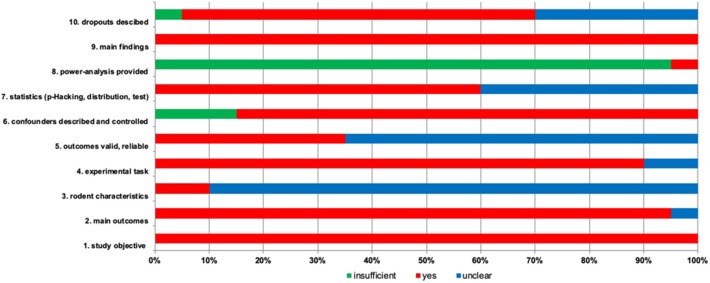
Cognitive bias refers to emotional influences on cognition and provides a cognitive measure of negativity- or positivity-bias through assessment of the behavioral responses to ambiguous stimuli. Thus, under negative conditions an animal is more likely to judge ambiguous stimuli as negative, and under positive conditions as positive. The transfer of past experiences to novel but similar situations is highly adaptive, as it allows the animal to anticipate on the most likely outcome of the ambiguous cues. We conducted a systematic review to summarize the current state of evidence on cognitive bias in rodents under adverse and rewarding or supportive conditions. In total 20 studies were identified, in which auditory, spatial, tactile, or visual tasks were used. Stressed rodents generally made fewer positive responses than their non-stressed conspecifics. Housing enrichment made rodents more positive in anticipation of ambiguous cues. Ethanol seeking rats generalized the ambiguous cues to sucrose and less to ethanol if sucrose was available. Amphetamine, fluoxetine, and ketamine shifted the bias toward positivity, while reboxetine elevated negative bias. The auditory tasks have been most extensively validated, followed by the tactile and spatial tasks, and finally the visual tasks. The tactile and spatial tasks use latency as readout, which is sensitive to confounding factors. It is yet uncertain whether spatial tasks measure cognitive bias. Across all tasks, with some exceptions, rodents exposed to stress show less positivity-bias when exposed to ambiguous cues, whereas rodents exposed to rewarding substances or treated with antidepressant drugs are biased toward reward. Considering the methodological heterogeneity and risk of bias, the present data should be interpreted with caution.
认知偏差是指情绪对认知的影响,并通过评估对模糊刺激的行为反应来提供对消极或积极偏差的认知测量。因此,在消极条件下,动物更有可能将模糊刺激判断为消极,而在积极条件下则判断为积极。将过去的经验转移到新颖但相似的情境中具有高度适应性,因为它使动物能够预测模糊线索的最可能结果。我们进行了一项系统综述,以总结在不利、奖励或支持条件下啮齿动物认知偏差的现有证据状态。总共确定了20项研究,其中使用了听觉、空间、触觉或视觉任务。应激的啮齿动物通常比未应激的同种动物做出更少的积极反应。丰富饲养环境使啮齿动物在预期模糊线索时更积极。如果有蔗糖,寻求乙醇的大鼠会将模糊线索推广到蔗糖,而较少推广到乙醇。苯丙胺、氟西汀和氯胺酮使偏差转向积极,而瑞波西汀则提高了消极偏差。听觉任务得到了最广泛的验证,其次是触觉和空间任务,最后是视觉任务。触觉和空间任务使用潜伏期作为读数,这对混杂因素敏感。空间任务是否测量认知偏差尚不确定。在所有任务中,除了一些例外,暴露于应激的啮齿动物在面对模糊线索时表现出较少的积极偏差,而暴露于奖励物质或接受抗抑郁药物治疗的啮齿动物则偏向于奖励。考虑到方法学的异质性和偏差风险,对目前的数据应谨慎解释。