Liu Yia-Ping, Chien Wu-Chien, Chung Chi-Hsiang, Chang Hsin-An, Kao Yu-Chen, Tzeng Nian-Sheng
Department of Psychiatry, Cheng Hsin General Hospital, Taipei, Taiwan.
Department of Psychiatry, Tri-Service General Hospital, School of Medicine, National Defense Medical Center, Taipei, Taiwan.
Front Pharmacol. 2020 Feb 14;11:30. doi: 10.3389/fphar.2020.00030. eCollection 2020.
BACKGROUND/OBJECTIVE: In previous reports, the usage of anticholinergic medications has been associated with an increased risk of dementia with prolonged usage or with a high Anticholinergic Cognitive Burden (ACB). This study aimed to investigate the association between anticholinergic medications and the risk of dementia using data from Taiwan's National Health Research Database (NHIRD).
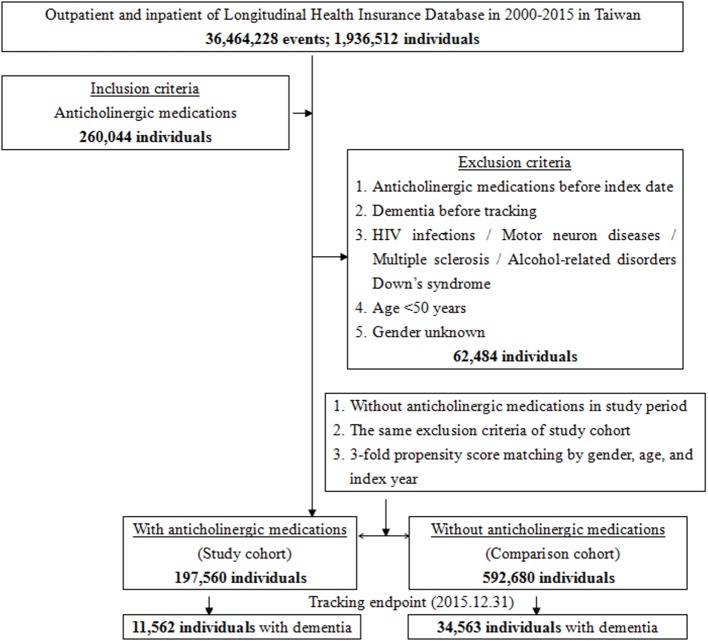
A total of 790,240 patients, with 197,560 patients receiving anticholinergic medications and 592,680 control patients (1:3) matched for sex, age, and index-year, were enrolled from the two million Longitudinal Health Insurance Dataset, a subdataset of the NHIRD, between 2000 and 2015. The time-dependent Cox regression analysis was used to explore the hazard ratio (HR) with a 95% confidence interval for the association between anticholinergics and the risk of dementia during the 15-year follow-up. The behavioral and psychological symptoms of dementia (BPSD) were recognized by the usage of psychotropics. The ACB ranged from zero to three, divided as score <1, 1-1.9, 2-2.9, 3-4.9,and ≧5. The sensitivity analysis was done by excluding the diagnoses of dementia in the first 2 or 4 years after anticholinergic usage.
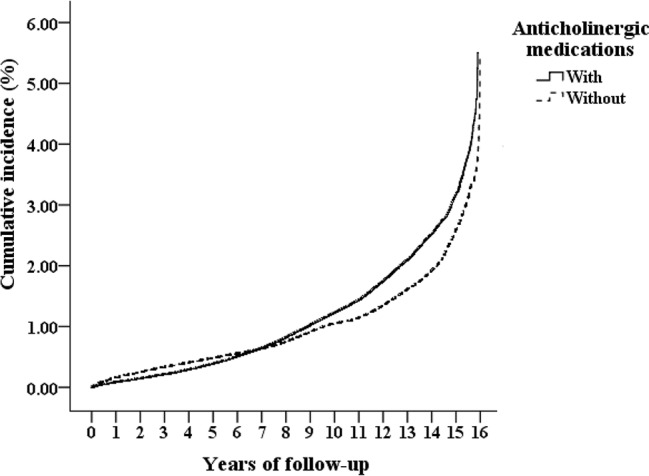
In the anticholinergic usage cohort, the HR was 1.043 (95% CI = 0.958-1.212, = 0.139) without a significant difference. The sensitivity analysis revealed no association between the usage of anticholinergics and the risk of dementia. Anticholinergic usage was not associated with BPSD. Male sex, patients of ages of 60-64 and ≧80, usage of antiparkinsonian medications, a history of Parkinson's disease, epilepsy, urinary incontinence, depression, bipolar disorder, and psychotic disorder were independent risk factors of dementia. Increased HRs for dementia were associated with an ACB ≥ 5 and an anticholinergic usage period ≥ 1,460 days.
In this study, the usage of anticholinergics was not associated with the risk of dementia or BPSD in a 15-year follow-up study. However, patients with the male sex, patients with ages of 65-79 and ≧80, patients with some comorbidities, high ACB scores, and long anticholinergic treatment duration were associated with the risk of dementia.
背景/目的:在以往的报告中,抗胆碱能药物的使用与长期使用或高抗胆碱能认知负担(ACB)导致的痴呆风险增加有关。本研究旨在利用台湾国家健康研究数据库(NHIRD)的数据,调查抗胆碱能药物与痴呆风险之间的关联。
从NHIRD的一个子数据集——两百万纵向健康保险数据集中,纳入了总共790240名患者,其中197560名患者接受抗胆碱能药物治疗,592680名对照患者(1:3)按性别、年龄和索引年份进行匹配,时间跨度为2000年至2015年。采用时间依赖性Cox回归分析,以探索在15年随访期间抗胆碱能药物与痴呆风险之间关联的风险比(HR)及95%置信区间。通过使用精神药物来识别痴呆的行为和心理症状(BPSD)。ACB范围为0至3,分为得分<1、1 - 1.9、2 - 2.9、3 - 4.9和≥5。敏感性分析通过排除抗胆碱能药物使用后头2年或4年内的痴呆诊断来进行。
在抗胆碱能药物使用队列中,HR为1.043(95%CI = 0.958 - 1.212,P = 0.139),无显著差异。敏感性分析显示抗胆碱能药物的使用与痴呆风险之间无关联。抗胆碱能药物的使用与BPSD无关。男性、60 - 64岁及≥80岁的患者、使用抗帕金森药物、有帕金森病、癫痫、尿失禁、抑郁症、双相情感障碍和精神障碍病史是痴呆的独立危险因素。痴呆的HR增加与ACB≥5和抗胆碱能药物使用期≥1460天有关。
在本研究的15年随访中,抗胆碱能药物的使用与痴呆或BPSD风险无关。然而,男性患者、65 - 79岁及≥80岁的患者、患有某些合并症的患者、ACB评分高以及抗胆碱能治疗持续时间长的患者与痴呆风险有关。