Division of Cardiovascular Surgery, Department of Surgery, Tri-Service General Hospital, School of Medicine, National Defense Medical Center, Taipei, Taiwan.
Department of Psychiatry, Taoyuan Armed Forced General Hospital, School of Medicine, National Defense Medical Center, Taipei, Taiwan.
Sci Rep. 2022 Mar 3;12(1):3531. doi: 10.1038/s41598-022-06377-3.
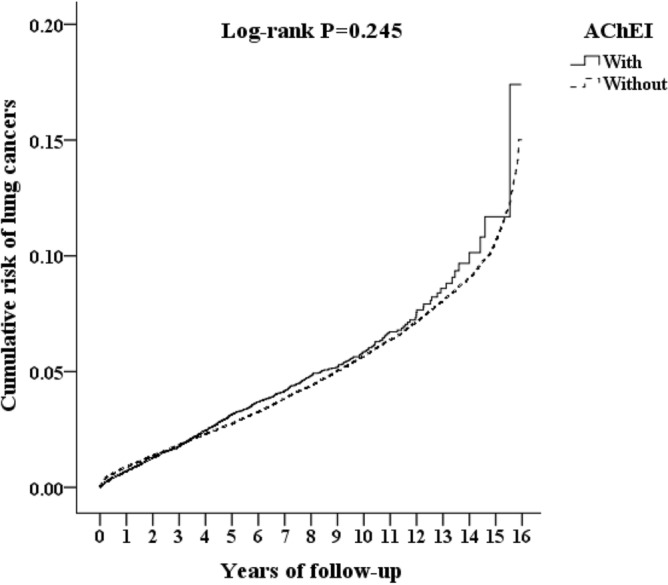
This retrospective cohort study aimed to evaluate the association between acetylcholinesterase inhibitors (AChEI) usage and the risk of lung cancer. Data from 116,106 new users of AChEI and 348,318, at a ratio of 1:3, matched by age, sex, and index-year, between 2000 and 2015 controls were obtained from the Taiwan Longitudinal Health Insurance Database in this cohort study. The Cox regression model was used to compare the risk of lung cancer. The adjusted hazard ratio (aHR) of lung cancer for AChEI users was 1.198 (95% confidence interval [CI] = 0.765-1.774, p = 0.167). However, the adjusted HR for patients aged ≥ 65 was adjusted to HR: 1.498 (95% CI = 1.124-1.798, p < 0.001), in contrast to the comparison groups. In addition, patients with comorbidities such as pneumonia, bronchiectasis, pneumoconiosis, pulmonary alveolar pneumonopathy, hypertension, stroke, coronary artery disease, diabetes mellitus, chronic kidney disease, depression, anxiety, smoking-related diseases, dementia, and seeking medical help from medical centers and regional hospitals, were associated with a higher risk in lung cancer. Furthermore, longer-term usage of rivastigmine (366-730 days, ≥ 731 days) and galantamine (≥ 731 days) was associated with the risk of lung cancer. AChEI increased the risk of lung cancer in the older aged patients, several comorbidities, and a longer-term usage of rivastigmine and galantamine. Therefore, physicians should estimate the risks and benefits of AChEI usage and avoid prescribing antidepressants concurrently.
本回顾性队列研究旨在评估乙酰胆碱酯酶抑制剂 (AChEI) 使用与肺癌风险之间的关联。这项队列研究的数据来自于 2000 年至 2015 年期间,台湾纵向健康保险数据库中的 116106 名新使用 AChEI 的患者和 348318 名年龄、性别和索引年份相匹配的对照者,比例为 1:3。使用 Cox 回归模型比较肺癌风险。AChEI 使用者肺癌的调整后危险比 (aHR) 为 1.198(95%置信区间 [CI] = 0.765-1.774,p = 0.167)。然而,≥65 岁患者的调整后 HR 为 HR:1.498(95%CI = 1.124-1.798,p<0.001),与对照组相比。此外,患有肺炎、支气管扩张症、尘肺、肺泡性肺炎、高血压、中风、冠心病、糖尿病、慢性肾脏病、抑郁症、焦虑症、与吸烟有关的疾病、痴呆症以及在医疗中心和区域医院寻求医疗帮助等合并症的患者,其肺癌风险更高。此外,使用加兰他敏(366-730 天,≥731 天)和利斯的明(≥731 天)的时间较长与肺癌风险相关。AChEI 在年龄较大的患者、几种合并症以及较长时间使用利斯的明和加兰他敏的情况下增加了肺癌的风险。因此,医生应评估 AChEI 使用的风险和益处,并避免同时开具抗抑郁药。