Widmayer Patricia, Partsch Vanessa, Pospiech Jonas, Kusumakshi Soumya, Boehm Ulrich, Breer Heinz
Institute of Physiology, University of Hohenheim, Stuttgart, Germany.
Experimental Pharmacology, Center for Molecular Signaling, School of Medicine, Saarland University, Homburg, Germany.
Front Physiol. 2020 Feb 7;11:32. doi: 10.3389/fphys.2020.00032. eCollection 2020.
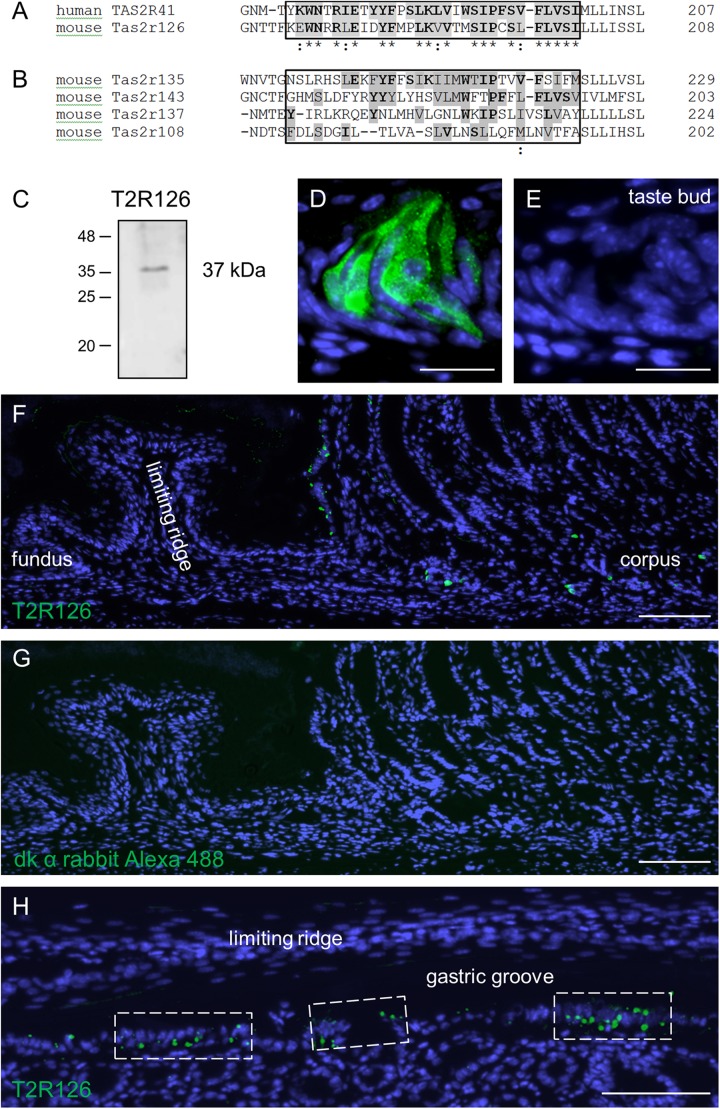
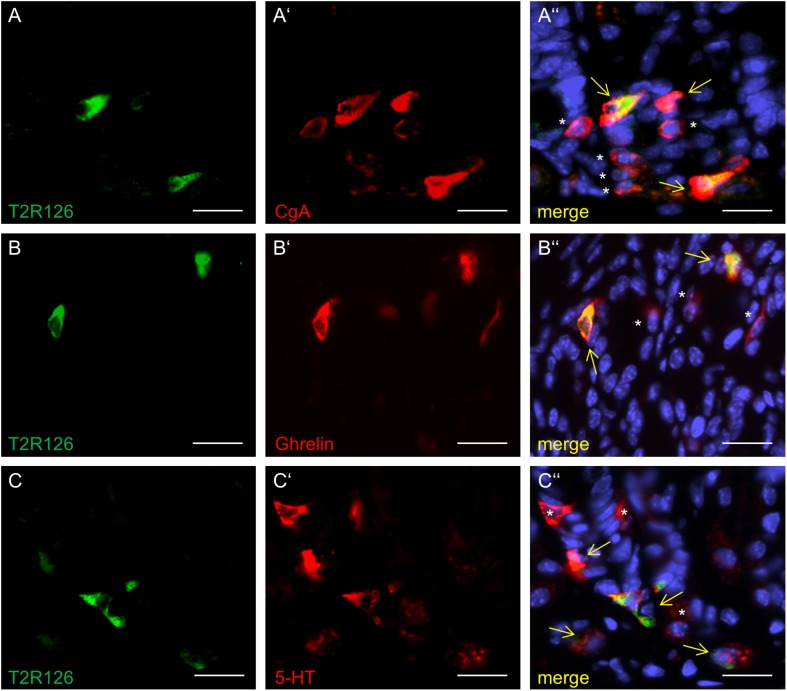
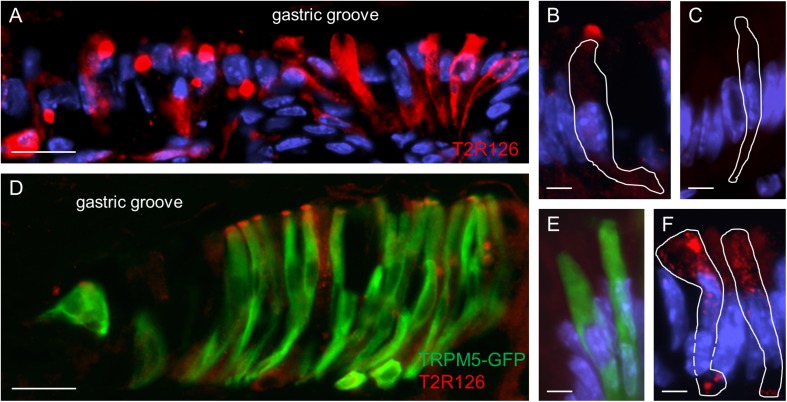
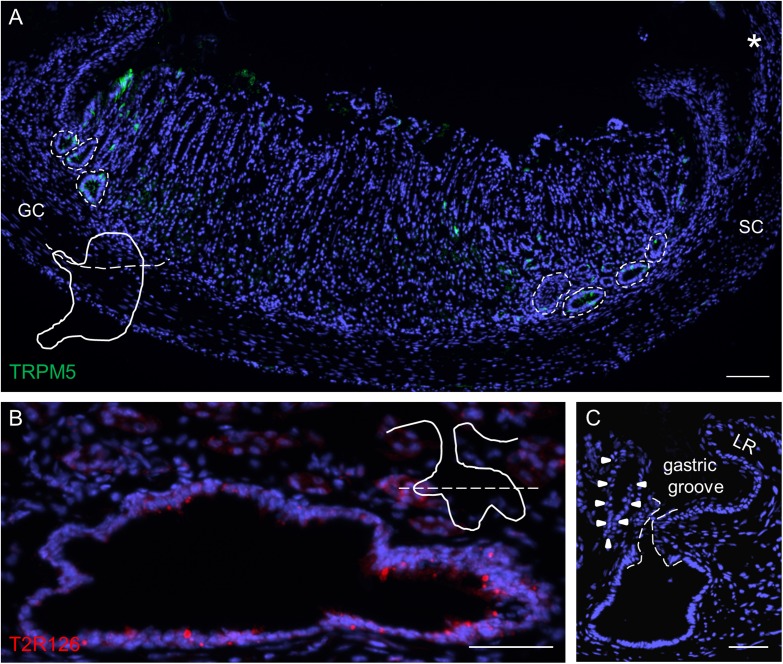
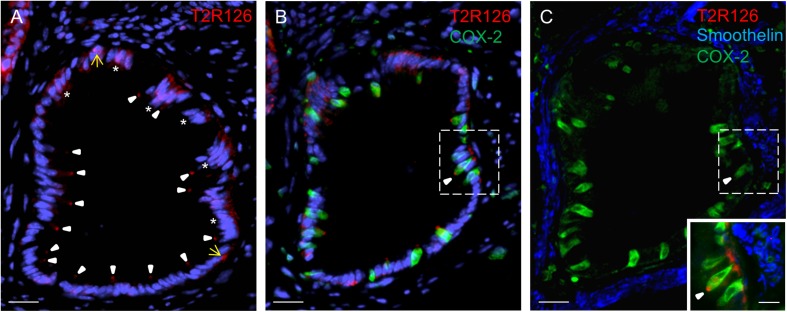
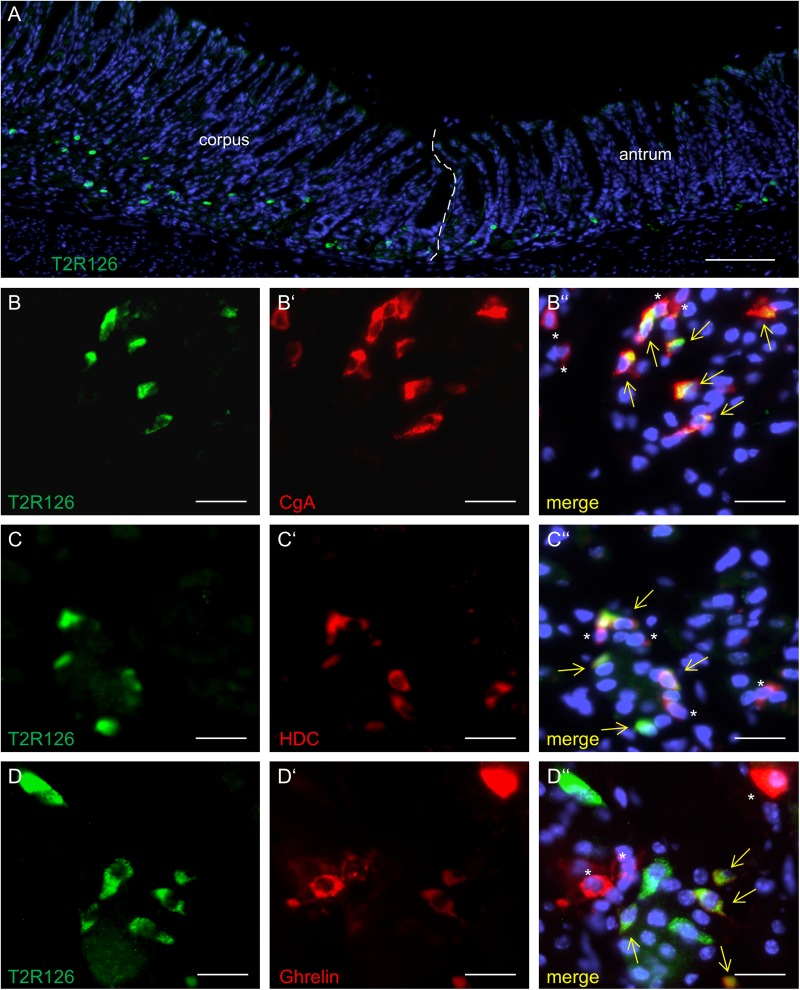
Cells expressing bitter taste receptors (T2Rs or Tas2rs) in extraoral tissues are considered to be chemosensory cells mediating protective responses to potentially harmful or even antiinflammatory or antimicrobial compounds. In a previous study the activity of the cluster promoter in the stomach was monitored using a Cre-reporter mouse line. Reporter gene expression and mRNA were found in brush cells located at the distal wall of the gastric groove. In this study, we explored whether brush cells and epithelial cells of the stomach in fact contain the Tas2r126 receptor protein. Using immunohistochemistry, we demonstrate the presence of Tas2r126 immunoreactivity in different cell populations in the glandular stomach, in a subset of brush cells at the gastric groove and in unique glandular units as well as in certain enteroendocrine cells. In brush cells at the gastric groove, a strong immunofluorescence signal for the Tas2r126 receptor was observed at the most apical region of the cells, i.e., the microvillar tuft. In addition, we found a high density of Tas2r126-positive brush cells in the unique glandular units. These invaginations are located distally to the groove, open directly into the furrow and are enwrapped by smoothelin-immunoreactive muscles. In the corpus, Tas2r126 immunoreactivity was found in histamine-producing ECL cells and in ghrelin-producing X/A-like cells, the main enteroendcrine cells of this compartment. In the antrum, Tas2r126 labeling was observed in serotonin-storing EC cells and ghrelin cells, both representing only minor populations of enteroendocrine cells in this compartment. In conclusion, our data provide evidence for the presence of the Tas2r126 receptor protein in distinct cell types in the epithelium lining the mouse stomach which render the stomach responsive to agonists for bitter receptors.
在口腔外组织中表达苦味受体(T2Rs或Tas2rs)的细胞被认为是化学感应细胞,可介导对潜在有害甚至抗炎或抗菌化合物的保护反应。在先前的一项研究中,使用Cre报告基因小鼠品系监测了胃中簇启动子的活性。在位于胃沟远端壁的刷细胞中发现了报告基因表达和mRNA。在本研究中,我们探究了胃的刷细胞和上皮细胞是否实际上含有Tas2r126受体蛋白。通过免疫组织化学,我们证明了Tas2r126免疫反应性存在于腺胃的不同细胞群体中、胃沟处刷细胞的一个亚群中、独特的腺单元中以及某些肠内分泌细胞中。在胃沟处的刷细胞中,在细胞的最顶端区域,即微绒毛簇,观察到了Tas2r126受体强烈的免疫荧光信号。此外,我们在独特的腺单元中发现了高密度的Tas2r126阳性刷细胞。这些内陷位于沟的远端,直接通向沟,并被平滑肌肌动蛋白免疫反应性肌肉包裹。在胃体中,在产生组胺的肠嗜铬样细胞(ECL细胞)和产生胃泌素的X/A样细胞中发现了Tas2r126免疫反应性,这是该区域的主要肠内分泌细胞。在胃窦中,在储存5-羟色胺的肠内分泌细胞(EC细胞)和胃泌素细胞中观察到了Tas2r126标记,这两种细胞在该区域仅占肠内分泌细胞的少数群体。总之,我们的数据为Tas2r126受体蛋白存在于小鼠胃内衬上皮的不同细胞类型中提供了证据,这使得胃对苦味受体激动剂有反应。