Adhikari Bhawana, Pangomm Kamonporn, Veerana Mayura, Mitra Sarmistha, Park Gyungsoon
Plasma Bioscience Research Center, Kwangwoon University, Seoul, South Korea.
Department of Basic Science, Maejo University Phrae Campus, Phrae, Thailand.
Front Plant Sci. 2020 Feb 14;11:77. doi: 10.3389/fpls.2020.00077. eCollection 2020.
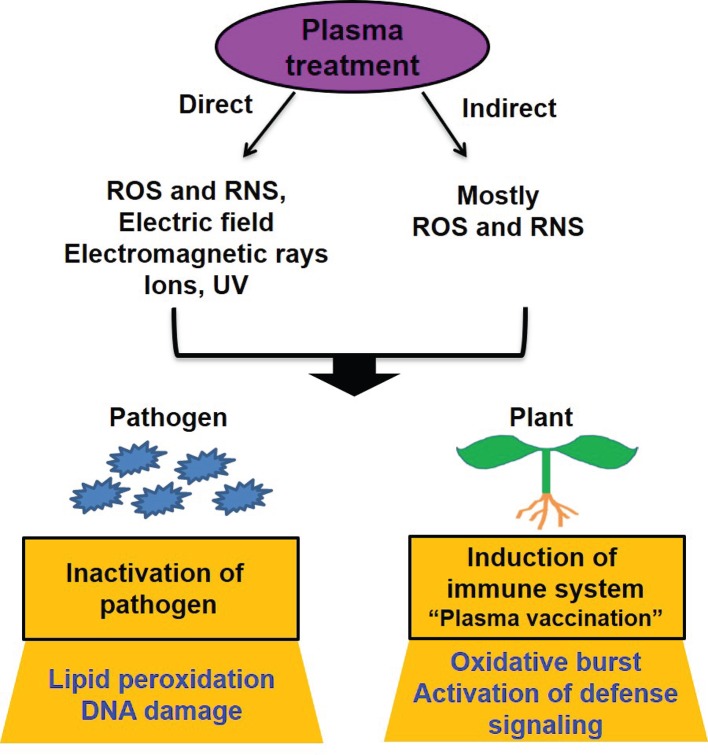
Disease stresses caused by pathogenic microorganisms are increasing, probably because of global warming. Conventional technologies for plant disease control have often revealed their limitations in efficiency, environmental safety, and economic costs. There is high demand for improvements in efficiency and safety. Non-thermal atmospheric-pressure plasma has demonstrated its potential as an alternative tool for efficient and environmentally safe control of plant pathogenic microorganisms in many studies, which are overviewed in this review. Efficient inactivation of phytopathogenic bacterial and fungal cells by various plasma sources under laboratory conditions has been frequently reported. In addition, plasma-treated water shows antimicrobial activity. Plasma and plasma-treated water exhibit a broad spectrum of efficiency in the decontamination and disinfection of plants, fruits, and seeds, indicating that the outcomes of plasma treatment can be significantly influenced by the microenvironments between plasma and plant tissues, such as the surface structures and properties, antioxidant systems, and surface chemistry of plants. More intense studies are required on the efficiency of decontamination and disinfection and underlying mechanisms. Recently, the induction of plant tolerance or resistance to pathogens by plasma (so-called "plasma vaccination") is emerging as a new area of study, with active research ongoing in this field.
由病原微生物引起的病害压力正在增加,这可能是全球变暖所致。传统的植物病害防治技术往往在效率、环境安全性和经济成本方面暴露出局限性。人们对提高效率和安全性有很高的需求。在许多研究中,非热大气压等离子体已显示出其作为一种高效且环境安全的植物病原微生物防治替代工具的潜力,本综述将对这些研究进行概述。在实验室条件下,各种等离子体源对植物致病细菌和真菌细胞的高效灭活已屡有报道。此外,经等离子体处理的水具有抗菌活性。等离子体和经等离子体处理的水在植物、水果和种子的去污和消毒方面展现出广泛的效率,这表明等离子体处理的效果会受到等离子体与植物组织之间微环境的显著影响,如植物的表面结构和性质、抗氧化系统以及表面化学性质等。在去污和消毒效率及其潜在机制方面,还需要更深入的研究。最近,等离子体诱导植物对病原体的耐受性或抗性(即所谓的“等离子体疫苗接种”)正成为一个新的研究领域,该领域目前正在进行积极的研究。