Zhang Yaran, Hu Yan, Wang Xiuge, Jiang Qiang, Zhao Han, Wang Jinpeng, Ju Zhihua, Yang Liguo, Gao Yaping, Wei Xiaochao, Bai Jiachen, Zhou Yang, Huang Jinming
Dairy Cattle Research Center, Shandong Academy of Agricultural Sciences, Jinan, China.
Key Laboratory of Agricultural Animal Genetics, Breeding and Reproduction of Ministry of Education & College of Animal Science and Technology, Huazhong Agricultural University, Wuhan, China.
Front Genet. 2020 Feb 14;10:1404. doi: 10.3389/fgene.2019.01404. eCollection 2019.
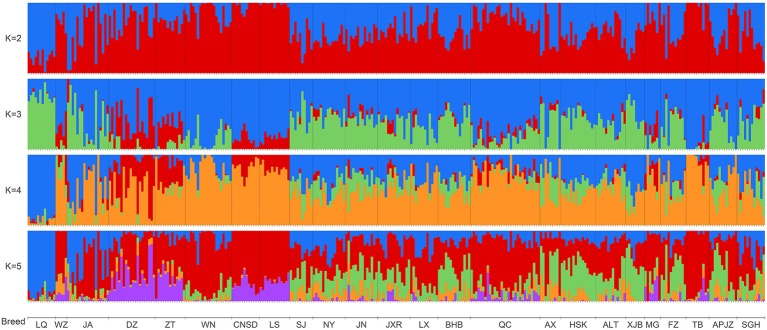
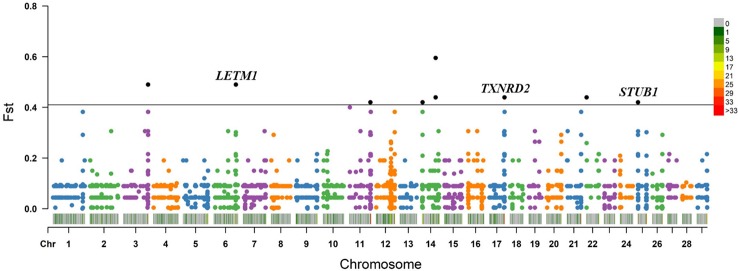
Copy number variations (CNVs) have been demonstrated as crucial substrates for evolution, adaptation and breed formation. Chinese indigenous cattle breeds exhibit a broad geographical distribution and diverse environmental adaptability. Here, we analyzed the population structure and adaptation to high altitude of Chinese indigenous cattle based on genome-wide CNVs derived from the high-density BovineHD SNP array. We successfully detected the genome-wide CNVs of 318 individuals from 24 Chinese indigenous cattle breeds and 37 yaks as outgroups. A total of 5,818 autosomal CNV regions (683 bp-4,477,860 bp in size), covering ~14.34% of the bovine genome (UMD3.1), were identified, showing abundant CNV resources. Neighbor-joining clustering, principal component analysis (PCA), and population admixture analysis based on these CNVs support that most Chinese cattle breeds are hybrids of (hereinafter to be referred as ) and (). The distribution patterns of the CNVs could to some extent be related to the geographical backgrounds of the habitat of the breeds, and admixture among cattle breeds from different districts. We analyzed the selective signatures of CNVs positively involved in high-altitude adaptation using pairwise Fst analysis within breeds with a strong background (taurine-type breeds) and within × hybrids, respectively. CNV-overlapping genes with strong selection signatures (at top 0.5% of Fst value), including (Fst = 0.490), (Fst = 0.440), and (Fst = 0.420) within taurine-type breeds, and (Fst = 0.233), (Fst = 0.222), and (Fst=0.154) within hybrids, were potentially involved in the adaptation to hypoxia. Thus, we provide a new profile of population structure from the CNV aspects of Chinese indigenous cattle and new insights into high-altitude adaptation in cattle.
拷贝数变异(CNV)已被证明是进化、适应和品种形成的关键底物。中国本土牛品种具有广泛的地理分布和多样的环境适应性。在此,我们基于高密度牛HD SNP芯片得出的全基因组CNV,分析了中国本土牛的群体结构和对高海拔的适应性。我们成功检测了来自24个中国本土牛品种的318个个体以及作为外群的37头牦牛的全基因组CNV。共鉴定出5818个常染色体CNV区域(大小为683 bp至4477860 bp),覆盖牛基因组(UMD3.1)的约14.34%,显示出丰富的CNV资源。基于这些CNV的邻接法聚类、主成分分析(PCA)和群体混合分析支持大多数中国牛品种是瘤牛(以下简称T)和牦牛(以下简称Y)的杂交种。CNV的分布模式在一定程度上可能与品种栖息地的地理背景以及不同地区牛品种之间的混合有关。我们分别在具有强烈T背景的品种(瘤牛型品种)内以及T×Y杂交种内,使用成对Fst分析,分析了积极参与高海拔适应的CNV的选择特征。具有强烈选择特征(Fst值处于前0.5%)的CNV重叠基因,包括瘤牛型品种内的EPO(Fst = 0.490)、HIF-1α(Fst = 0.440)和VEGFA(Fst = 0.420),以及杂交种内的EGLN1(Fst = 0.233)、HIF-2α(Fst = 0.222)和VEGFB(Fst = 0.154),可能参与了对缺氧的适应。因此,我们从中国本土牛的CNV方面提供了群体结构的新概况,并对牛的高海拔适应有了新的见解。