Centre for Genetic Analysis and Applications, School of Environmental and Rural Science, University of New England, Armidale, NSW, 2351, Australia.
International Livestock Research Institute and Centre for Tropical Livestock Genetics and Health, Nairobi, Kenya.
BMC Genomics. 2020 Dec 7;21(1):869. doi: 10.1186/s12864-020-07270-x.
Humpless Bos taurus cattle are one of the earliest domestic cattle in Africa, followed by the arrival of humped Bos indicus cattle. The diverse indigenous cattle breeds of Africa are derived from these migrations, with most appearing to be hybrids between Bos taurus and Bos indicus. The present study examines the patterns of admixture, diversity, and relationships among African cattle breeds.
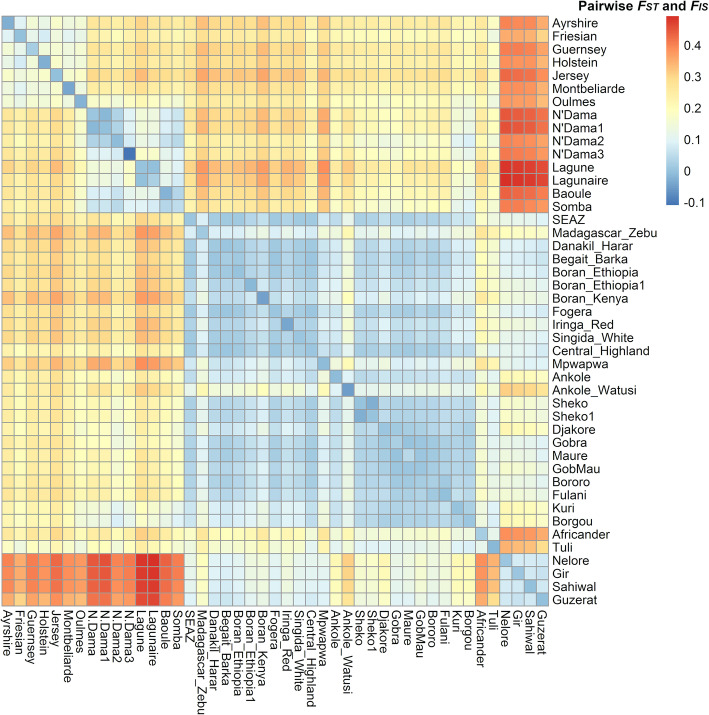
Data for ~ 40 k SNPs was obtained from previous projects for 4089 animals representing 35 African indigenous, 6 European Bos taurus, 4 Bos indicus, and 5 African crossbred cattle populations. Genetic diversity and population structure were assessed using principal component analyses (PCA), admixture analyses, and Wright's F statistic. The linkage disequilibrium and effective population size (Ne) were estimated for the pure cattle populations.
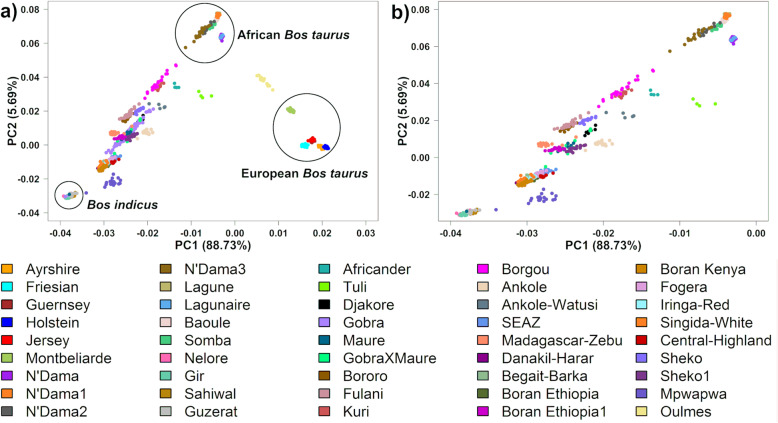
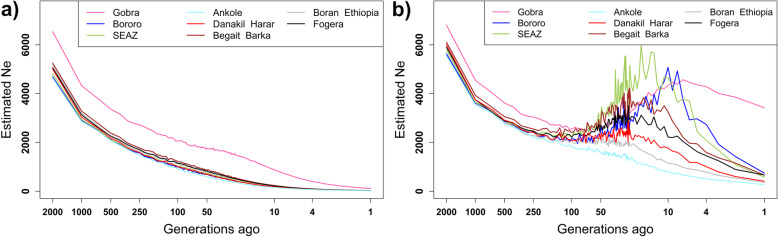
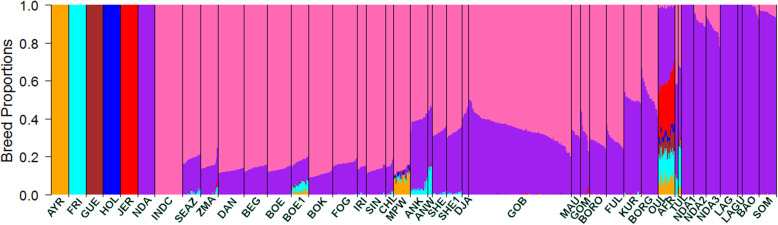
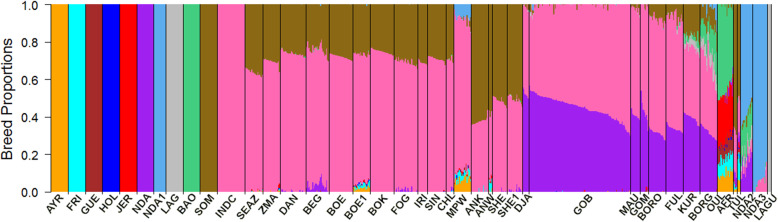
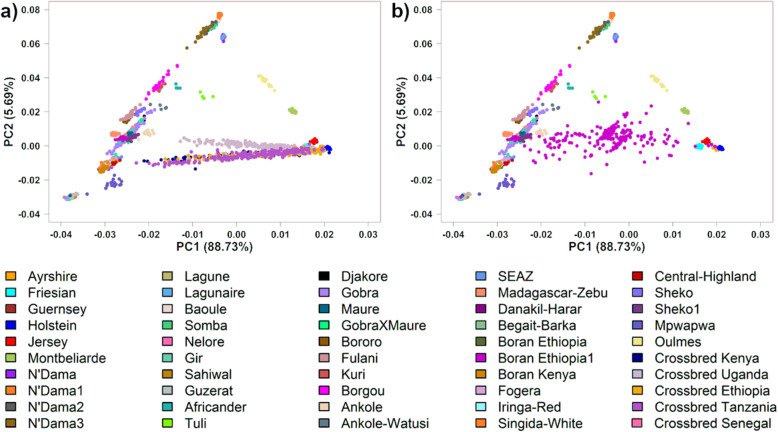
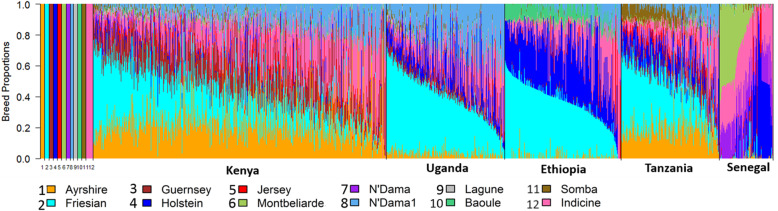
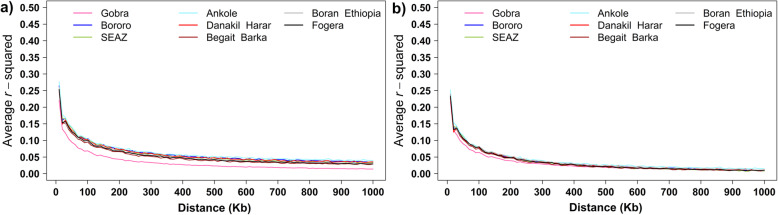
The first two principal components differentiated Bos indicus from European Bos taurus, and African Bos taurus from other breeds. PCA and admixture analyses showed that, except for recently admixed cattle, all indigenous breeds are either pure African Bos taurus or admixtures of African Bos taurus and Bos indicus. The African zebu breeds had highest proportions of Bos indicus ancestry ranging from 70 to 90% or 60 to 75%, depending on the admixture model. Other indigenous breeds that were not 100% African Bos taurus, ranged from 42 to 70% or 23 to 61% Bos indicus ancestry. The African Bos taurus populations showed substantial genetic diversity, and other indigenous breeds show evidence of having more than one African taurine ancestor. Ne estimates based on r and r showed a decline in Ne from a large population at 2000 generations ago, which is surprising for the indigenous breeds given the expected increase in cattle populations over that period and the lack of structured breeding programs.
African indigenous cattle breeds have a large genetic diversity and are either pure African Bos taurus or admixtures of African Bos taurus and Bos indicus. This provides a rich resource of potentially valuable genetic variation, particularly for adaptation traits, and to support conservation programs. It also provides challenges for the development of genomic assays and tools for use in African populations.
无角瘤牛是非洲最早的家牛之一,随后有有角瘤牛的到来。非洲多样化的本地牛品种是从这些迁移中衍生而来的,其中大多数似乎是无角瘤牛和有角瘤牛之间的杂交品种。本研究检查了非洲牛品种的混合、多样性和关系模式。
从之前的项目中获得了约 40000 个 SNP 的数据,用于代表 35 个非洲本地、6 个欧洲无角瘤牛、4 个有角瘤牛和 5 个非洲杂交牛种群的 4089 只动物。使用主成分分析(PCA)、混合分析和 Wright 的 F 统计量评估遗传多样性和种群结构。对纯牛种群进行了连锁不平衡和有效种群大小(Ne)的估计。
前两个主成分区分了有角瘤牛和欧洲无角瘤牛,以及非洲无角瘤牛和其他品种。PCA 和混合分析表明,除了最近混合的牛之外,所有本地品种要么是纯非洲无角瘤牛,要么是非洲无角瘤牛和有角瘤牛的混合。非洲瘤牛品种的有角瘤牛遗传背景比例最高,从 70%到 90%或从 60%到 75%,具体取决于混合模型。其他不是 100%非洲无角瘤牛的本地品种,有角瘤牛遗传背景比例从 42%到 70%或从 23%到 61%不等。非洲无角瘤牛种群显示出相当大的遗传多样性,其他本地品种表明有不止一个非洲牛祖先。基于 r 和 r 的 Ne 估计显示,在 2000 代前的一个大种群中,Ne 下降,这对于本地品种来说令人惊讶,因为在那段时间里,牛种群预计会增加,而且缺乏结构化的繁殖计划。
非洲本地牛品种具有丰富的遗传多样性,要么是纯非洲无角瘤牛,要么是非洲无角瘤牛和有角瘤牛的混合。这为潜在有价值的遗传变异提供了丰富的资源,特别是对适应性状,以及支持保护计划。这也为在非洲种群中开发基因组检测和工具带来了挑战。