Li Zhexuan, Chen Xun, Wei Ming, Liu Guancheng, Tian Yongquan, Zhang Xin, Zhu Gangcai, Chen Changhan, Liu Jiangyi, Wang Tiansheng, Lin Gongbiao, Wang Juncheng, Cai Gengming, Lv Yunxia
Department of Otolaryngology Head and Neck Surgery, Xiangya Hospital, Central South University, Changsha, China.
Department of Stomatology, First Affiliated Hospital of Quanzhou, Fujian Medical University, Quanzhou, China.
Front Oncol. 2020 Feb 7;10:87. doi: 10.3389/fonc.2020.00087. eCollection 2020.
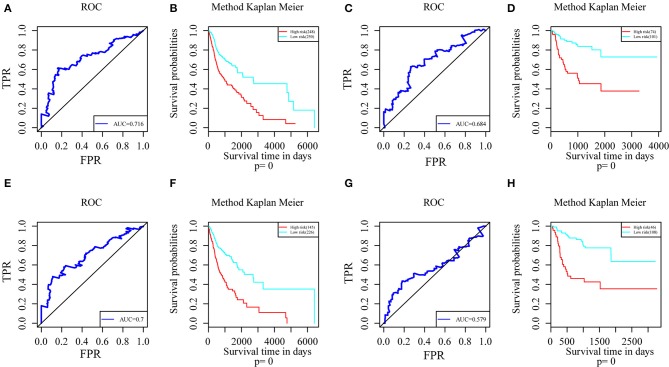
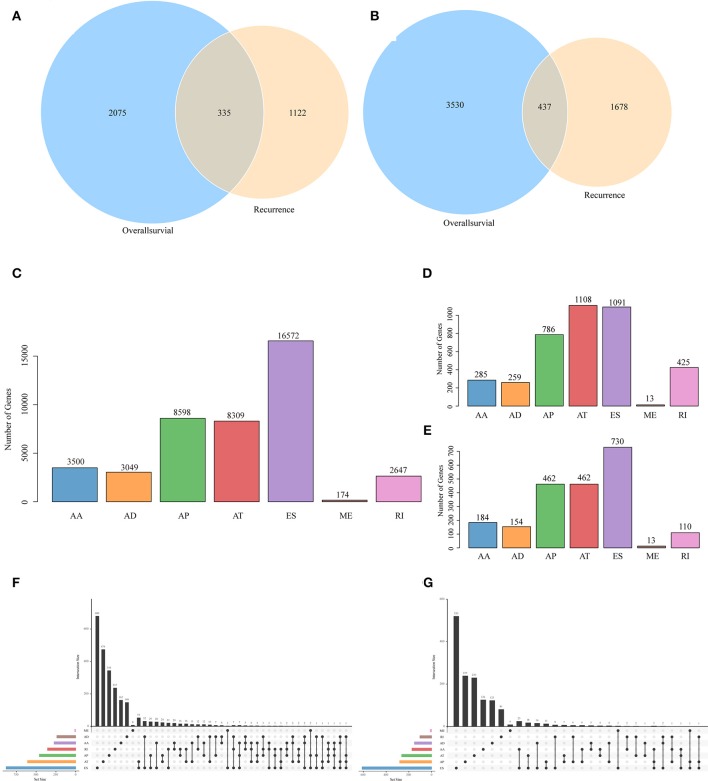
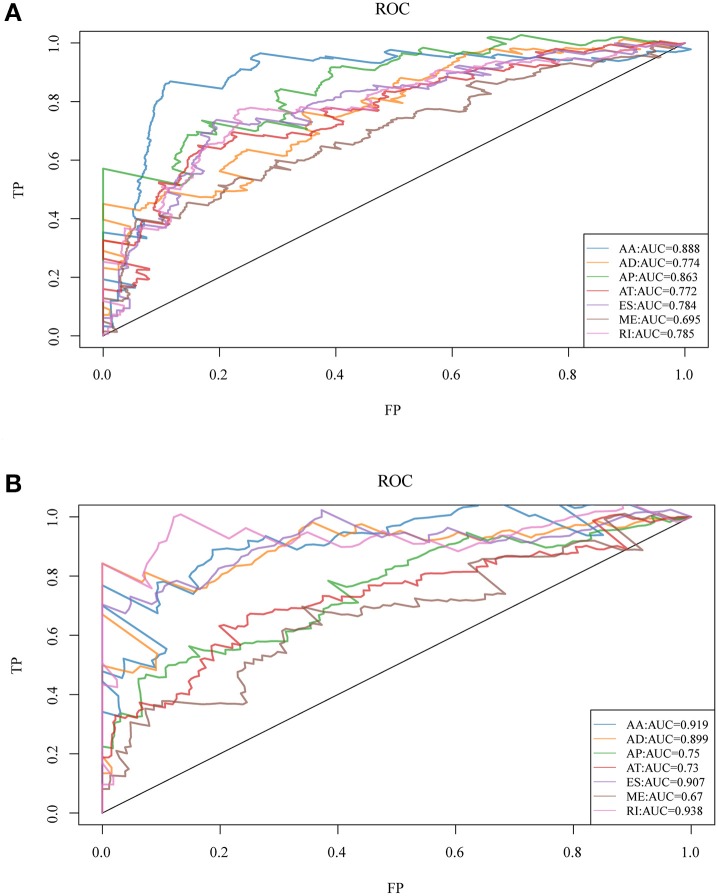
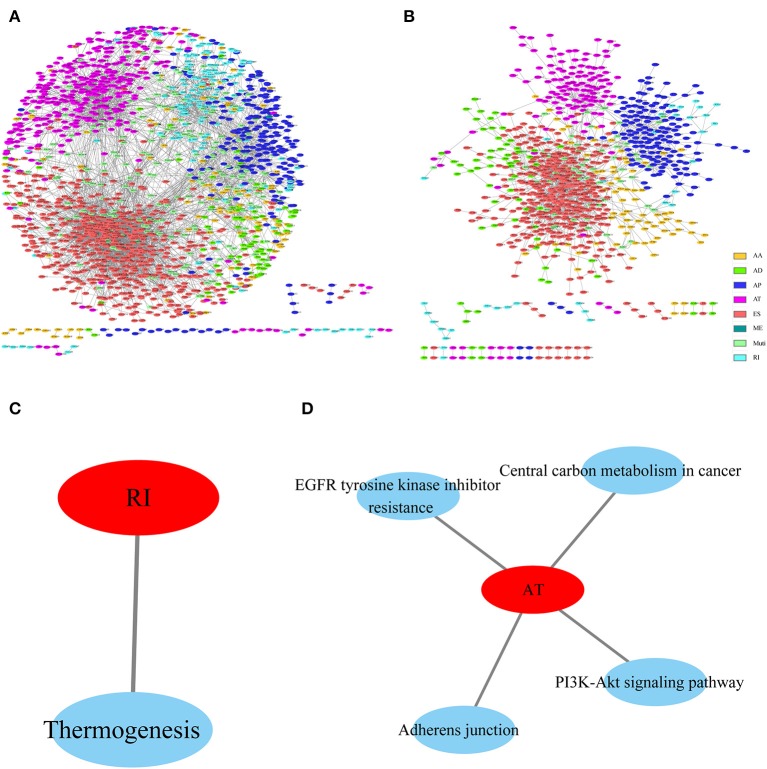
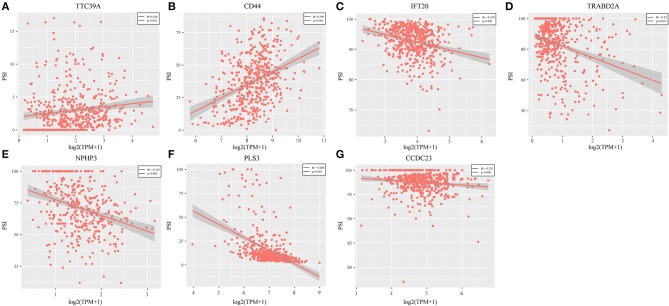
Alternative splicing (AS) is an important mechanism that is responsible for the production of protein diversity. An increasing body of evidence has suggested that out-of-control AS is closely related to the genesis and development of cancer. Systematic analysis of genome-wide AS in head and neck squamous cell carcinoma (HNSCC) has not yet been carried out, and consideration of this topic remains at the preliminary stage and requires further investigation. In this study, systemic bioinformatic analysis was carried out on the genome-wide AS events of 555 clinical HNSCC samples from the TCGA database. Firstly, we statistically analyzed the distributions of seven AS event types in HNSCC samples. Then, through univariate survival analysis, we observed the relationship between AS and the prognosis of the disease and found that 437 intersections of AS events were significantly related to overall survival. Among them, 335 cross-genes showed a high degree of consistency in the genes associated with overall survival and recurrence. The overall survival was significantly related to AS events. Besides, the frequency of overall survival-related ES events was evidently reduced, while the AP and the AT events were increased. In addition, AT events accounted for the largest proportion. Further, multiple regression model analysis proved that AS could become a new classification method for HNSCC, and KEGG enrichment analysis proved that most genes and proteins interacting with AS events had different biological functions and were associated with a variety of diseases. Finally, through the selection of characteristic HNSCC genes and the construction of a prognostic model, seven cross-genes related to survival and recurrence were screened out, and these characteristic genes were verified by multivariate survival model analysis so as to classify the prognosis at different splicing times and gene expression levels. These results have laid a solid foundation for our further research and play a decisive role in showing the correlation of AS with the prognosis of HNSCC.
可变剪接(AS)是一种重要机制,负责产生蛋白质多样性。越来越多的证据表明,失控的可变剪接与癌症的发生和发展密切相关。对头颈部鳞状细胞癌(HNSCC)进行全基因组可变剪接的系统分析尚未开展,对该主题的考虑仍处于初步阶段,需要进一步研究。在本研究中,对来自TCGA数据库的555例临床HNSCC样本的全基因组可变剪接事件进行了系统的生物信息学分析。首先,我们对HNSCC样本中七种可变剪接事件类型的分布进行了统计分析。然后,通过单变量生存分析,我们观察了可变剪接与疾病预后之间的关系,发现437个可变剪接事件的交集与总生存期显著相关。其中,335个交叉基因在与总生存期和复发相关的基因中表现出高度一致性。总生存期与可变剪接事件显著相关。此外,与总生存期相关的外显子跳过(ES)事件的频率明显降低,而可变多聚腺苷酸化(AP)和可变转录起始位点(AT)事件增加。此外,AT事件占比最大。进一步的多元回归模型分析证明,可变剪接可成为HNSCC的一种新的分类方法,京都基因与基因组百科全书(KEGG)富集分析证明,大多数与可变剪接事件相互作用的基因和蛋白质具有不同的生物学功能,并与多种疾病相关。最后,通过选择HNSCC特征基因并构建预后模型,筛选出七个与生存和复发相关的交叉基因,并通过多变量生存模型分析对这些特征基因进行了验证,以便在不同的剪接时间和基因表达水平对预后进行分类。这些结果为我们的进一步研究奠定了坚实基础,在揭示可变剪接与HNSCC预后的相关性方面发挥了决定性作用。