LSU Neuroscience Center, Louisiana State University Health Sciences Center, New Orleans, LA, United States.
Department of Ophthalmology, Louisiana State University Health Sciences Center, New Orleans, LA, United States.
Front Cell Infect Microbiol. 2020 Feb 12;10:22. doi: 10.3389/fcimb.2020.00022. eCollection 2020.
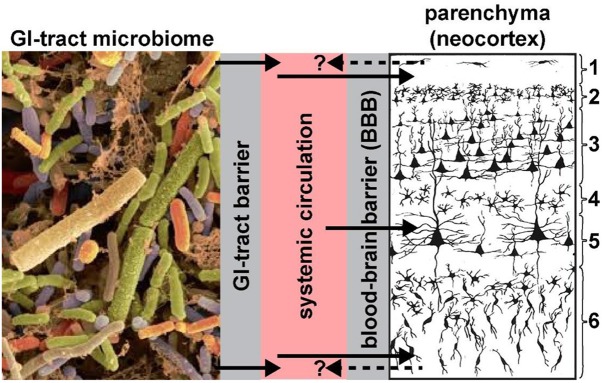
The microbiome of the human gastrointestinal (GI)-tract is a rich and dynamic source of microorganisms that together possess a staggering complexity and diversity. Collectively these microbes are capable of secreting what are amongst the most neurotoxic and pro-inflammatory biopolymers known. These include lipopolysaccharide (LPS), enterotoxins, microbial-derived amyloids and small non-coding RNA (sncRNA). One of the major microbial species in the human GI-tract microbiome, about ~100-fold more abundant than , is , an anaerobic, rod-shaped Gram-negative bacterium that secretes: (i) a particularly potent, pro-inflammatory LPS glycolipid subtype (BF-LPS); and (ii) a hydrolytic, extracellular zinc metalloproteinase known as toxin (BFT) or . Ongoing studies support multiple observations that BF-LPS and BFT ( disrupt paracellular barriers by cleavage of intercellular proteins, such as E-cadherin, between epithelial cells, resulting in '' barriers. These defective barriers, which also become more penetrable with age, in turn permit entry of microbiome-derived neurotoxic biopolymers into the systemic circulation from which they can next transit the blood-brain barrier (BBB) and gain access into the brain. This short communication will highlight some recent advances in this extraordinary research area that links the pro-inflammatory exudates of the GI-tract microbiome with innate-immune disturbances and inflammatory signaling within the human central nervous system (CNS) with reference to Alzheimer's disease (AD) wherever possible.
人类胃肠道(GI)微生物组是微生物的丰富而动态的来源,这些微生物共同拥有惊人的复杂性和多样性。这些微生物能够分泌出已知的最具神经毒性和促炎的生物聚合物。其中包括脂多糖(LPS)、肠毒素、微生物衍生的淀粉样蛋白和小非编码 RNA(sncRNA)。在人类 GI 微生物组中,一种主要的微生物物种是,它比丰度高约 100 倍,是一种厌氧的、杆状革兰氏阴性细菌,它分泌:(i)一种特别有效、促炎的 LPS 糖脂亚型(BF-LPS);和(ii)一种水解的、细胞外锌金属蛋白酶,称为 毒素(BFT)或 。正在进行的研究支持了多个观察结果,即 BF-LPS 和 BFT(通过切割上皮细胞之间的细胞间蛋白,如上皮钙黏蛋白,破坏细胞旁屏障,导致“渗漏性肠道”。这些有缺陷的屏障随着年龄的增长而变得更加通透,反过来又允许微生物组衍生的神经毒性生物聚合物进入全身循环,从中它们可以穿过血脑屏障(BBB)并进入大脑。本简讯将重点介绍该非凡研究领域的一些最新进展,该领域将 GI 微生物组的促炎渗出物与人类中枢神经系统(CNS)中的固有免疫紊乱和炎症信号联系起来,并尽可能地参考阿尔茨海默病(AD)。